
ISO 27001 vs NIST CSF: Which Framework to Implement?
Picture this. A CISO walks into a board meeting in 2025 armed with news of a $4.44 million average data breach cost and no certified security framework to show for it. The board does not ask “Are we secure?” They ask, “Can you prove it?” That one question is exactly what separates these two frameworks.
ISO 27001 is an internationally certified information security standard. NIST CSF is a flexible cybersecurity risk management guideline. Both protect your data, but they serve different masters.
Here is the surprising truth: most organizations do not need to choose between them. But picking the wrong one to start with can cost you months of rework, failed audits, and expensive consultant fees. This guide cuts through the noise.
The Core Difference Most Comparison Guides Get Wrong
Every article out there tells you NIST CSF is flexible and ISO 27001 is structured. That is true, but it barely scratches the surface.
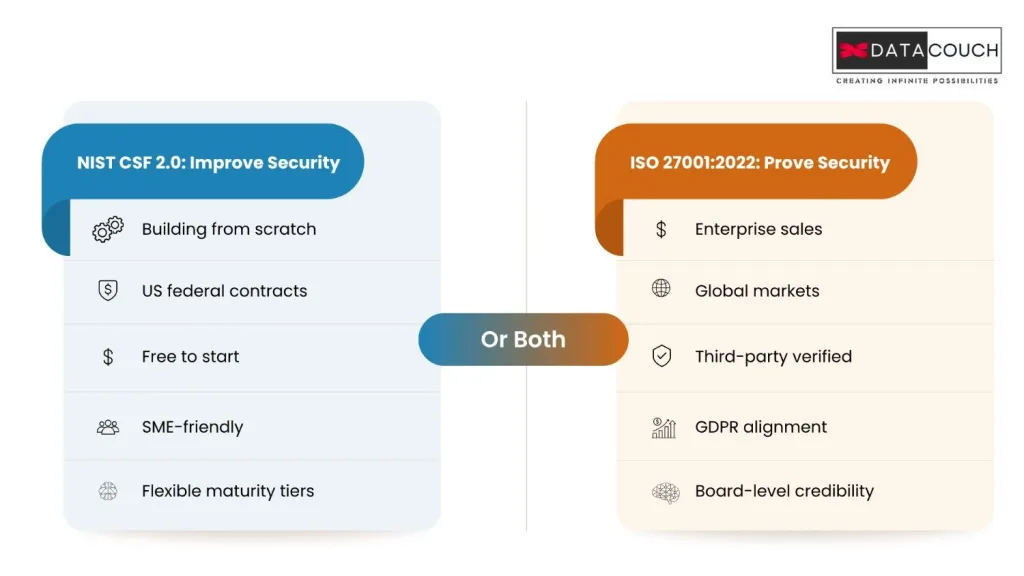
The real distinction is this: NIST CSF helps you improve security. ISO 27001 helps you prove security. If your goal is internal maturity, NIST CSF gives you a roadmap. If your goal is external credibility with clients, regulators, or investors, ISO 27001 gives you a verifiable certificate.
What most people do not realize is that this is not a technical decision. It is a business strategy decision. Where are your clients? What do your contracts require? Are you expanding into international markets? The answer to those questions should drive your framework choice, not just what your security team prefers.
Quick Overview: What Each Framework Actually Is
NIST CSF 2.0: Updated February 2024
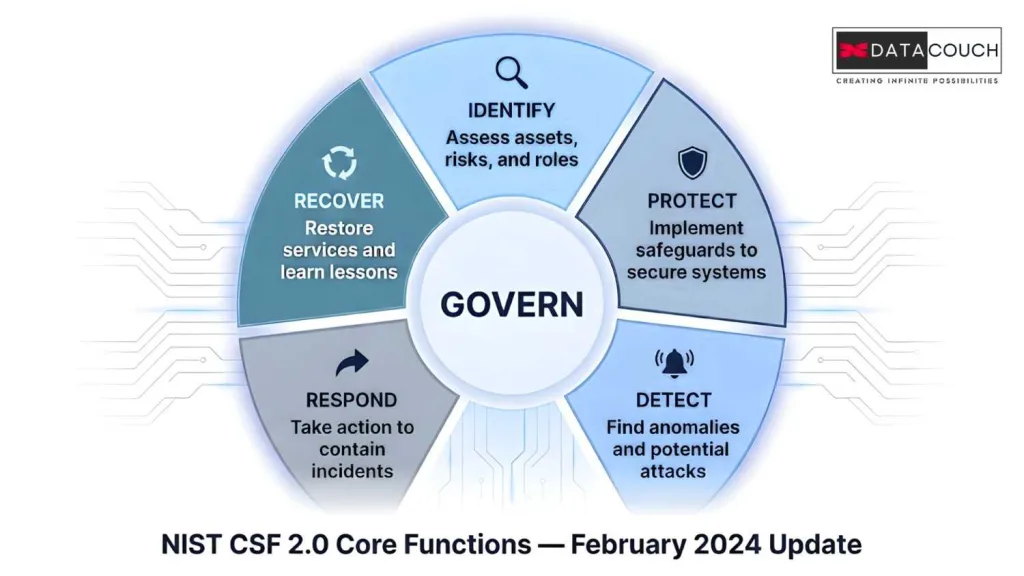
The NIST Cybersecurity Framework was built by the US National Institute of Standards and Technology, originally for critical infrastructure. Today it applies to every organization, from a three-person startup to a Fortune 500 enterprise. CSF 2.0, released in February 2024, introduced a major structural change: a brand-new “Govern” function that places cybersecurity governance at the center of everything else.
The six core functions now form a wheel: Govern, Identify, Protect, Detect, Respond, and Recover. The framework uses four implementation tiers (Partial to Adaptive) to measure your maturity. It is free to download, requires no third-party audit, and lets you self-assess at your own pace.
ISO/IEC 27001:2022: The Global Certification Standard
ISO 27001 is maintained by the International Organization for Standardization. The latest version, published in 2022, updated the standard to 93 controls organized across four themes (down from 114 controls in 14 domains in the 2013 version). Organizations that achieve certification pass a two-stage external audit conducted by an accredited body. The certificate is valid for three years, with annual surveillance audits in between.
ISO 27001 builds what is called an Information Security Management System (ISMS). That means it covers not just your technology but also your people, physical access, processes, and documented policies. It is a full organizational commitment, not just a technical checklist.
ISO 27001 vs NIST CSF 2.0: Side-by-Side Comparison
| Criterion | NIST CSF 2.0 | ISO/IEC 27001:2022 |
|---|---|---|
| Type | Voluntary guideline | Certifiable international standard |
| Certification | None (self-attestation) | Third-party auditor required |
| Cost | Free to download | $6,000 to $40,000+ in direct costs |
| Geographic Focus | US-centric, global adoption growing | Globally recognized standard |
| Best For | Building and improving security maturity | Proving security to clients and regulators |
| AI Governance | Cyber AI Profile (2025 draft overlay) | Extendable via ISO 42001 |
| Supply Chain | GV.SC function in CSF 2.0 | Annex A: Supplier Relationship Controls |
| Update Cycle | CSF 2.0 released February 2024 | ISO 27001:2022 (latest revision) |
| Audit Requirement | Optional third-party assessment | Mandatory Stage 1 and Stage 2 audit |
| Maturity Tiers | 4 tiers (Partial to Adaptive) | No formal tiers |
Here Is What Most Websites Do Not Talk About
AI Governance Is Now a Framework-Level Problem
Most comparison articles were written before 2024. They do not address the AI security crisis. In 2025, 97% of organizations that reported an AI-related security incident lacked proper AI access controls. That is not a minor oversight. That is a systemic failure.
NIST responded by releasing a draft Cyber AI Profile in late 2025, which extends CSF 2.0 specifically to cover AI risks such as model manipulation, data poisoning, and shadow AI deployments. If your organization works with machine learning pipelines, language models, or enterprise AI tools, you need to account for this overlay. ISO 42001 is the corresponding AI management system standard that pairs with ISO 27001 to close this gap.
Supply Chain Breaches Are the Fastest-Growing Threat Vector
The Verizon 2025 Data Breach Investigations Report found a 100% year-over-year increase in third-party-linked breaches. Separately, SecurityScorecard’s 2025 data shows that over 35% of all breaches now originate from third-party intrusions. NIST CSF 2.0 directly addresses this through its expanded GV.SC (Supply Chain Risk Management) function. ISO 27001 covers it through Annex A supplier relationship controls. Most articles compare these frameworks on governance and cost. Almost none tell you that your biggest breach risk in 2025 is sitting inside your vendor ecosystem.
Your Framework Choice Now Shows Up in ESG Reports
Here is an angle that virtually no comparison article covers. Publicly listed companies and large enterprises are increasingly required to disclose cybersecurity governance practices in their ESG (Environmental, Social, and Governance) reports. ISO 27001 certification signals to investors and board members that information security has been independently verified. NIST CSF alignment signals that a structured risk management program is in place. Both signals matter at the board level, which means your framework decision is no longer just a security team conversation.
Small Business Adoption Is Rising Faster Than Anyone Expected
In 2023, only 29% of small businesses used NIST-aligned models. By 2025, that number climbed to 42%, driven by cyber insurance requirements, managed service provider templates, and easier tooling. This matters because the old assumption that NIST CSF is “just for enterprises” is no longer accurate. If you are a growing company or a mid-market firm, you likely already need to align with at least one of these frameworks to satisfy a key customer or insurer.
Building a cybersecurity program from scratch?
Get structured, instructor-led training on NIST CSF and ISO 27001 fundamentals.
Explore DataCouch's Cybersecurity Training Programs and build a team that can own your framework implementation end to end.
Which Framework Is Right for Your Organization?
Choose NIST CSF 2.0 If You...
- Are building your cybersecurity program from the ground up (Tiers 1 or 2)
- Work with US federal agencies, DoD suppliers, or critical infrastructure sectors
- Need a flexible, cost-free starting point with no audit pressure
- Want to improve your internal security maturity before pursuing formal certification
- Are a small or mid-size business just starting to address cyber risk systematically
Choose ISO/IEC 27001:2022 If You...
- Sell to enterprise clients who require certified vendors (common in B2B SaaS and cloud)
- Operate across international markets, especially in the EU, UK, or Asia-Pacific
- Need to demonstrate GDPR, HIPAA, or PCI DSS alignment to regulators
- Are competing for government or financial services contracts where certification is a prerequisite
- Have reached operational maturity and are ready to formalize your ISMS for external verification
What Most Growing Organizations Actually Do
Start with NIST CSF to map your current security posture, identify gaps, and build foundational controls. Then use that work as the foundation for ISO 27001 certification. NIST has officially published a mapping document between CSF 2.0 and ISO 27001:2022, which means the controls you implement for one directly satisfy requirements in the other. You reduce duplication, accelerate certification timelines, and avoid starting from scratch.
Think of it this way: NIST CSF gives you the “what and why.” ISO 27001 gives you the “how and prove it.”
Industry-by-Industry Framework Guidance
| Industry / Sector | Recommended Framework Path |
|---|---|
| Healthcare | NIST CSF (HIPAA crosswalk exists) + ISO 27001 for global contracts |
| Finance / Fintech | ISO 27001 (GDPR and PCI DSS alignment) supported by NIST CSF |
| Manufacturing / Defense | NIST CSF (CMMC pathway for DoD) with ISO 27001 as next step |
| SaaS / Cloud Providers | ISO 27001 (enterprise sales prerequisite) with NIST CSF internalized |
| Startups and SMEs | NIST CSF first to build maturity, then pursue ISO 27001 at scale |
| AI and Data Companies | Both frameworks plus NIST Cyber AI Profile and ISO 42001 overlay |
The Real Cost of Getting This Decision Wrong
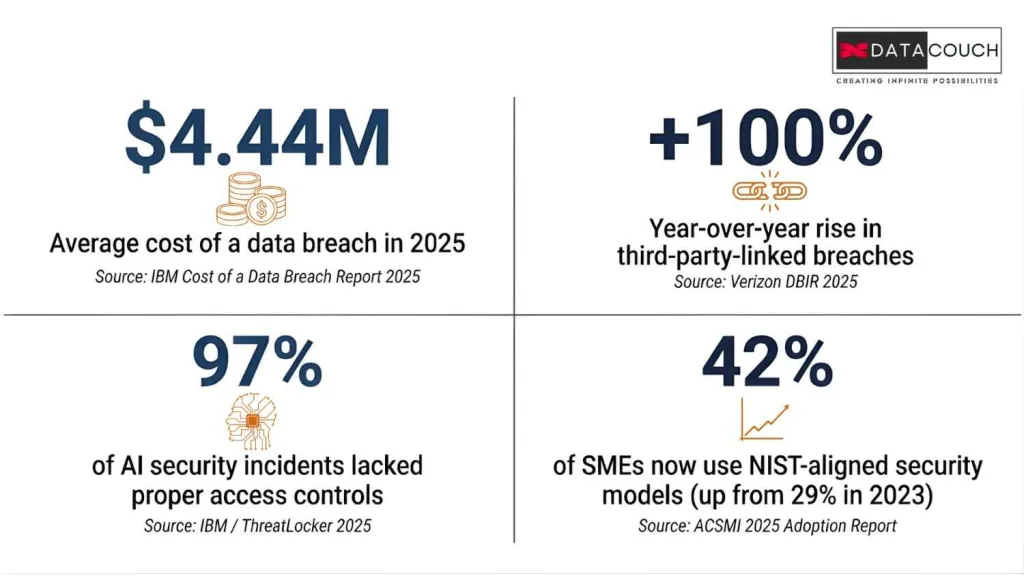
The average cost of a data breach in 2025 reached $4.44 million according to the IBM Cost of a Data Breach Report. For organizations with no formal cybersecurity framework, that number climbs significantly higher. But the financial cost is only part of the picture.
Organizations that pursue ISO 27001 without first mapping their baseline through NIST CSF often discover mid-audit that entire control areas are undocumented. That leads to delayed certification, expensive remediation work, and in some cases, failed Stage 1 audits. Conversely, organizations that rely solely on NIST CSF self-attestation often find that enterprise clients start requiring a formal certificate during contract negotiations, and suddenly, a three-to-twelve-month certification process stands between them and a signed deal.
The most costly mistake is treating either framework as a one-time project. Both NIST CSF and ISO 27001 are continuous programs. CSF 2.0 has four implementation tiers precisely because security maturity is a journey. ISO 27001 requires annual surveillance audits and recertification every three years. If your team lacks the internal knowledge to sustain these programs, external consultants will fill that gap at a steep ongoing cost.
Want your team ready before the auditors arrive?
DataCouch's hands-on cybersecurity consulting and training builds the internal expertise to implement, sustain, and scale your chosen framework.
5 Common Implementation Mistakes to Avoid
1. Using NIST CSF as a One-Time Checklist
CSF 2.0 is designed as a continuous program, not a one-and-done assessment. Organizations that treat it as a static checklist miss the entire purpose of the Govern function, which requires ongoing risk ownership at the leadership level.
2. Underestimating the Scope of ISO 27001
ISO 27001 covers people, processes, and physical security, not just technology. A company that only addresses its IT systems during certification will fail audit sections covering HR policies, physical access controls, and supplier agreements.
3. Ignoring Third-Party and Supply Chain Risk
With a 100% year-over-year increase in third-party-linked breaches per the Verizon 2025 DBIR, vendor risk management is no longer optional. Both frameworks address it, but most implementation teams focus on internal controls and underinvest in supply chain oversight.
4. Skipping the NIST CSF Baseline Before Pursuing ISO 27001
Jumping straight to ISO 27001 without a baseline gap analysis often leads to expensive surprises during the Stage 1 audit. Using NIST CSF to assess your current maturity first gives you a clear remediation roadmap before external auditors arrive.
5. Building No Internal Expertise
Outsourcing your entire framework implementation to consultants is a short-term fix with long-term costs. Frameworks only work when they are embedded in daily operations. That requires trained internal champions who understand both the governance requirements and the technical controls involved.
Key Takeaways
- NIST CSF 2.0 is a free, flexible framework for building and measuring cybersecurity maturity, with no certification required.
- ISO 27001:2022 is an internationally recognized certifiable standard that proves security governance to clients, regulators, and investors.
- The average data breach cost in 2025 is $4.44 million. A formal framework significantly reduces your risk exposure.
- NIST CSF 2.0 introduced a new “Govern” function and a draft Cyber AI Profile in 2025, directly addressing AI governance gaps.
- Third-party breaches rose 100% year-over-year per the Verizon 2025 DBIR. Both frameworks address supply chain risk, but it is the most commonly underimplemented area.
- Most growing organizations benefit from using NIST CSF first and then building toward ISO 27001 certification using NIST’s official CSF-to-ISO 27001 mapping.
- Your framework decision now affects ESG disclosures, cyber insurance premiums, and enterprise contract eligibility, not just your security posture.
Conclusion
The question is not really “ISO 27001 or NIST CSF?” For most organizations in 2025, the smarter question is “When do we need each one, and are we building toward both?” NIST CSF gives you a common language for managing risk internally. ISO 27001 gives you external proof that the language is backed by action.
Whether you are a student exploring cybersecurity as a career, a working professional tasked with building your organization’s security program, or a CTO deciding which framework best supports your growth plans, the path forward is the same: start with a clear baseline, build systematically, and invest in the internal knowledge that makes frameworks stick.
What is the one thing holding your organization back from committing to a formal cybersecurity framework today? Share your thoughts or reach out to explore where you stand.
Ready to get certified, get compliant, or simply get started?
Explore DataCouch's Cybersecurity and Compliance Training and find the program that fits your organization's maturity level and certification goals.