
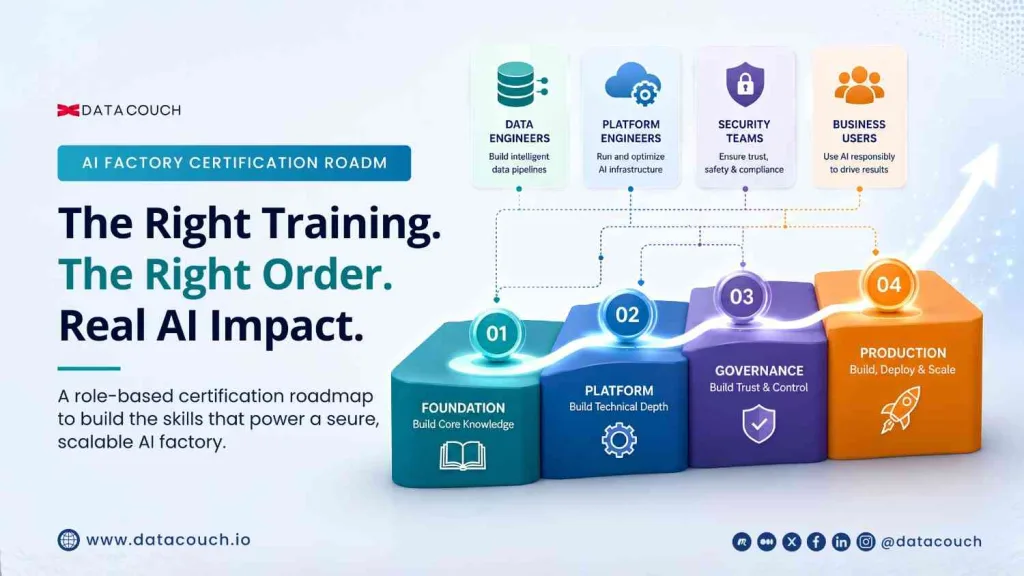
AI Factory Certification Roadmap: Which Courses Should Your Team Complete First?
The missed investment in every AI factory project: Organizations spend months and millions on AI hardware. They spend weeks on software. They spend days on training. Then they spend years wondering why the hardware is underperforming and the AI initiatives are stalling.
Building an AI factory is a capital investment. Building the team to run it is an operational investment. Organisations consistently prioritise the first and underfund the second. The predictable result is expensive infrastructure running at a fraction of its capability because the people responsible for operating it do not have the specific skills that AI factory operations require.
The World Economic Forum’s Future of Jobs Report 2025 found that 94% of business leaders report AI-critical skill shortages, with one-third reporting skill gaps of 40 to 60% in AI-critical roles. Employers expect 39% of workers’ core skills to change by 2030, and 85% of organisations plan to offer upskilling programs. The challenge is knowing which programs to prioritise for which roles.
This guide provides a structured certification roadmap for the five roles that make an AI factory work: data engineers who build the pipelines, platform engineers who operate the compute, AI developers who build and deploy models, security and governance professionals who keep the system trustworthy, and business users who work alongside the AI to produce results. For each role, we identify the specific certifications and training programs that provide the skills most directly relevant to AI factory operations.
Why AI Factory Operations Require Specific Training
The most common mistake in AI factory workforce planning is assuming that existing skills transfer directly. A data engineer who excels at traditional ETL pipelines needs additional training to design AI-ready data pipelines with vector embeddings, streaming architecture, and ML feature stores. A platform engineer who manages traditional server infrastructure needs specific training to schedule GPU workloads, configure MLOps platforms, and monitor model behavioural drift. These are not advanced versions of existing skills. They are adjacent skills with different toolsets, different failure modes, and different governance requirements.
OECD’s 2025 AI Skills Gap analysis found that the current global supply of AI training programs is structurally insufficient to meet demand, particularly for AI literacy at the general workforce level. Most workers need general AI literacy rather than specialist skills, but organisations typically invest only in specialist training.
The AI Factory Certification Roadmap by Role
The roadmap below organises training priorities by role and by urgency. Each tier indicates whether the certification should be completed before the AI factory goes into production (Foundation), in parallel with early production operations (Platform), or as a second-phase capability-building program (Advanced).
Role 1: Data Engineers
Data engineers build and maintain the Layer 4 data pipelines that feed the AI factory. Their training priorities centre on real-time data architecture, AI-specific data governance, and the specific platforms used in the organisation’s data stack.
Foundation Tier: Real-Time Data and Streaming Architecture
Courses: Confluent Certified Developer for Apache Kafka; Confluent Certified Operator for Apache Kafka; Starburst Galaxy Developer certification
Outcome: Design and operate real-time data pipelines that feed AI models with governed, low-latency data. Confluent certification is mandatory for organisations using Kafka-based streaming.
Platform Tier: Data Platform and Feature Engineering
Courses: Databricks Data Engineer Associate and Professional; Snowflake SnowPro Core certification; dbt Fundamentals and Advanced certification
Outcome: Build ML feature stores, orchestrate data transformation pipelines at scale, and maintain the governed data layer that AI models depend on for reliable training and inference.
Advanced Tier: AI-Specific Data Architecture
Courses: Neo4j Certified Professional; vector database implementation training; AI data governance frameworks
Outcome: Design knowledge graphs for GraphRAG systems, implement vector retrieval architectures, and build the data governance controls that satisfy EU AI Act Article 10 data quality requirements.
Role 2: Platform and Infrastructure Engineers
Platform engineers operate the Layer 2 and Layer 3 compute and orchestration layers. Their training priorities focus on GPU workload management, MLOps platform operation, and AI security.
Foundation Tier: GPU Infrastructure and Orchestration
Courses: NVIDIA DLI GPU Operations and Optimisation; Kubernetes Administrator (CKA); HashiCorp Terraform Associate
Outcome: Configure, schedule, and govern GPU workloads at enterprise scale. Understanding NVIDIA’s scheduling and networking architecture is essential for utilisation optimisation.
Platform Tier: MLOps and AI Platform Operations
Courses: Databricks Machine Learning Professional; AWS Machine Learning Speciality or Google Cloud Professional ML Engineer; MLflow and Kubeflow operations training
Outcome: Deploy, monitor, and maintain production ML models. Design CI/CD pipelines for AI systems. Manage model versioning, rollback, and behavioural monitoring in production.
Advanced Tier: AI Security and Governance Operations
Courses: NIST AI RMF implementation training; AI red teaming methodology; ISO 42001 auditor preparation
Outcome: Implement access controls, behavioural monitoring, and adversarial testing requirements at the infrastructure layer. Build the governance controls that the EU AI Act Article 17 quality management system requirements demand.
Role 3: AI Developers and Data Scientists
AI developers build and deploy the models that the AI factory processes. Their training priorities centre on responsible model development, production deployment, and the specific AI platforms used in the organisation.
Foundation Tier: Foundation Model Development and Fine-Tuning
Courses: Databricks Machine Learning Associate; AWS Certified AI Practitioner; Anthropic Claude API and prompt engineering fundamentals
Outcome: Design and implement AI applications using foundation models. Understand fine-tuning requirements, prompt engineering for enterprise use cases, and the responsible AI considerations that apply at the model layer.
Platform Tier: Production AI Development and Evaluation
Courses: Databricks Machine Learning Professional; LLM evaluation and red teaming methodology aligned to OWASP LLM Top 10; RAG architecture and GraphRAG implementation
Outcome: Build production-grade AI applications with appropriate evaluation frameworks, adversarial testing, and the retrieval architectures that make AI outputs reliable on enterprise knowledge.
Advanced Tier: Agentic AI Architecture and Governance
Courses: Anthropic Claude advanced tool use and MCP integration; agentic workflow design and governance; AI agent red teaming aligned to MITRE ATLAS
Outcome: Design and deploy agentic AI systems with appropriate scope definition, human-in-the-loop requirements, audit logging, and adversarial testing before production deployment.
Role 4: Security and Governance Professionals
Security and governance professionals ensure that the AI factory operates within defined risk boundaries, satisfies regulatory requirements, and maintains the trust that makes AI outputs usable in production contexts.
Foundation Tier: AI Governance Fundamentals
Courses: NIST AI RMF practitioner training; EU AI Act compliance fundamentals; AI governance policy design
Outcome: Implement the governance framework that satisfies the Govern function of NIST AI RMF. Design AI policies that address shadow AI, access controls, incident response, and the EU AI Act requirements that take effect in August 2026.
Platform Tier: AI Security and Adversarial Testing
Courses: AI red teaming methodology aligned to OWASP LLM Top 10 and MITRE ATLAS; prompt injection testing; behavioural drift detection
Outcome: Build and run structured adversarial testing programs for AI systems before production deployment. Implement monitoring that detects behavioural anomalies in production.
Advanced Tier: AI Compliance and Audit
Courses: ISO 42001 Auditor certification; EU AI Act conformity assessment preparation; AI incident response leadership
Outcome: Lead EU AI Act conformity assessments for high-risk AI systems. Design audit-ready documentation systems. Lead AI security incident response.
Role 5: Business Users and Operational Teams
Business users interact with AI factory outputs daily. Their training is the mechanism that translates AI capability into business value. Without it, even the most sophisticated AI factory produces outputs that teams do not trust, do not use, or misuse in ways that create governance risk.
Foundation Tier: AI Literacy for Business Users
Courses: AI fundamentals for non-technical teams; prompt engineering for knowledge workers; AI output evaluation and critical review
Outcome: Understand what AI can and cannot do reliably, how to evaluate outputs before using them in business decisions, and what to do when an AI system produces something unexpected or concerning.
Platform Tier: AI Governance for Business Teams
Courses: Shadow AI awareness and policy training; AI governance responsibilities for line managers; data classification and AI data handling
Outcome: Understand organisational AI policies, how to identify and report shadow AI usage, what data can and cannot be shared with AI systems, and what the escalation path is when governance issues arise.
DataCouch delivers certified training across every role in the AI factory stack, from Confluent and Databricks to NIST AI RMF and EU AI Act governance.
The Sequencing Question: What to Train First
The sequencing of AI factory training follows the same logic as the sequencing of AI factory infrastructure. You cannot govern what you cannot see, and you cannot operate what you have not been trained on. The training sequence that produces the fastest return on infrastructure investment is:
| Sequence | Training Priority | Why This Order |
|---|---|---|
| First | Platform engineers: GPU scheduling, orchestration, monitoring | Directly unlocks GPU utilisation. The highest-leverage first training investment for organisations with existing hardware. |
| Second | Data engineers: streaming architecture, data governance | Ensures the data feeding the AI factory is governed, current, and AI-ready. Cannot be deferred past the first production model deployment. |
| Third | Security and governance: NIST AI RMF, EU AI Act, adversarial testing | Must be in place before any high-risk AI system goes into production. Deferring this creates regulatory exposure and incident risk. |
| Concurrent | AI developers: model development, fine-tuning, production deployment | Runs in parallel with infrastructure and governance training. AI developers cannot wait for infrastructure to be complete before building skills. |
| Ongoing | Business users: AI literacy, output evaluation, governance awareness | Must begin before AI outputs reach business users and must be refreshed as AI capabilities and policies evolve. This is never complete. |
Key Takeaways
- AI factory training is not the last investment. It is a parallel investment that must begin when infrastructure planning begins and continue throughout the operational life of the factory.
- 94% of business leaders report AI-critical skill shortages per WEF 2025. The training gap is the constraint that limits AI factory output more consistently than any hardware limitation.
- Each role in the AI factory requires specific training that is adjacent to, not the same as, their existing skills: data engineers need streaming and AI governance training, platform engineers need GPU scheduling and MLOps training, and security teams need adversarial AI testing training.
- The highest-leverage first training investment for organisations with existing GPU hardware is platform engineer training on workload scheduling and orchestration. This directly and immediately improves utilisation.
- EU AI Act Article 17 quality management requirements mean that governance and compliance training are not optional for organisations with high-risk AI systems, effective August 2026. It is a documented regulatory requirement.
- DataCouch’s certification programs cover the full AI factory training stack: Confluent and Starburst for data engineers, NVIDIA and Databricks for platform engineers, NIST AI RMF and EU AI Act for governance teams, and custom AI literacy programs for business users.
Here is the question to ask before your AI factory goes live: for each role that will operate, govern, or work alongside this system, can you name the specific training they have completed and the certification that validates it?
If the answer is unclear, that is where the next investment goes, before the infrastructure investment, not after it.