
The GCC Wave In India: Building The Future Of Global Talent
Global Capability Centers (GCCs) are dedicated business operations that multinational companies establish in India to manage specific functions. From software engineering to data analytics to customer support, they’ve evolved from simple cost-saving back offices into strategic innovation hubs that drive business transformation across industries.
India’s Global Capability Centers landscape is experiencing a transformation that goes beyond the traditional outsourcing story. Over 1,800 GCCs now operate across India, employing 1.9 million professionals and generating $64.6 billion in export revenue. But here’s what most people get wrong: this wave isn’t about saving money on labor costs anymore.
The real story is simpler. India’s GCCs have shifted from handling back-office work to driving innovation for some of the world’s largest companies. Tech giants like Google, IBM, and UBS operate major research centers here. This change matters because it signals where global business is heading and what your organization needs to understand about building competitive advantage in 2026.
Let’s walk through what’s actually happening, why it matters, and what comes next.
From Cost Centers To Innovation Hubs
To understand where India’s GCCs are heading, you need to see where they’ve been.
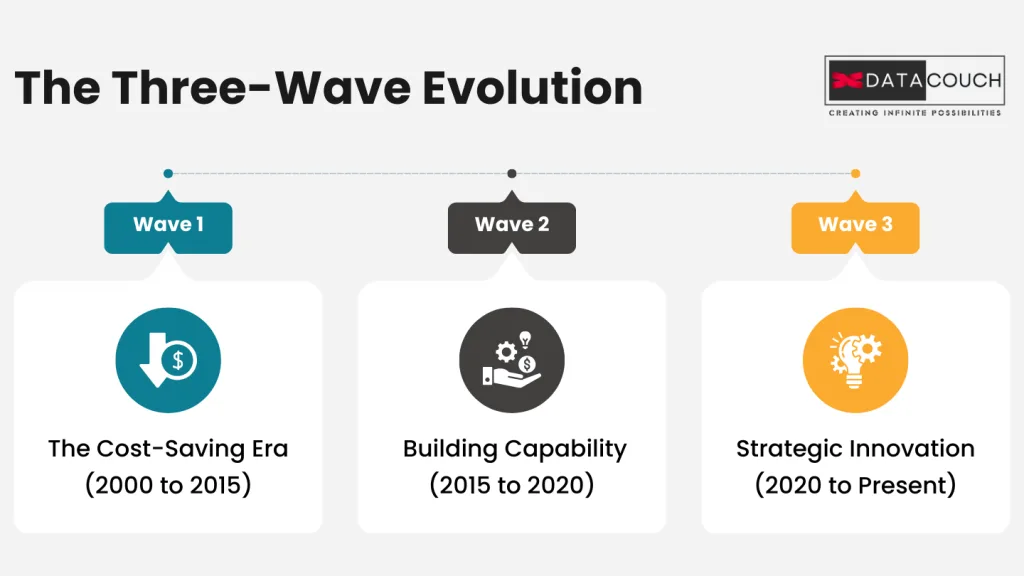
Wave 1: The Cost-Saving Era (2000 to 2015)
Companies first came to India because labor costs were low. A software developer in Bangalore costs a fraction of what you’d pay in Silicon Valley. So multinational corporations set up back-office operations here. Customer service teams, basic IT support, and routine data entry. The math was simple: cut expenses, boost profit margins.
This worked. Companies saved between 40 to 60 percent on operational costs. GCCs became financial centers, not innovation centers.
Wave 2: Building Capability (2015 to 2020)
Something shifted around 2015. Companies realized they could do more than just save money in India. They had access to talented engineers, mathematicians, and data scientists. Infrastructure improved. Tech talent pipelines grew deeper.
GCCs started taking on more complex work. Delivery excellence became the focus. Companies built dedicated teams for specific functions. Software development, data analytics, quality assurance. The best talent stayed longer. Better work happened. These weren’t cost centers anymore. They were capability centers.
But they still reported to headquarters. They still followed orders from global command centers in New York or Frankfurt. Strategic decisions still happened elsewhere.
Wave 3: Strategic Innovation (2020 to Present)
Then came the inflection point.
By 2020, India’s GCCs had built something unexpected: deep expertise, proven execution, and access to emerging talent in artificial intelligence and machine learning. Companies realized they could ask harder questions. Why not build products here? Why not make strategic decisions here? Why not treat this center as a command hub, not a support office?
This is where we are now.
Nearly 50 percent of India’s GCCs now own end-to-end product delivery. About 30 percent function as global AI and analytics hubs. Some make billion-dollar business decisions from Bangalore or Hyderabad. They’re not following the playbook anymore. They’re writing it.
The numbers tell this story clearly. In FY2025, India’s GCCs contributed approximately 1.6 percent to the national GDP. By 2030, that number will hit 2 percent. The revenue projection jumps from $64.6 billion today to $99 to 121 billion within five years. That’s not growth in a cost-saving business. That’s growth in a strategic value creation business.
Why India's GCC Opportunity Matters Now
The timing of this wave is crucial.
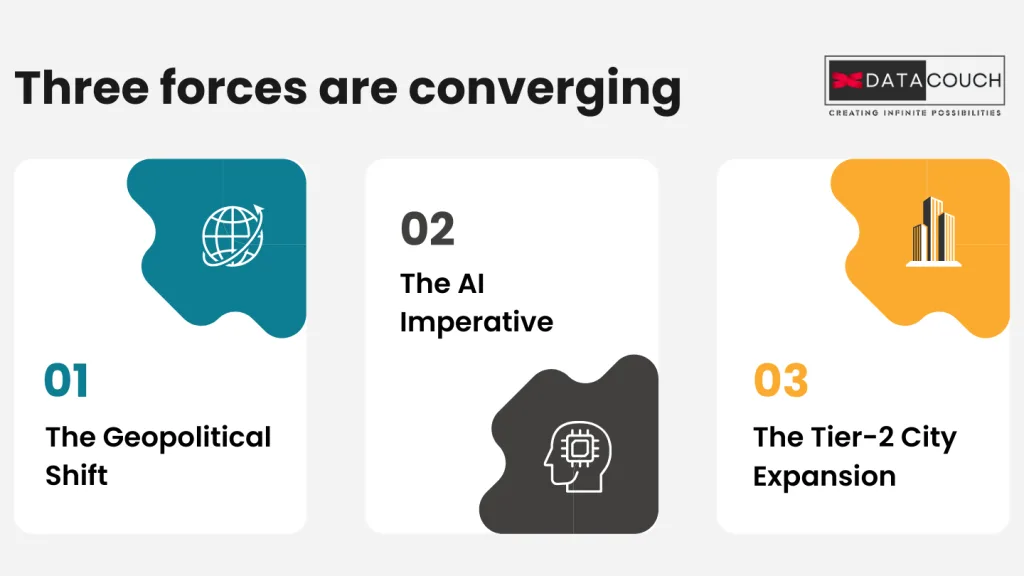
The Geopolitical Shift
Companies are diversifying where they operate. Eastern Europe was popular for a decade. Now rising political risk and talent costs have companies looking elsewhere. India offers stability, scale, and proven execution. It’s becoming the default choice for companies building global operations.
The AI Imperative
Artificial intelligence isn’t coming to business. It’s here. Companies need AI engineers, data scientists, and machine learning specialists today, not tomorrow. India has 120,000 plus AI professionals already working in GCCs. Another 78 percent of GCC companies are investing in AI upskilling right now. The talent pipeline is real.
The Tier-2 City Expansion
This is the angle most people miss. For years, GCCs clustered in Bangalore, Hyderabad, and Pune. That model is reaching limits. Real estate costs are climbing. Competition for talent is fierce. Attrition rates are high.
But something interesting is happening in Tier-2 cities. Coimbatore, Kochi, Ahmedabad, and Indore are emerging as GCC hubs. Why? Operational costs drop 40 to 60 percent. Talent retention improves by 20 percent. Local infrastructure is getting better. The job opportunities are transforming local economies.
By 2030, around 350,000 new GCC jobs are expected in non-metro areas. That’s not a side story. That’s a major shift in how India’s economy works.
The Talent Revolution: What Global Capability Centers Really Need
Numbers tell one story. People tell others.
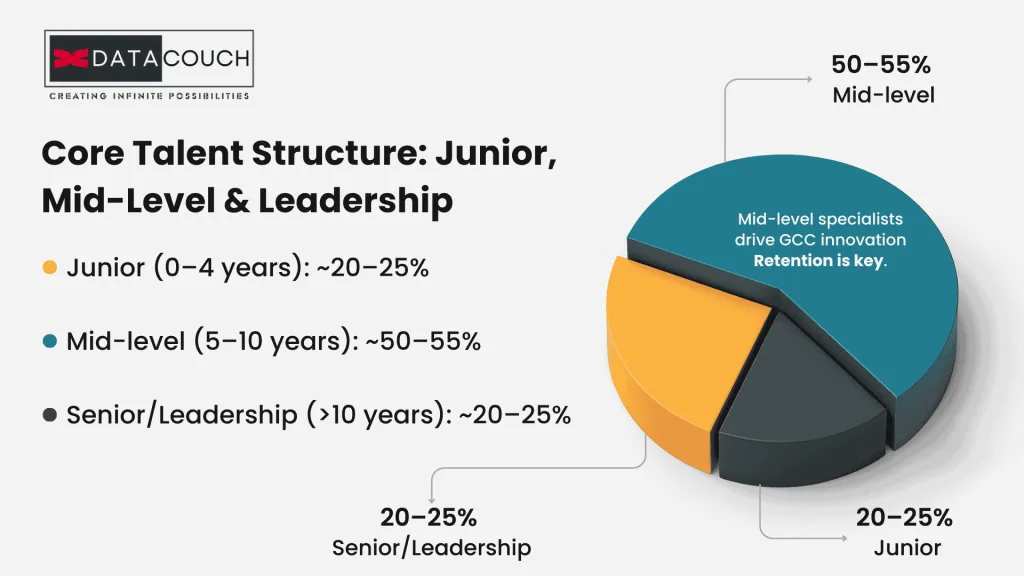
India’s GCC workforce looks different than it did five years ago. Your average GCC employee in 2025 isn’t a customer service representative. They’re likely a mid-level specialist with five to ten years of experience. They probably write code, manage data, or design systems. About 40 percent are women, and that number is rising.
But here’s the challenge: 51 percent of GCC companies cite talent retention as their top concern. More than half their workforce is actively looking for new jobs. Why? Because the old playbook doesn’t work anymore.
What Changed About Talent in GCCs?
When GCCs were about cost savings, companies managed them like factories. High turnover was acceptable. You hired dozens of junior people, kept the best, and let the rest move on. The model worked because the work was fungible. Anyone could do it with basic training.
Now, when your GCC is driving product innovation or managing AI research, you can’t afford that turnover. You need continuity. You need people who understand your business, your customers, your strategy. You need builders, not operators.
This requires a different approach. Career progression matters now. Compensation matters. Salaries in GCCs run 25 to 30 percent higher than the national average. But something deeper matters more: belonging and purpose.
The companies winning at this game treat their India GCCs like genuine headquarters offices, not satellite operations. People get access to global teams. They participate in strategic decisions. They see how their work connects to the company’s mission. Attrition drops. Performance improves.
The AI Skills Gap
Here’s a specific need: AI expertise. Every GCC company wants it. Most don’t have enough of it. About 70 percent of GCCs are implementing AI use cases right now, but 78 percent say they need more upskilling. The demand outpaces supply.
This creates opportunity. Companies that build AI capability in their GCCs will outcompete companies that don’t. The infrastructure exists. The talent pool exists. Execution determines the winner.
Geographic Expansion: Why Tier-2 And Tier-3 Cities Are Reshaping India's GCC Map
The conventional wisdom about GCCs says: Bangalore, Hyderabad, or nowhere. That thinking is becoming outdated.
The Tier-1 Problem
India’s biggest cities are reaching saturation. Consider the practical challenges.
Infrastructure limits real estate expansion. Building new offices takes years. Existing space gets expensive. A square foot of office space in Bangalore costs significantly more than it did five years ago.
Talent competition creates wage pressure. When everyone in the city is hiring, salaries rise. The cost advantage that made India attractive starts shrinking.
Attrition rates climb. Tier-1 cities offer workers lots of choices. Someone unhappy at their current GCC can find three new jobs by Monday. Retention requires constant effort and premium compensation.
Migration becomes a problem. Young people from smaller cities move to Bangalore looking for opportunities. Local unemployment rises in Tier-2 cities. This creates political and social pressure. Governments want GCC expansion outside the metros.
The Tier-2 Opportunity
Now look at what Tier-2 and Tier-3 cities offer.
Expenditure savings of 40 to 60 percent compared to Bangalore. That’s substantial. A team of 100 engineers costs significantly less to operate, and the quality of work doesn’t decline.
Better retention. In Coimbatore or Kochi, a good job at a GCC is a premium opportunity. People stay longer. Turnover drops 20 percent compared to Tier-1 cities.
Quality of life benefits. Shorter commutes, lower housing costs, less congestion. This matters to workers more than most executives realize.
Growing infrastructure. Tier-2 cities are investing in tech parks, fiber connectivity, and quality office spaces. Coimbatore, for example, is emerging as a genuine AI and technology hub.
The Hub-and-Spoke Model
Smart GCC operators are adopting a Hub-and-Spoke approach.
The Tier-1 hub handles strategic planning, innovation, and leadership. This is where executives sit. Where big decisions happen. Where the culture gets set.
The Tier-2 and Tier-3 spokes handle operations, customer service, analytics, and routine delivery. This is where you place proven processes and high-volume work.
This model reduces risk. If something disrupts Bangalore, your operations keep running from Kochi. It optimizes costs. And it distributes opportunity across India.
By 2030, expect to see roughly equal investment between Tier-1 and Tier-2 GCC locations. The geographic wave is real.
The Innovation Transformation: Real Examples Of What GCCs Build Today
Talk about “innovation hubs” sounds abstract. Real examples ground it.
Banking: Fraud Detection at Scale
A major bank’s GCC in Hyderabad built an AI-powered fraud detection system. The system catches fraudulent transactions in real time. Result? A 25 percent reduction in transaction fraud. The system now protects billions of dollars in daily transactions. This wasn’t built in New York or London. It was built in India, by an Indian team.
Retail: Recommendation Engines
An e-commerce company’s GCC team in Bangalore developed a recommendation engine using machine learning. The system learns from customer behavior and suggests relevant products. Result? An 18 percent increase in average order value. The effect goes straight to the bottom line.
Healthcare: Diagnostic AI
A healthcare company’s GCC team built AI systems that read medical imaging. X-rays, CT scans, MRIs. The system achieves 90 percent plus accuracy. It helps doctors make faster, better diagnoses. This is deep technical work. It requires specialized expertise. It came from India.
These examples matter because they show the actual transformation. GCCs aren’t handling customer service calls anymore. They’re building products that millions of people use.
The Challenge That Most GCCs Get Wrong: Talent Retention And Career Growth
Here’s the friction point that nobody talks about enough.
Retention isn’t just about salary. When 51 percent of GCC companies cite retention as their top concern, salary rarely tops the list of reasons people leave. People leave because:
They don’t see a clear path forward. Five years in, they’re doing the same type of work. No promotion. No new challenge. No growth.
They feel disconnected from the mission. They ship code, but they don’t know what it does or who it helps. The work feels transactional.
They have limited influence on decisions. Their ideas get heard, but rarely implemented. Leadership happens elsewhere.
They want different problems to solve. Today’s specialists want exposure to strategy, business, customer thinking. Not just technical execution.
The companies winning at GCC talent retention solve for these needs. They create internal mobility. They run innovation labs where people solve hard problems. They bring senior leaders from headquarters to visit and explain strategy. They sponsor people to learn adjacent skills.
This isn’t expensive. It’s mostly intentional. And it works.
Why Compliance And Governance Are Competitive Advantages (Not Burdens)
Most GCC conversations overlook something important: compliance.
Running a GCC involves navigating about 500 distinct legal obligations across 27 compliance categories. Data privacy, foreign investment rules, labor laws, environmental standards, cybersecurity. The list goes on. Most companies view this as overhead. A burden. A tax on operations.
But companies that master compliance actually build competitive advantage. Why? Because compliance excellence builds trust. It reduces risk. It creates operational predictability.
Companies that struggle with compliance waste resources on fixes. They get audited. They face penalties. They spend executive time on problems that could have been prevented. The cost compounds.
The smart approach? Treat compliance as a system. Invest in technology that automates compliance tracking. Build processes around it. Make it part of your operating model, not an afterthought.
Looking Ahead: What GCCs Will Look Like By 2030
Projections for 2030 show dramatic changes.
Scale
The number of GCCs grows from 1,800 to 2,100 to 2,550. Employment grows from 1.9 million to 2.8 to 4 million people. Revenue grows from $64.6 billion to $99 to 121 billion.
Geography
Tier-2 and Tier-3 cities account for 40 to 50 percent of GCC employment. The concentration in Bangalore and Hyderabad diminishes.
Capability
Most GCCs own end-to-end product delivery. More to handle strategic decisions. Innovation isn’t centralized anymore. It’s distributed.
Talent
AI and machine learning talent becomes the baseline, not the exception. Leadership roles increase. Women representation in leadership climbs to 20 percent plus.
Value Creation
GCCs stop being measured on cost savings. They’re measured on business impact. Revenue, innovation, customer outcomes.
The Bottom Line: What This Wave Means For Your Organization
The GCC wave in India isn’t coming. It’s here.
If you lead a global company, your India GCC isn’t a cost center. It’s a strategic asset. The question isn’t whether to expand it. It’s how to unlock its full potential. This means treating it like headquarters. Giving it autonomy. Investing in capability. Measuring it on impact, not expense.
If you’re in India, the opportunity is real. Companies building GCCs create jobs. They train talent. They transform local economies. The opportunity extends beyond Bangalore. Tier-2 cities are emerging. The geographic wave is just starting.
If you’re a professional in a GCC, understand what’s happening. The old playbook. Show up, do your job, collect a paycheck. That isn’t enough anymore. The companies winning in this wave invest in their people. They create paths forward. They solve interesting problems. The talent that shows initiative, builds capability, and thinks strategically thrives.
The transformation from cost center to innovation hub requires more than hiring and infrastructure. It requires continuous investment in capabilities. It requires teams that know how to implement AI solutions. It requires professionals who can think beyond their current domain and contribute to strategic business challenges.
At DataCouch, we’ve worked with Fortune 500 companies navigating exactly this transformation. What we’ve learned: the organizations that win aren’t the ones with the biggest budgets. They’re the ones that treat capability building as a core business function. They partner with experts who understand both AI technologies and enterprise transformation. They invest in their teams through structured learning programs in generative AI, agentic systems, and modern data architectures. They measure success not just by delivery metrics, but by the depth of expertise their teams develop.
The key insight we share with every client: it’s not about outsourcing the problem. It’s about building internal competency that compounds over time. Organizations that build these capabilities internally, that foster learning cultures, that invest in their people’s growth, will lead the next wave of GCC innovation.
The wave is real. The opportunity window is open. The question now is simple: Will you be a participant or an observer?