
Adapting to the AI Era: Reskilling Developers for Success
Three years ago, Marcus managed a team of eight developers at a mid-size fintech company. They were good. Really good. His team shipped features on time. Customers loved the product. The company was growing steadily. Then came the board meeting that changed everything. The CEO announced: “We’re going all-in on AI. In six months, our entire tech stack gets reimagined around generative AI and automation.”
Marcus felt his stomach drop. He looked at his team. Sarah, his senior engineer with a decade of expertise, was already asking in their team Slack: “So, are we getting replaced?” Within weeks, the conversations completely shifted. Nobody talked about React anymore. Now it was LLMs, prompt engineering, and something called “agentic AI orchestration.” Sarah, who had built systems from scratch, suddenly felt like she didn’t belong. She wasn’t alone. Across the tech industry, thousands of skilled developers faced the same gut-wrenching crisis. The knowledge that made them valuable yesterday felt completely outdated today.
Here’s what Marcus and his team didn’t know: they weren’t becoming obsolete. Their jobs were evolving, not disappearing. But without a clear roadmap, they were left guessing. That confusion? That fear? It’s exactly what’s happening in organizations right now.
Developer reskilling in the AI era is the process of equipping developers with new AI-related skills while preserving their core technical strengths. It enables them to thrive in a workplace transformed by generative AI, large language models, and autonomous AI agents.
Why Are 92% of Companies Investing in AI While Only 8% of Managers Know What to Do?
Here’s the frustrating truth that most training articles completely skip: 92% of companies are planning to increase their AI investments. That’s nearly every major organization betting billions on artificial intelligence. But here’s where the story gets messy.
Only 8% of HR leaders believe their managers are actually ready to guide teams through this transformation.
Let that sink in. Companies are making massive bets on AI technology while their leadership isn’t prepared to support the people implementing it.
The consequence? Developers like Sarah are left in the lurch. They’re told they need to learn AI. But nobody at the management level knows how to help them actually succeed. Managers don’t know what skills to prioritize. They can’t mentor developers on something they’re still figuring out themselves. The result is organizational chaos. Ambitious AI initiatives stall because the people implementing them don’t have the right foundation.
What most people don’t realize: The real bottleneck isn’t technology. It’s not even developer capability. The bottleneck is leadership readiness. When managers understand AI’s potential and limitations, they can guide teams effectively. When they don’t, everything falls apart. No matter how hard developers work, the system fails from the top down.
How Are Developer Roles Actually Changing in the Age of AI?
Here’s the surprising truth about how developer work is actually changing: developers aren’t being replaced by AI. They’re evolving into something completely different. Something more valuable, actually, but completely different.
The Old Model (How Most People Still Think About It):
The developer writes code. Code solves the problem. Developers get promoted for writing better code.
The New Model (How It Actually Works Now):
Developers design how AI agents work together. Agents generate code and execute tasks. Developer orchestrates, validates, and improves the system.
This isn’t just semantics. It’s a complete mental shift. It’s a fundamental change in how developers think about problem-solving.
Check our YouTube Artificial Intelligence series for in-depth tutorials, expert insights, and practical AI development techniques you can implement immediately.
Three Emerging Roles Transforming the Developer Landscape
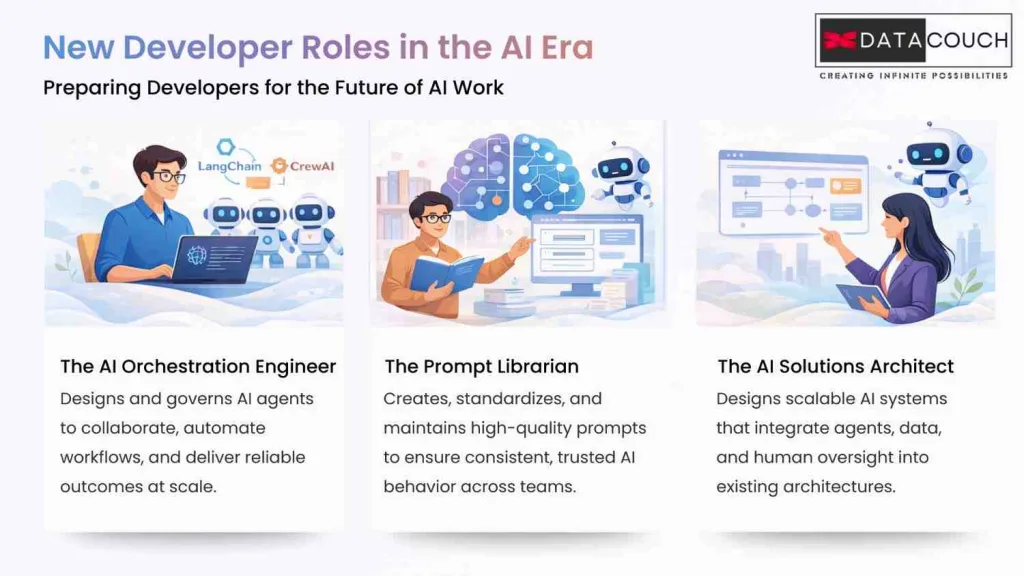
The Agentic Engineer
Old definition: Writing every line of code yourself, testing manually, debugging until 2 AM.
New definition: Designing how multiple AI agents coordinate to solve problems. Using frameworks like LangChain and CrewAI to orchestrate workflows seamlessly.
Here’s a real example: Instead of writing a customer support system from scratch, an agentic engineer designs a system where one agent retrieves customer history from databases. A second agent analyzes what the customer actually needs. A third agent executes the solution. An orchestrator layer manages handoffs between agents and ensures quality throughout.
The Prompt Librarian (Barely Exists Today)
This role is emerging as organizations scale their AI adoption. Think of it like a library architect for AI prompts. As companies deploy more AI agents, they need consistency across the organization. One developer writes a prompt template that works great for data analysis. Another team reinvents the wheel doing something similar. A prompt librarian maintains reusable prompt templates that everyone uses, ensuring consistency and quality across the entire company.
The AI Solutions Architect
Old definition: Designing system architecture for traditional software systems.
New definition: Designing how AI agents work at scale, how they connect to existing systems, and how humans properly oversee them.
Here's What Competitors Miss About This Shift
Training articles talk about technical skills. They mention Python, LLMs, and prompt engineering. But they skip the most critical shift. Developers need to think in agent workflows, not just code blocks. This is fundamental. A developer can know how to use ChatGPT and still not understand how to design two AI agents working together. Understanding multi-agent systems isn’t an “advanced topic” for specialists. It’s becoming baseline literacy for all developers.
What's Really Stopping Reskilling Programs From Working?
This is the part nobody writes about. And it’s the reason reskilling programs fail 70% of the time.
When organizations announce “We’re going all-in on AI,” the first reaction isn’t curiosity. It’s fear. Raw, honest fear. Developers worry constantly. Will my job exist in two years? Am I getting laid off? If I don’t learn this fast, will I become unemployable?
Research shows something striking: 58% of employees worry that AI will cost them their job. Another 60% fear increased stress and burnout from the transformation. But here’s the really important part that always gets overlooked: AI adoption doesn’t automatically cause depression or anxiety. Instead, it reduces psychological safety first. Depression and anxiety follow after.
What does psychological safety actually mean?
It means employees feel safe asking questions without fear of looking stupid. When AI adoption happens in an environment with low psychological safety, people don’t ask for help. They hide their confusion. They feel isolated and alone. That’s when burnout and imposter syndrome take over.
This is exactly why traditional training fails. You can put developers through a two-week bootcamp. They complete all the assignments. They pass the tests. But then they return to a workplace where managers dismiss their concerns about AI. Where admitting confusion gets punished. They won’t actually learn. The knowledge won’t stick. They’ll burn out.
The antidote that works: Ethical leadership from managers. When leaders are transparent about what they don’t know, when they encourage questions, when they celebrate learning attempts instead of punishing mistakes, psychological safety returns. Employees stay engaged. Learning actually happens. Organizations see real results.
What Specific Skills Should Your Developers Actually Learn?
Let’s move past theory and get practical. What should a developer actually learn? What skills matter most?
Foundation Skills Every Developer Needs
Python Proficiency
It’s become the lingua franca of AI development. If developers don’t know Python well, they’re starting from a disadvantage. Everything in the AI ecosystem connects to Python.
Prompt Engineering
Understanding how to communicate with AI systems effectively. It sounds simple. It’s not. Precision matters tremendously. Small changes in wording produce dramatically different outputs from AI systems.
Understanding LLM Limitations
AI systems hallucinate. They have context windows. They make mistakes. They misunderstand ambiguous instructions. Developers need to know these constraints intimately. They need to build safeguards accordingly.
Systems Thinking
Not just writing one piece of code, but understanding how components interact with each other. This is where orchestration thinking becomes crucial. This is where the mental shift from code execution to orchestration happens.
Check out our blog here:
Specialization Skills (Choose Your Path)
If You’re Becoming an Agentic Engineer:
- Multi-agent orchestration using frameworks like CrewAI and LangChain
- Building Retrieval-Augmented Generation (RAG) systems, which means how to make AI smarter by giving it access to company data
- State management, which covers how do agents remember information and share context
- Error handling in autonomous systems, which addresses what happens when an agent fails
If You’re Focusing on ML and AI Model Work:
- Fine-tuning techniques (how to specialize AI models for your company’s specific needs)
- Embeddings and vector databases
- Model evaluation and selection
If You’re Product-Focused:
- Prompt design for user experience
- A/B testing AI outputs
- Building feedback loops so systems improve over time
Emerging Skills (Next 18 Months)
- Security concerns like prompt injection attacks
- Multi-modal AI (systems that work with text, images, and audio together)
The key insight here: Developers don’t need to learn everything. They need to understand their specific path and go deep there. One person doesn’t need to master all three specializations. But every developer needs the foundation.
Why Are Most Managers Missing From Reskilling Conversations?
Here’s an uncomfortable truth that organizations ignore: most reskilling initiatives fail because they focus on developers instead of managers.
Think about what managers actually do. They assign work. They review output. They guide career paths. They set the tone for how the team responds to change. They’re the cultural leaders of their organizations. If a manager doesn’t understand AI, they can’t do any of those things effectively in an AI-first world. They become bottlenecks instead of enablers.
Here's what actually changes for managers in the AI era:
| Traditional Management Approach | AI Era Management Approach | Why It Matters |
|---|---|---|
| Assign specific tasks | Set clear intent, let developers orchestrate solutions | Developers need freedom to experiment, not micromanagement |
| Review code for bugs | Evaluate AI-generated outputs and quality gates | Different evaluation criteria; completely different metrics |
| Mentor through expertise | Mentor through curiosity and modeling learning | Leaders who admit "I don't know" build psychological safety |
| Measure productivity by hours worked | Measure by orchestration quality and business impact | "Code shipped" doesn't equal "system works well" |
Only 8% of managers are AI-ready. That means 92% of teams have leaders who are still figuring this out themselves. Those developers feel that confusion from the top. It compounds their own anxiety. It creates a domino effect of confusion throughout the organization.
The best-performing companies do something different: they train leaders first. They spend weeks helping managers understand the AI landscape, the capabilities, the limitations, and critically, how to lead teams through transformation. Those teams learn faster. They have higher morale. They produce better results.
Why Do 50% of Employees Want Training, But Only 28% Actually Get It?
Almost 50% of employees say they want AI training. Only 28% of organizations actually provide it. Even when training exists, most programs don’t work.
Here’s why traditional approaches fail: You can’t take developers out of their jobs for two weeks, teach them abstract concepts in a classroom, then expect them to apply everything when they return to normal work. It doesn’t stick. Knowledge gets forgotten. Context is missing. The real world is messier than textbook examples.
The companies doing this right use a three-part approach that actually works.
Part One: Baseline AI Fluency for Everyone
Every person at the company, regardless of role, requires understanding what AI can do and what it can’t. What are the ethical concerns? What tools exist? How does this company plan to use AI? This takes a few hours, not weeks, and it builds common language across teams. Everyone speaks the same language.
Part Two: Role-Specific, Project-Based Learning
Developers learn by building actual projects, not reading textbooks. They work on real problems that matter to the business. A learning coach is there to help them navigate challenges. This is where the skills actually stick. They’re solving problems that matter. They’re building things people will use.
Part Three: Business-Tech Bridge
How does AI impact customer value? What’s the ROI of this AI project? Why are we investing in this technology? Developers who understand the business logic behind AI decisions are more engaged. They make better technical choices. They see the bigger picture.
The secret that most training programs miss: Micro-learning beats classroom training 10-to-1. A 15-minute guidance session when a developer actually needs it is worth more than a full-day course they take three months later. Learning needs to be woven into daily work, not separated from it.
What Are the Companies Actually Succeeding With Developer Reskilling?
IBM's Personalized Learning Approach:
IBM created a system where AI evaluates what each person needs to learn. It creates a personalized learning path. It offers a mix of online courses, in-house training, and mentorship. Results: they reduced time-to-competency by 40%. Employee retention improved significantly. People stayed because they felt invested in.
Infosys's Springboard Strategy:
They launched Springboard, a free learning portal where employees reskill at their own pace and earn recognized certificates. What makes this work: it normalizes continuous learning throughout the organization. It’s not “mandatory training.” It’s “here’s what’s available when you need it.” Employees choose what they learn based on their career goals.
Accenture's Community Approach:
They combine personalized learning paths with peer learning groups. Employees learn together, not in isolation. It builds community. It makes learning less intimidating. People support each other.
The Reality Check Nobody Talks About:
Microsoft laid off 6,000 employees (including 40% of their engineers) betting that AI would do the work. Simultaneously, Klarna hired human employees back after discovering that AI-only customer service disappointed customers. The lesson is clear: companies can reduce headcount with AI, but humans are still needed. Especially for complex judgment calls. Especially for situations that require nuance and empathy.
How Can Your Team Start Getting Ready in the Next 6 Months?
For Individual Developers:
Months 1 to 2: Foundation Phase
- Master Python if it’s not already your strong suit
- Complete a structured AI training course
- Build your first project: a simple chatbot using LangChain
- Study and understand transformers, tokenization, and context windows
Months 3 to 4: Specialization Phase
- Choose your path: agentic engineering, ML specialist, or product engineer
- If you choose agentic: go deep into multi-agent orchestration and RAG systems
- Start a real project that matters to your current job
- Get code reviews focused specifically on orchestration quality
Months 5 to 6: Advanced & Portfolio Building
- Learn security considerations (how to prevent prompt injection attacks)
- Build cost optimization into your thinking
- Create 2 to 3 production projects you’re genuinely proud of
For Team Managers:
Weeks 1 to 4: Assess and Plan
- Understand what your team currently knows about AI
- Identify which skills matter most for your business
- Establish a baseline of current capabilities
Weeks 5 to 12: Pilot and Learn
- Run a workshop teaching agentic thinking to your team
- Pick one team to go deep with AI projects first
- Embed a learning coach if your budget allows
- Document what works and what doesn’t
Weeks 13+: Scale Across the Organization
- Smaller teams (3 to 5 people) amplified by AI agents is the emerging model
- Establish a “prompt librarian” role for consistency across projects
- Build feedback loops into your sprint retrospectives
Are You Ready to Transform Your Team Into AI Orchestrators?
The companies winning in the AI era aren’t the ones with the fanciest AI tools or the biggest budgets. They’re the ones where developers understand the mindset shift, from individual code execution to orchestrating AI agents working together. They’re the ones where managers create psychological safety. Where teams experiment without fear of punishment. Where learning is woven into actual work.
The developers who’ll thrive aren’t the ones who master the most frameworks. They’re the ones who embrace continuous learning. They’re the ones who think in systems. They’re the ones who understand both the power and limitations of AI. They’re adaptable.
If you’re a CTO, Engineering Manager, or L&D leader trying to reskill teams for AI without slowing delivery, the next step is clarity and a practical plan, not another tool or generic course.
DataCouch helps enterprise teams shift from solo coding to orchestrating AI agents, while building the psychological safety teams need to experiment, learn, and ship. Our programs combine real project work with the leadership habits that make change stick.
DataCouch’s AI training programs are designed for real-world transformation. We’ve partnered with Fortune 500 teams navigating exactly what you’re facing now.
The difference?
We focus on both technical capability and organizational behavior, so learning actually shows up in delivery. You’re not just getting training; you’re getting a partner who understands the messy reality of digital transformation.
We design role-specific pathways for:
- Enterprise AI reskilling across engineering orgs
- B2B AI training that aligns to your delivery goals
- AI training for engineering managers to lead adoption confidently
- Book a confidential strategy call.
Book a confidential strategy call to discuss enterprise AI training and adoption for your engineering teams
What’s the one change you can make today to start preparing your team for the AI era?