
AIOps 2026: Automating the Modern Enterprise from Concept to Execution
Let’s start with a number that should shake up any CTO or IT leader: $2 million. That’s how much a single hour of downtime costs a financial institution today. Not yesterday. Not in some hypothetical future. Right now, in 2026.
And here’s the frustrating part: most of those outages are preventable. The problem is not missing data. IT environments generate mountains of it. Logs, metrics, traces, alerts, events. The problem is that humans can’t process it fast enough to act before things break.
That’s exactly the gap that AIOps fills.
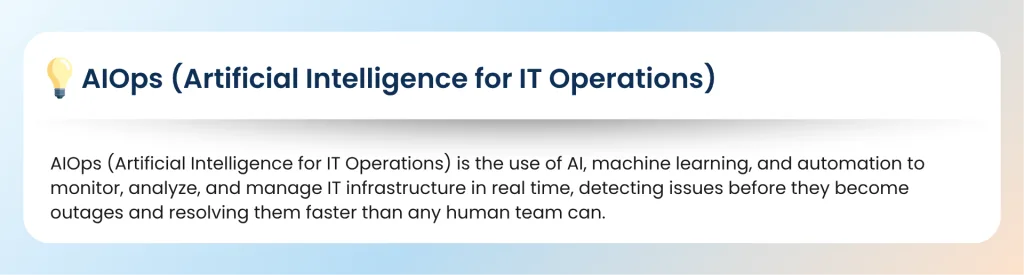
In 2026, AIOps is no longer an experiment for Fortune 500 companies. It’s becoming a baseline requirement for any organization that runs digital services at scale. If you’re a CTO, IT team lead, CFO evaluating training budgets, or a student figuring out where the best tech careers are heading, this blog is for you.
We’re going to cover what AIOps actually does, why the moment to act is right now, the honest ROI numbers, the failure modes other blogs skip over, and a clear roadmap to get your team from concept to execution.
The AIOps Market in 2026: These Numbers Tell the Story
The AIOps space has crossed a major threshold. It’s not a niche IT experiment anymore. It’s a mainstream enterprise investment that is growing faster than almost any other category in tech operations.
$47.29B Global AIOps market size in 2026 (GlobalGrowthInsights)
22.95% CAGR Projected growth rate through 2035 (GlobalGrowthInsights)
72% of enterprises now prioritize AI-driven IT automation (GlobalGrowthInsights)
42% to 54% jump in AI-powered monitoring adoption between 2024 and 2025 alone (Mordor Intelligence)
$303.63B AIOps market projected size by 2035 (GlobalGrowthInsights)
Those numbers reflect a simple reality: IT environments have grown too complex for manual management. Organizations that move fast on AIOps get ahead. Those that wait get buried in alert noise, slow incident response, and rising operational costs.
Why Is 2026 the Tipping Year for AIOps Adoption?
Here’s the surprising truth about AIOps timing: the technology has existed for years. So why is 2026 the year every CTO is talking about it in their strategy meetings? Five specific forces converged at the same time, and together they make the old way of running IT operations simply unworkable.
1. The Telemetry Explosion Is Out of Control
When you shift from a monolithic application to a microservices architecture, your monitoring data doesn’t grow by 10%. It grows by 10 times or more. Each service generates its own logs, metrics, and traces. According to Mordor Intelligence’s 2026 AIOps Market Report, enterprises moved from 42% to 54% AI-powered monitoring adoption in a single year, driven precisely by this telemetry overload. Traditional rule-based alerts can’t cope. They produce so many false alarms that engineers start ignoring them, which is the most dangerous outcome of all.
2. The Talent Gap Is Getting Wider, Not Smaller
This one doesn’t get enough attention in tech discussions. Over 63% of organizations report a shortage of professionals skilled in AI-driven IT operations. And 58% of IT teams say they struggle to interpret ML outputs even when they have the tools deployed. You can’t fix a talent shortage by hiring alone. The answer is structured upskilling at the team level, which is exactly why corporate training in AIOps has become a strategic priority, not a nice-to-have.
3. Hybrid Cloud Complexity Has Reached Peak Pain
The average enterprise now uses eight different cloud providers simultaneously, according to research cited by Fortune Business Insights. Managing performance, security, and uptime across that many environments is genuinely impossible without AI-assisted correlation. What used to be a single monitoring dashboard is now a sprawl of tools that don’t talk to each other.
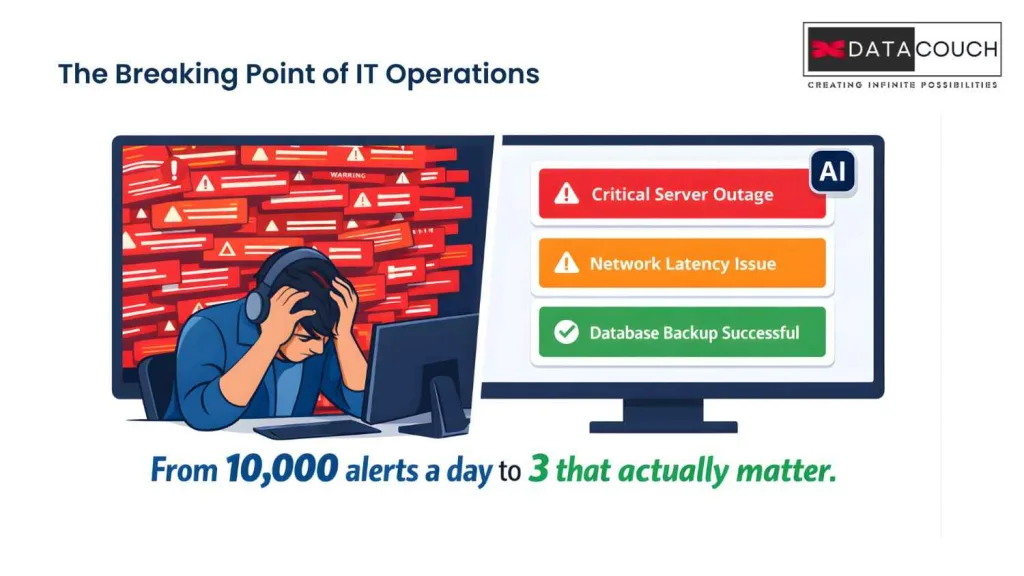
4. Alert Fatigue Is Real and It's Getting People Hurt
Most enterprise IT teams receive thousands of alerts per day. Engineers burn out chasing noise, and the critical signals get lost in it. AIOps platforms address this directly by correlating related alerts into single, meaningful incidents. The results are measurable. ServiceNow benchmarks from mature deployments show 99.2% event noise reduction in environments with fully implemented AIOps.
5. GenAI Workloads Broke Traditional Monitoring
This is the 2026-specific force that most blogs haven’t caught up to yet. When your applications now include large language model calls, the monitoring challenge changes fundamentally. AI workloads are non-deterministic. They don’t fail in predictable ways. Datadog introduced LLM Observability in 2025 specifically because traditional tools couldn’t track token consumption, latency, and costs in GenAI pipelines. Any organization deploying AI products needs AIOps platforms that can monitor AI itself, not just the infrastructure it runs on.
The talent gap is the most fixable of these five forces
DataCouch's AIOps Essentials: From Concept to Execution course is a structured 2-day, instructor-led program built for IT professionals at the intermediate level, fully customizable to your team's stack. If your organization is among the 63% with an AIOps skills gap, this is the fastest structured path to closing it.
What AIOps Actually Does: A Practical Breakdown
Most explanations of AIOps stay at the surface level. Here’s how it actually works in a real enterprise environment, layer by layer.
Layer 1: Data Ingestion and Normalization
AIOps starts by pulling in data from every monitoring tool in your stack: logs, metrics, traces, events, CMDB records, cloud telemetry, ticketing data. It normalizes all of that into a common format so the intelligence layer can reason across it. This is where the ‘big data’ part of the course curriculum becomes real. Understanding how this layer works determines whether your AI models are fed clean data or garbage.
Layer 2: The Intelligence Engine (Where Machine Learning Lives)
This is the core. Machine learning models learn what normal looks like across every service and every system. When something deviates from that baseline, even subtly, the platform flags it. Root cause analysis (RCA) connects the anomaly to its source automatically, often within seconds. The key difference between basic monitoring and AIOps: monitoring tells you something is wrong; AIOps tells you why and recommends what to do next.
Layer 3: Automation and Orchestration
For known failure patterns, AIOps doesn’t just alert. It acts. It runs self-healing scripts, restarts crashed services, reroutes traffic, or rolls back a bad deployment, all without waking up an engineer at 3am. According to a Research Square academic study on MTTR reduction, AIOps improves incident detection by 35% and reduces MTTR by 40% across multiple systems. For automated remediation specifically, reports cite reductions of 50 to 85% in time-to-resolution for common issue types.
Layer 4: Dashboards, Governance, and Audit Trails
None of the above means anything without visibility and control. Mature AIOps platforms give SREs, NOC teams, and leadership a shared view of service health, SLA adherence, and automation activity. Critically, they maintain audit trails of every action the AI took and why. This is not optional. It’s what turns a PoC into a production-grade system that executives can trust.
AIOps Platforms Compared: Picking the Right Tier for Your Organization
What most people don’t realize is that ‘AIOps’ is not a single category. Different tools solve different problems, and the right choice depends entirely on where your organization sits on the maturity curve. Here’s a simplified breakdown of the major platforms and what they’re actually best for:
| Platform | AI Engine | Best For | Watch Out For |
|---|---|---|---|
| Dynatrace | Davis Causal AI | Full-stack enterprise auto-RCA; self-healing infra | High cost; complex for SMBs |
| Datadog AIOps | ML anomaly detection | Cloud-native infra with wide integration ecosystem | Costs spike at scale; less advanced AI vs Dynatrace |
| IBM AIOps Insights | Watson AI | Hybrid/multi-cloud + ITSM-heavy enterprises | Steep setup complexity; needs trained professionals |
| Splunk ITSI | ML Toolkit (MLTK) | Log analytics + SIEM + AIOps for SRE teams | Manual use-case setup; not plug-and-play |
| BigPanda | Correlation + GenAI | Alert noise reduction on top of existing tools | Not a standalone observability platform |
| ServiceNow ITOM | Now Assist (GenAI) | ITSM-heavy workflows + enterprise governance | Expensive; AI features still maturing |
Source: Gartner Peer Insights, OpenObserve, SigNoz, Better Stack — March 2026
The practical advice: if you’re starting your AIOps journey, don’t pick the most powerful platform first. Pick the one your team has the skills to operate. Gartner data shows that 58% of enterprises that get certified AIOps professionals still need 6 months of mentoring before independent operation. Tool selection and team readiness have to move together.
The ROI Reality: What Enterprises Are Actually Getting
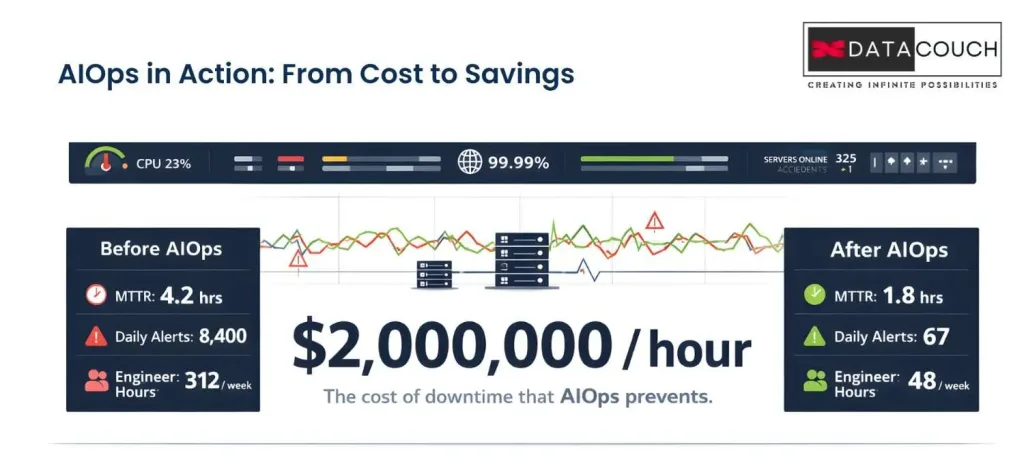
Let’s get past the vendor marketing and look at real numbers from real deployments. The ROI case for AIOps is strong, but it requires proper baselining before implementation to measure honestly.
| Metric | Typical Improvement | Source |
|---|---|---|
| Mean Time to Resolution (MTTR) | 40% to 60% reduction | Research Square academic study + enterprise case studies |
| Event/alert noise | 99.2% reduction | ServiceNow mature deployment benchmarks (NTT DATA) |
| Engineering hours saved | 9,500+ hours per month | ServiceNow global deployment benchmark |
| System outage reduction | 70% fewer outages | ServiceNow ROI benchmark data |
| Revenue-generating app availability | +15% improvement | Forrester study commissioned via ACI Infotech |
| Automated incident resolution | 10,000+ issues/month auto-resolved | Major network carrier case study (IntelligentVisibility) |
That 9,500 hours per month figure is worth pausing on. That’s roughly five full-time engineers’ annual working hours, saved every single month, across one enterprise deployment. For a CFO evaluating AI investment, the math becomes clear: the cost of a proper AIOps deployment is dwarfed by what it saves in engineering time alone, before you even count downtime prevention.
The most important ROI lesson from early adopters: establish your baseline metrics before you deploy. MTTR, alert volume, incident frequency, and engineering hours spent on triage need to be measured before week one. Without that, you can’t prove the impact to your finance team or your board.
What Most Blogs Won't Tell You: Why AIOps Projects Fail
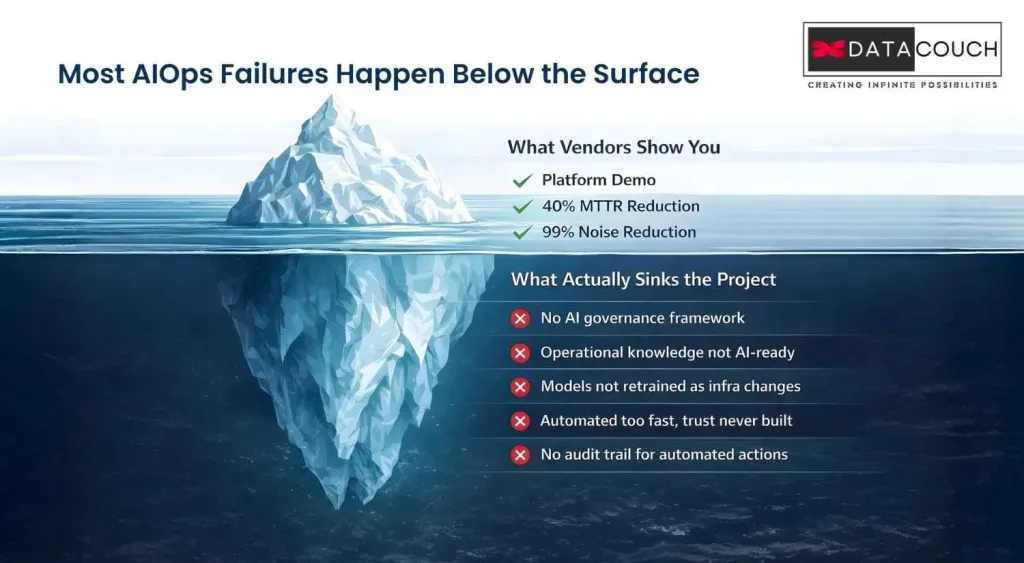
Here’s something the vendor websites won’t put in their case studies: a lot of AIOps deployments never make it past the proof-of-concept stage. A January 2026 analysis by Thoughtworks Canada found that while more than half of AIOps PoCs did reach production in 2025, the rest failed for structural reasons that had nothing to do with the technology itself.
Failure Mode 1: No AI Governance Framework
Enterprises go live with AIOps automation without defining who is accountable when AI takes the wrong action, what the audit trail looks like, and how the models get retrained when infrastructure changes. Without governance, one bad automated remediation can take down a service that was actually running fine. AI governance is not an IT topic. It’s a leadership decision.
Failure Mode 2: Operational Knowledge Is Not AI-Ready
AIOps platforms are only as smart as the data they are trained on. If your incident runbooks are stored in people’s heads, your architecture documentation is six months out of date, and your alert naming conventions are inconsistent across teams, the AI has nothing reliable to learn from. Getting your operational knowledge organized and structured is a prerequisite for AIOps, not an afterthought.
Failure Mode 3: Teams Treat AIOps as Set-and-Forget
ML models drift. As your infrastructure changes, the models need retraining. As new services are added, baselines need updating. As automation playbooks are built, they need validation and expansion. Organizations that treat AIOps as a one-time purchase instead of an ongoing operational discipline consistently see their platforms degrade within 12 months of deployment.
Failure Mode 4: Jumping to Full Automation Too Fast
Moving straight from manual operations to closed-loop self-healing automation without building trust in the system’s recommendations is a common and expensive mistake. The best implementations start with Level 1 (noise reduction and anomaly surfacing), prove value there, then climb the maturity ladder deliberately. Automation should expand as confidence grows, not as ambition demands.
The AIOps Implementation Roadmap: A Practical 5-Stage Path
The title of this blog is ‘from concept to execution’ for a reason. Here’s what that actually looks like in practice, broken into stages that any team can follow regardless of size or budget.
- Stage 1: Baseline Everything. Before touching a single tool, document your current MTTR, alert volumes, incident frequency, and engineering hours on triage. These are your before numbers. Without them, you can’t measure anything.
- Stage 2: Start with Noise Reduction. Your first AIOps use case should be reducing alert fatigue. Pick one high-noise environment, implement correlation and deduplication, and show your team that fewer, better alerts are possible. This builds trust in the system faster than any other starting point.
- Stage 3: Add AI-Assisted RCA. Once the noise is under control, layer in root cause analysis. Engineers should see the AI’s suggested root cause alongside each incident. They validate it, correct it when wrong, and the model learns. Human in the loop at this stage is essential.
- Stage 4: Automate Low-Risk Remediation. Start with low-stakes, well-understood failure patterns. Service restarts, cache flushes, log rotations. Build playbooks. Each one goes through validation before becoming automated. Audit trails on every action.
- Stage 5: Expand to Predictive Operations. With a stable foundation, move to predictive capacity planning and proactive failure prevention. This is where the real competitive moat is built: preventing outages rather than responding to them.
This 5-stage roadmap is the strategic overview
DataCouch's AIOps Essentials: From Concept to Execution gives your team the execution layer: 2 days of structured, instructor-led training covering core AIOps technologies, the relationship between AIOps and DevOps/MLOps/SRE, implementation best practices, and real-world challenge scenarios. Intermediate level. Fully customizable for your team's environment.
The Skills Gap Reality: Why Upskilling Is Now a Board-Level Decision
Enterprise AIOps adoption is outrunning the availability of professionals who can actually run it. The numbers are sobering:
63% of organizations report a shortage of AIOps-skilled professionals (GlobalGrowthInsights)
58% of enterprises struggle to interpret ML outputs from their deployed AIOps tools (Mordor Intelligence)
6 months average time for certified AIOps professionals to manage platforms independently without mentorship (Mordor Intelligence)
The skills required to run AIOps effectively sit at the intersection of three disciplines: infrastructure fluency, statistical modeling, and software development. Very few people start with all three. The practical path for most organizations is structured corporate training that builds the AIOps mindset and foundational skills, followed by hands-on application in the real environment.
What’s changing in 2026 is that this is no longer a decision being made at the team manager level. It’s becoming a board-level conversation because the ROI is now measurable, the competitive gap between AIOps-mature and AIOps-immature organizations is widening, and regulators in financial services and healthcare are starting to ask questions about IT resilience that only AIOps can answer.
What's Coming Next: GenAI + AIOps + Agentic Operations
The next frontier is already arriving. AIOps platforms are expanding beyond monitoring traditional IT systems to monitoring AI workloads themselves, including the latency, token consumption, and accuracy of LLMs running in production applications. Simultaneously, the category is moving from ‘AI that recommends actions’ to agentic AIOps, where AI agents plan, execute, and iterate on remediation autonomously.
Gartner predicts that by 2030, AI will touch 75% of all IT work. The organizations that are building AIOps capability now are the ones that will have the systems, the governance frameworks, and the trained teams to operate in that environment. The ones starting later will face both a technology catch-up and a talent catch-up simultaneously.
Key Takeaways
- AIOps is the intelligence layer that sits on top of your observability data and turns it into action. It is not a monitoring tool. It is the automation engine that makes monitoring meaningful.
- The market has crossed its tipping point. At $47.29B in 2026 and growing at 22.95% per year, AIOps investment is no longer a forward-looking bet. It’s catching up to where most enterprises already need to be.
- ROI is real and measurable: 40 to 60% MTTR reduction, 99.2% event noise reduction, 9,500+ engineering hours saved per month in mature deployments. These are not marketing claims. They’re benchmarks from documented enterprise implementations.
- Most AIOps failures are organizational, not technical. AI governance, knowledge readiness, continuous tuning, and a measured approach to automation are what separate PoCs that die from platforms that deliver.
- The skills gap is the most urgent problem, and also the most solvable. Structured upskilling at the team level is faster and more reliable than hiring, and it builds organizational capability that external consultants can’t replace.
AIOps in 2026 is not a future capability to put on a roadmap. It’s a present-day operational requirement for any organization running digital services at scale. The question is not whether to adopt it, but how quickly your team can be ready to run it well.
Ready to Move From Concept to Execution?
DataCouch's AIOps Essentials: From Concept to Execution is a 2-day, intermediate-level course that walks your team through the full AIOps landscape: core technologies (AI, big data, ML), the relationship between AIOps and DevOps/MLOps/SRE, adoption benefits and real challenges, and a pragmatic integration roadmap. Fully customizable for your team's environment and goals.
2 Days | Intermediate Level | Instructor-Led | Team Customizable
What’s the one thing holding your team back from deploying AIOps this year? Is it the skills gap, the governance question, or the fear of getting the platform choice wrong? Drop your answer in the comments, and let’s figure it out together.
Sources
GlobalGrowthInsights: AIOps Market 2026-2035
Mordor Intelligence: AIOps Platform Market Report, January 2026
Grand View Research: AI for IT Operations Platform Market
Fortune Business Insights: AIOps Market Report
Research Square: Reducing MTTR with AIOps (Academic Study)
Thoughtworks Canada: AIOps – What We Learned in 2025 (January 2026)
Judge Group: ServiceNow ROI in 2026 – AIOps Playbook
Gartner Peer Insights: AIOps Platforms 2026