

How AI Is Changing Cybersecurity in 2026
What is AI in Cybersecurity? AI in cybersecurity means using machine learning and automation to detect threats, prevent attacks, and protect data. In 2026, it is also the most powerful weapon attackers have ever had at their disposal.
If you are a student studying cybersecurity, a working professional protecting your company’s systems, a CTO building digital infrastructure, or a CEO making risk decisions, this article is for you.
Because here’s the hard fact most articles are skipping: the rules have changed. Firewalls and antivirus software are still important, but they are no longer enough. AI has shifted both sides of the battlefield, and understanding that shift is now a core part of any serious cybersecurity and digital risk management strategy.
Let’s break it all down, step by step.
1. The Numbers Every Security Team Needs to See
Before we go into what is changing, the data tells the clearest story.
| $29.6B | Global AI in cybersecurity market size in 2025 | Precedence Research |
| $93.75B | Projected market size by 2030 (24.4% CAGR) | Grand View Research |
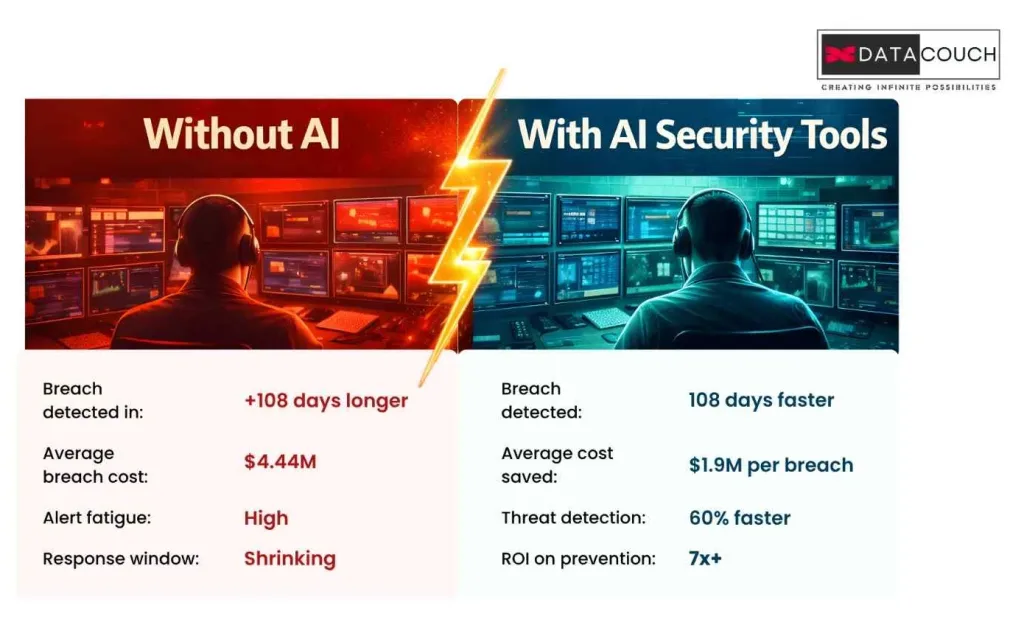
| $4.44M | Average global cost of a data breach in 2025 | IBM Cost of Data Breach Report, 2025 |
| 108 days | Faster breach detection for organizations using AI security tools | IBM, 2025 |
| $1.9M | Average breach cost savings for teams using AI security tools | IBM Security, 2025 |
That gap, 108 days and $1.9 million, is really what the AI cybersecurity conversation comes down to. But there is a lot more to it than just buying AI tools. Let’s look at both sides.
2. How AI Has Become the Attacker's Most Powerful Weapon
Here’s the part of the story that makes security teams uncomfortable. The same AI tools your company uses to automate reports, improve customer support, and generate ideas are also helping hackers write better phishing emails, clone executive voices, and scan your systems for weaknesses at machine speed.
AI-Powered Phishing: Why Your Team Can No Longer Spot It by Eye
Most people still think phishing emails are easy to catch. Bad grammar. Odd sender names. A subject line that feels off.
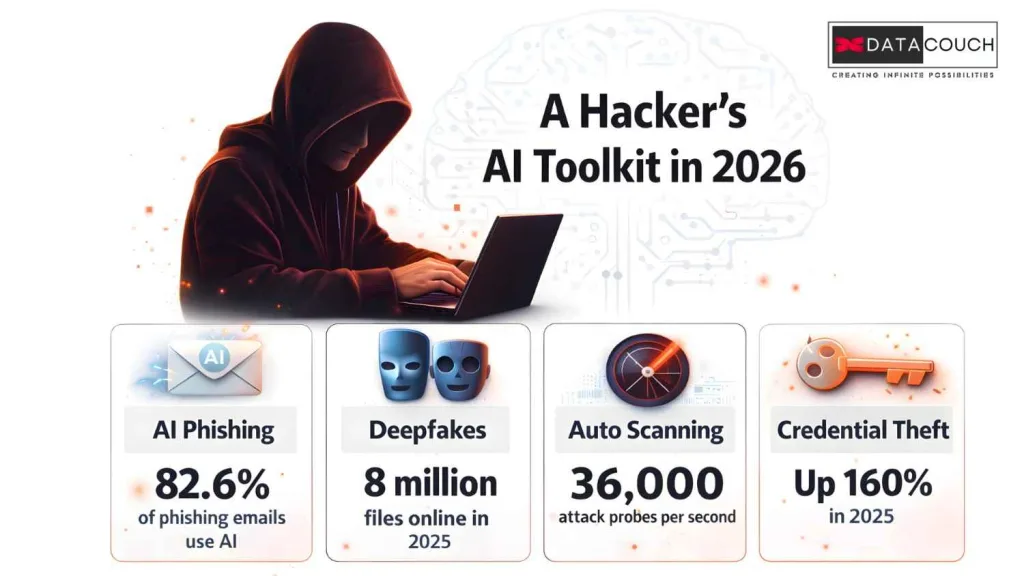
That is no longer a reliable defense. According to research from DeepStrike (2025), 82.6% of phishing emails now incorporate AI in some form. AI-generated phishing emails achieve a 78% open rate and a 21% click-through rate. That is nearly double the response rates of professionally written marketing emails.
The reason is straightforward. AI removes the human errors that used to make phishing detectable. The language reads naturally. The content references real events. The tone matches the person being impersonated. And because the messages are uniquely generated each time, signature-based filters cannot catch them.
Here’s the surprising truth: AI-generated phishing emails now have a higher open rate than most legitimate marketing emails. Your employees have no reliable way to identify them by reading alone.
Deepfake Fraud: This Is Not a Future Problem
Deepfakes moved from being a theoretical concern to an industrial-scale fraud tool faster than almost anyone expected.
In the first quarter of 2025 alone, 179 separate deepfake incidents were recorded across enterprises. That exceeded the total for all of 2024. The total number of deepfake files online jumped from 500,000 in 2023 to 8 million in 2025, a growth rate of over 1,500%.
One widely documented case involved a multinational firm where employees joined a video call. Every other participant on that call was an AI-generated deepfake. They authorized $25.6 million in wire transfers before the fraud was discovered.
What makes this especially serious is a finding from a University of Waterloo study: voice biometric authentication systems from major technology vendors can be bypassed in as few as six attempts using AI-generated voice clones. And only 0.1% of people can consistently identify a deepfake correctly [iProov Research, 2025]. That means virtually every employee in your organization is vulnerable.
Automated Vulnerability Hunting: Hackers Are Moving at Machine Speed
Attackers now scan networks at a rate of 36,000 probes per second using automated AI tools. In 2025, 41% of zero-day vulnerabilities were discovered by attackers using AI-assisted reverse engineering before defenders had even identified them.
Credential theft driven by AI jumped 160% in 2025. AI-powered ransomware has cut the median dwell time within a compromised network from 9 days down to 5 days. Your incident response window is shrinking, not growing.
Want your team to understand how AI-powered attacks actually work before they face one?
Explore AI and cybersecurity training programs built for real-world threats:
3. The Angle Most Articles Are Missing: Your AI Tools Are Now a Target
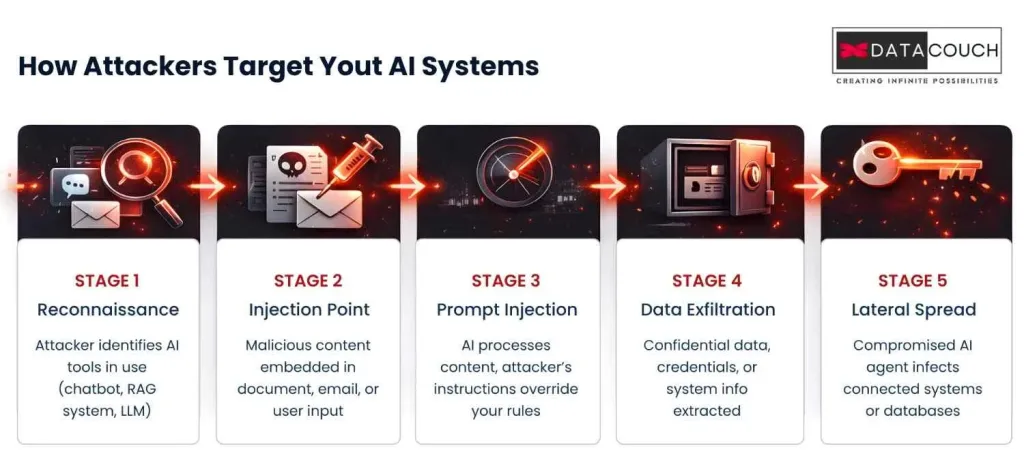
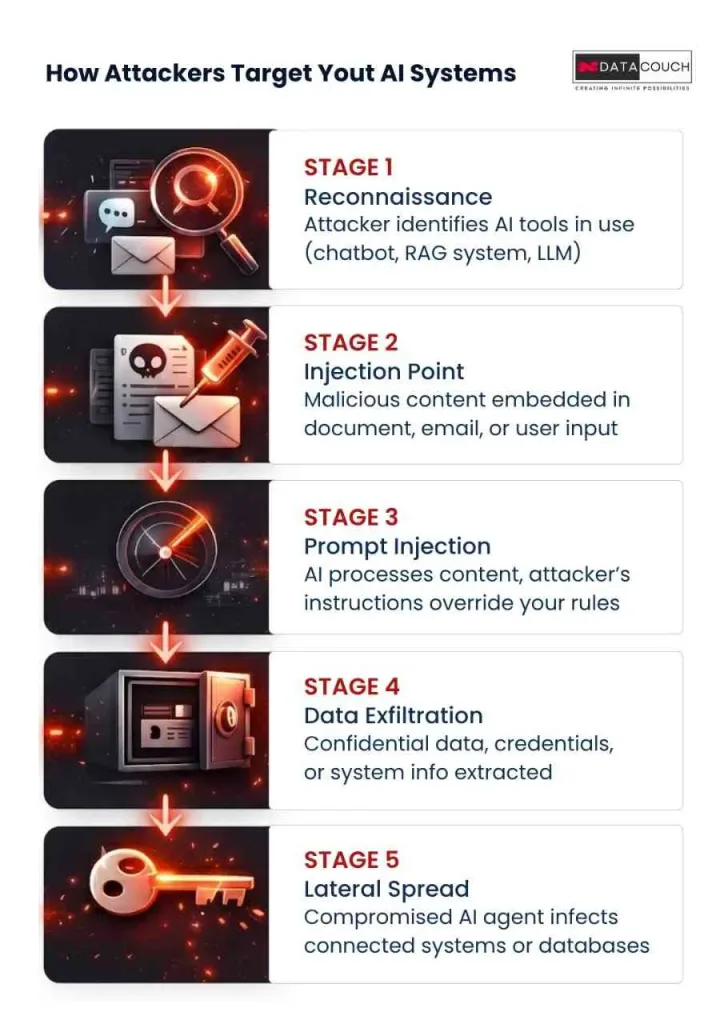
This is the part of the cybersecurity conversation that almost no one is covering. Everyone is writing about using AI to defend systems. Very few are writing about hackers attacking AI itself.
What most people don’t realize is: every AI tool your company uses, your chatbot, your AI assistant, your automated analysis platform, is now a potential attack surface with its own unique vulnerabilities.
Prompt Injection: The #1 AI Vulnerability No One Is Testing For
The OWASP Top 10 for LLM Applications (2025) ranks prompt injection as the number one critical vulnerability in AI systems. It appears in over 73% of enterprise AI deployments that have been audited.
What is prompt injection? Think of it as social engineering for AI. An attacker embeds hidden instructions inside a document, an email, or a user input. When your AI processes that content, it follows the attacker’s commands instead of your security rules. The model does not know the difference between a legitimate instruction and a malicious one.
The financial damage is already measurable. In 2025, prompt injection attacks caused an estimated $2.3 billion in losses globally. And current detection tools only catch about 23% of sophisticated injection attempts [Recorded Future, 2025].
RAG Poisoning: When Attackers Corrupt What Your AI Knows
Many enterprise AI tools now use a method called Retrieval-Augmented Generation, or RAG. It means the AI pulls from your company’s internal documents and databases to answer questions. This makes AI tools more accurate and useful for business.
It also creates a new attack path. Research published in a 2026 academic study (MDPI) found that just five carefully crafted documents injected into an AI knowledge base can manipulate that AI’s responses 90% of the time. Attackers do not need to breach your network directly. They only need to get malicious content into the data your AI trusts.
Shadow AI: Your Biggest Data Leak Is Probably Already Happening
A 2025 report by LayerX found that 77% of enterprise employees who use AI tools have pasted company information into a public chatbot at some point. More concerning, 22% of those instances included confidential financial or personal data.
This is what the industry calls Shadow AI. Employees are using AI tools that have not been vetted, approved, or secured by the organization. The data goes in. Where it ends up is beyond your control. This is a digital risk management problem that most security policies have not caught up to yet.
4. What AI-Powered Defense Actually Looks Like in 2026
The good news is that AI is also giving defenders tools they have never had before. The key is knowing what those tools actually do and how to use them well.
The SOC Is Changing. Here's What That Means Practically.
Traditional Security Operations Centers measured success by the number of alerts processed. More alerts equaled more work, which meant more tools and more headcount.
In 2026, that model is being replaced. According to a 2025 SOC survey by ISACA, teams that integrated AI-powered investigation tools alongside detection reduced their time-to-contain incidents by 38%.
The metrics that matter now are MTTD (Mean Time to Detect), dwell time, and cost per incident avoided. Not how many alerts got reviewed.
The Measurable Impact of AI Security Tools
Here is what organizations using AI security tools are actually reporting [IBM Cost of Data Breach Report, 2025]:
- 108 days faster on average breach detection compared to non-AI organizations
- $1.9 million average reduction in breach costs
- 60% faster threat detection speed using AI-driven security platforms
- 7x+ ROI on prevention investments across all threat categories
- 40% of development teams will use AI-based auto-remediation for insecure code by 2026, up from under 5% in 2023 [Gartner]
Zero Trust Is No Longer Optional
In 2025, compromised identities were involved in 60% of all cyber incidents. Attackers are not breaking down walls anymore. They are walking in through the front door using stolen credentials.
Zero trust security means verifying every user, every device, and every access request, every single time. No one gets automatic trust simply because they are inside your network. AI powers the behavioral analytics that make this kind of continuous verification practical at scale.
For teams deciding where to focus first, zero trust combined with AI behavioral monitoring is consistently the highest-impact combination in 2026 cybersecurity and digital risk management.
Need expert help designing an AI-ready cybersecurity strategy for your organization?
Talk to DataCouch's AI security consultants about building the right framework:
5. The Regulatory Clock Is Ticking: What You Need to Know Before August 2026
If your organization uses AI in any security-sensitive context, three regulatory deadlines are directly relevant right now.
| Regulation | Effective Date | Who It Affects | Key Requirement |
|---|---|---|---|
| EU AI Act (High-Risk AI) | August 2, 2026 | Any org using AI in regulated sectors | Prompt injection defense mandatory. Fines up to EUR 35M or 7% of global revenue |
| NIST AI RMF v2.0 | January 2026 | US federal agencies and NIST-following enterprises | Specific guidance on prompt injection, AI agent misuse, and autonomy risk management |
| HHS Healthcare AI Standards | March 2026 | Healthcare organizations using clinical AI | Prompt injection testing required before any AI tool deployment |
| Federal Reserve SR 26-1 | 2026 | Financial institutions using AI systems | Quarterly AI security assessments now mandatory |
The window to get compliant is getting shorter. Organizations that have not begun categorizing their AI systems under these frameworks need to start now, before enforcement catches up with them.
6. The Skills Gap: An Honest Conversation
Here is a number that tends to stop people: there are between 2.8 million and 4.8 million unfilled cybersecurity jobs globally right now [ISACA / (ISC)2, 2025]. And AI is accelerating demand, not reducing it.
According to ISACA’s 2025 State of Cybersecurity report, 55% of cybersecurity teams are currently understaffed. 66% of security professionals say their role is more stressful now than five years ago.
AI Will Not Take Your Job. But It Will Change What Your Job Requires.
This is the honest career conversation most articles skip entirely.
AI handles Level 1 and Level 2 tasks very well: log analysis, routine alert triage, pattern matching, and compliance reporting. That work is being absorbed by tools, and that trend is accelerating.
What AI cannot replace is judgment under pressure, adversarial thinking, governance design, and the ability to manage AI systems themselves. ISACA’s 2025 data found that the most common skills gaps in new security graduates are not technical at all. They are critical thinking (57%), communication (56%), and problem-solving (47%).
The professionals who will thrive are the ones actively building skills in AI governance, LLM security, adversarial machine learning defense, and cloud-native security architecture. ISACA launched two credentials specifically for this shift in 2025: the Certified Cybersecurity Operations Analyst (CCOA) and the Advanced in AI Security Management (AAISM). If you are a student or early-career professional, those designations are worth researching now.
7. Your 90-Day Action Plan
You do not need to transform your entire security program overnight. But these five steps represent the highest-priority actions for any team taking this seriously in 2026:
- Audit your AI inventory. List every AI tool in use across your organization, including tools employees may be using without approval. Map your actual attack surface.
- Test for prompt injection. Add AI-specific penetration testing to your next red-team exercise. Most teams have not done this yet. The OWASP LLM Top 10 is a practical starting framework.
- Update your identity verification stack. Multi-factor authentication is not sufficient against AI-generated deepfakes. Add behavioral biometrics and out-of-band confirmation for high-value transactions.
- Start EU AI Act compliance work. Classify your AI systems under the risk tiers before the August 2026 enforcement. The fines are real, and the timeline is close.
- Upskill your team. AI security governance, LLM security testing, and adversarial ML defense are now core competencies, not optional specializations for 2026 and beyond.
Key Takeaways
What Every Security Professional Should Know Heading Into 2026
- AI-powered attacks are 72% more common than they were a year ago and accelerating
Deepfakes are now industrial-scale fraud tools, not isolated incidents
- Your AI systems themselves are being attacked through prompt injection, RAG poisoning, and model tampering
AI defense tools work, but only when security teams understand how to use them
- Regulatory compliance deadlines in 2026 are not optional for organizations using AI in sensitive contexts
- The skills shortage is real, and the roles most in demand are shifting toward AI governance and LLM security
Wrapping Up
Cybersecurity and digital risk management in 2026 is not just a technical discipline anymore. It is a business function that sits at the intersection of technology, governance, and human judgment.
AI has made attacks faster, more convincing, and more targeted than anything we have dealt with before. It has also made defense more powerful, more precise, and more scalable than ever. The difference between organizations that thrive and those that struggle comes down to one thing: which side of that equation they are keeping pace with.
The organizations that understand both the threat and the capability will come out ahead. The ones assuming their existing tools and skills are enough are the ones that end up writing incident reports.
Whether you are a student entering cybersecurity or an enterprise building an AI-ready security program, the right training makes a measurable difference.
Explore AI, cybersecurity, and digital risk management programs at:
Is your security team truly prepared for AI-powered threats in 2026? What is the one capability gap you are most focused on closing right now? Share your thoughts in the comments.