
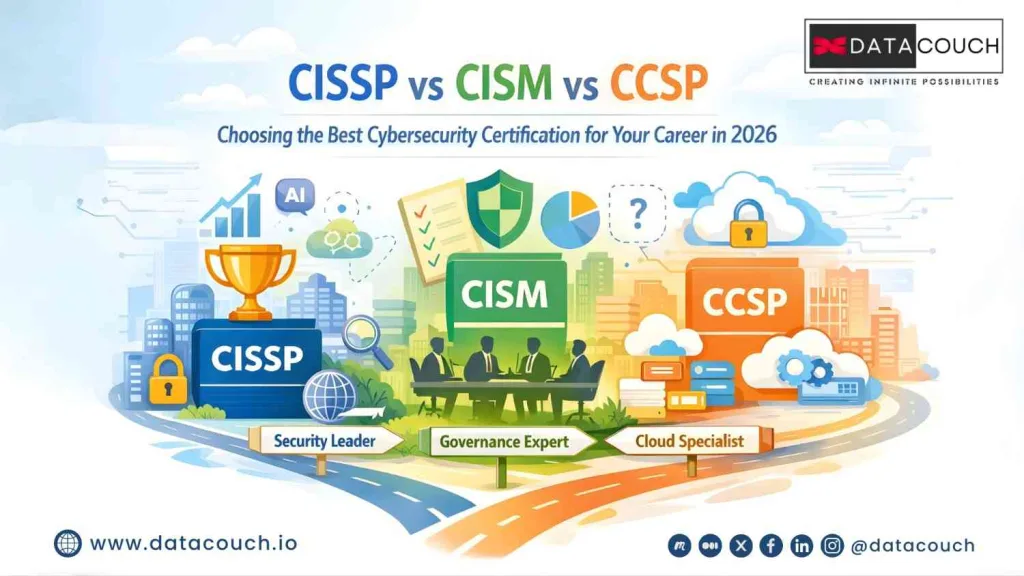
CISSP vs CISM vs CCSP: Which to Pursue in 2026?
Picking the right cybersecurity certification in 2026 can feel like choosing between three excellent paths that all lead somewhere good, but not to the same destination. CISSP, CISM, and CCSP are the three most respected advanced security credentials in the world. They are all rigorous. They all pay well. But they serve very different career goals.
Here is the problem. Most people spend months studying for the wrong one because they chose based on brand name alone, or because a friend recommended it, or because the job posting mentioned it. That is a costly mistake, both in time and money.
According to the 2025 ISC2 Cybersecurity Workforce Study, which surveyed a record 16,029 cybersecurity professionals worldwide, skills shortages are now the #1 crisis facing organizations. Not headcount. Skills. And the top two skills most in demand right now? AI security and cloud security, cited by 41% and 36% of respondents respectively. That context matters enormously when you are deciding which certification to pursue.
This guide will walk you through everything you need to know, covering what most articles skip entirely, so you can make the right choice for your career in 2026.
What Changed in 2026 That Most Articles Are Not Telling You
Before we compare the three certifications, there is a major policy change that every cybersecurity professional needs to know about. It directly affects which cert makes the most strategic sense right now.
The April 2026 CISSP Experience Waiver Shakeup
In April 2026, ISC2 quietly dropped a policy bomb. The list of certifications that qualify for a one-year experience waiver for CISSP was cut from approximately 50 credentials down to just 25. Major certifications like CEH, CISA, CRISC, and OSCP were removed from the list. (Source: ISC2 Community)
What this means for you: the traditional ‘get CEH, then use it to fast-track your CISSP’ path is gone. But here is the important flip side that almost nobody is talking about.
CISM and CCSP both survived the cut. They remain on the approved CISSP waiver list. That makes them smarter stepping stones to CISSP than ever before.
If you are planning to get CISSP eventually, starting with CISM or CCSP now is a strategically sound move in a way it simply was not before April 2026.
The Skills-First Hiring Shift
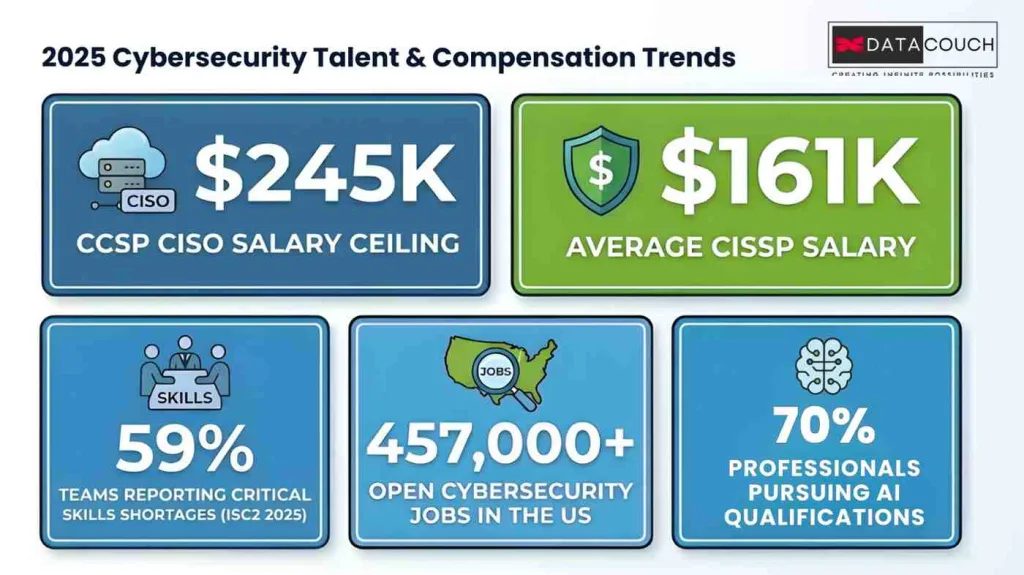
The 2025 ISC2 study also revealed something significant: for the first time ever, ISC2 declined to publish its global workforce gap number. Their reason? The problem has shifted. It is not about the number of available security professionals anymore. It is about the depth of their skills. Nearly 59% of security teams reported critical or significant skills shortages in 2025, up from 44% in 2024. (Source: ISC2 Workforce Study 2025)
Certifications that validate deep, specialized skills are now more valuable than ever. Which is great news if you are reading this guide.
Quick Comparison: CISSP vs CISM vs CCSP at a Glance
| Factor | CISSP | CISM | CCSP |
|---|---|---|---|
| Provider | ISC2 | ISACA | ISC2 |
| Focus | Broad enterprise security | Security governance & management | Cloud security specialization |
| Exam Domains | 8 domains | 4 domains | 6 domains |
| Exam Format | CAT: 100-150 Q / 3 hrs | Linear: 150 Q / 4 hrs | Linear: 125-175 Q / 4 hrs |
| Experience Required | 5 years (2+ domains) | 5 years in IS management | 5 yrs (3 in IS, 1 in cloud) |
| Exam Fee (2026) | ~$749 | ~$575 | ~$599 |
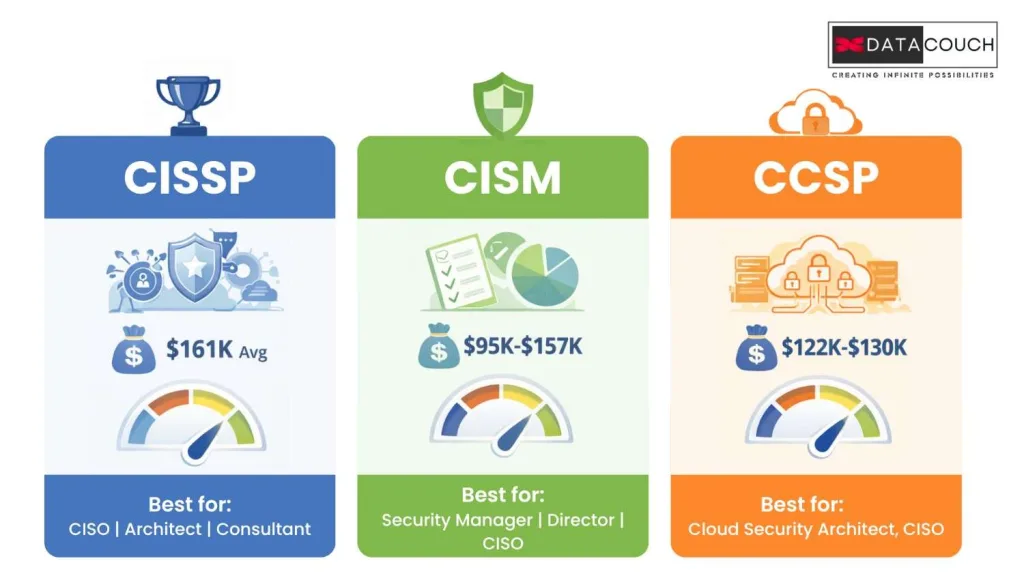
| Avg US Salary | ~$161K | ~$95K-$157K | ~$122K-$130K |
| CISSP Waiver Eligible? | N/A | Yes (post-April 2026) | Yes |
| DoD 8570 Approved? | Yes (IAM Level III) | Yes (IAM Level III) | Yes |
| Best Career Path | CISO, Architect, Consultant | Security Manager, Director, CISO | Cloud Security Architect, CISO |
Salary sources: Glassdoor / FlashGenius 2025, StationX CISM Data, Axis Intelligence 2026
CISSP: The Broadest Security Credential in the World
The Certified Information Systems Security Professional (CISSP) from ISC2 is widely regarded as the gold standard of cybersecurity certifications. It covers eight domains ranging from Security and Risk Management to Software Development Security. It is the one credential that consistently appears in job postings for senior security roles, CISO positions, and consulting engagements across every industry.
What the Exam Actually Tests (This Is What Most People Get Wrong)
Here is the surprising truth about CISSP. It is not a technical exam. It is a management mindset exam. The test uses Computerized Adaptive Testing (CAT), which means it adjusts difficulty based on your answers. You get 100 to 150 questions in a three-hour window. Many engineers who know their technical tools inside and out fail CISSP because they think like engineers. The exam wants you to think like a risk manager. That shift in thinking is the real challenge.
The Associate of ISC2 Path: The Underused Option Nobody Talks About
What most articles skip entirely is this: you do not need five years of experience before sitting the CISSP exam. You can pass the exam first and earn the status of Associate of ISC2, then collect your experience over the next six years. (Source: ISC2 Candidate Guide) This is a game-changer for students and early-career professionals who want to prove their credibility while they are still building their work history.
Who Should Pursue CISSP
- Security architects and senior engineers transitioning into leadership or consulting roles
- Professionals targeting CISO roles who need a widely recognized, vendor-neutral credential
- IT managers who need DoD 8570 / 8140 compliance for government or defense clients
- Students and early-career professionals who want to pass now and fulfill experience requirements over time
Salary reality: Glassdoor reports the median US salary for CISSP holders at approximately $161K, with top earners exceeding $250K to $295K. The certification also projects a 33% job growth rate. (Source: FlashGenius CISSP Salary Guide 2025)
Ready to earn your CISSP?
Explore DataCouch's instructor-led CISSP prep course, built for working professionals who want to pass on the first attempt.
CISM: The Governance Credential That Board Rooms Respect
The Certified Information Security Manager (CISM) from ISACA is often misunderstood. People assume it is a softer, less rigorous version of CISSP. That is wrong. CISM is not a lighter cert. It is a different cert designed for a different kind of security professional.
CISM Is a Board-Level Credential, Not a Technical One
CISM covers four domains: Information Security Governance, Information Security Risk Management, Information Security Program Development and Management, and Incident Management. These are the four areas that CISOs present to boards and executive teams. If you are the person who owns the security program, sets the strategy, manages the budget, and reports to the C-suite, CISM speaks your language.
The Strategic Angle Most People Miss
Here is what stands out in 2026: CISM survived the CISSP experience waiver cut. That means if you earn your CISM first, it counts as a one-year reduction in the five-year CISSP experience requirement. So getting CISM now is not just good for your governance career. It is a smart stepping stone toward CISSP for professionals on the management track. (Source: ISC2 Waiver Update)
CISM + CISSP together is the dual-credential power move that Directors and CISOs use to signal both governance depth and broad security leadership. Many top security executives hold both.
Who Should Pursue CISM
- IT managers and team leads who manage security programs rather than build controls
- GRC professionals and compliance officers who need a credential that validates their risk management expertise
- Aspiring CISOs who need a governance credential as part of a phased certification roadmap
- Working employees in finance, healthcare, or regulated industries where governance and audit skills are in high demand
Looking to sharpen your security governance skills?
Start your CISM prep with DataCouch's structured course covering all four ISACA domains.
CCSP: The Cloud Security Credential Built for the Modern Enterprise
The Certified Cloud Security Professional (CCSP), also from ISC2, is the specialist’s credential for cloud security. And in 2026, cloud security is not a niche. It is the core of most enterprise security programs. The ISC2 Workforce Study found that 36% of organizations list cloud security as a critical skills gap, second only to AI security. (Source: ISC2 2025 Study)
The Fastest Path to CCSP If You Already Hold CISSP
Here is a benefit that saves a lot of time. If you hold an active CISSP, the experience requirements for CCSP are automatically satisfied. You do not need to prove separate cloud security work experience. The CISSP experience covers it. (Source: ISC2 CCSP Info) That makes CISSP followed by CCSP one of the most efficient certification stacks you can build as a senior security leader.
CCSP Covers Six Cloud-Specific Domains
- Cloud Concepts, Architecture, and Design
- Cloud Data Security
- Cloud Platform and Infrastructure Security
- Cloud Application Security
- Cloud Security Operations
- Legal, Risk, and Compliance in Cloud Environments
Salary ceiling: Research into live job boards found CISO roles listing CCSP as a qualification with salaries reaching up to $245,000, and Staff Cloud Security Engineer roles hitting $230,000. (Source: passitexams.com research)
Who Should Pursue CCSP
- Cloud architects and cloud security engineers working on AWS, Azure, or GCP environments
- DevSecOps professionals who need a credential that validates their cloud-native security knowledge
- CISSP holders looking to add cloud specialization to their existing credential stack
- CTOs and technical leaders managing cloud-first organizations who need a recognized credential to back their strategic decisions
Cloud security is the fastest-growing skills gap in 2026.
Get CCSP-ready with DataCouch's expert-led course across all six cloud security domains.
Salary Comparison: What You Can Actually Expect to Earn
Certifications are an investment. Here is what the data says about the return.
| Certification | Entry Level | Mid Level | Senior / CISO |
|---|---|---|---|
| CISSP | $90K - $110K | $130K - $161K | $200K - $295K+ |
| CISM | $80K - $95K | $110K - $157K | $180K - $230K |
| CCSP | $85K - $105K | $122K - $145K | $200K - $245K |
Important note: For senior roles, total compensation including bonuses and equity frequently exceeds base salary by 20% to 40%. (Source: Axis Intelligence 2026) Also worth knowing: CISSP acts as a salary multiplier. A junior analyst with CISSP might see a $10K bump. A senior engineer with eight years of experience and a new CISSP might see a $40K increase on the same credential. (Source: ExamCert 2026 ROI Analysis)
So Which Certification Should You Actually Choose?
The answer depends on where you are in your career and where you want to be in three years. Here is the simplest way to think about it.
Choose CISSP If...
- You want the broadest, most universally recognized security credential
- You are targeting roles in architecture, consulting, or enterprise security leadership
- You need DoD 8570 compliance for government or defense work
- You are a student or early-career professional who wants to pass now and earn experience later through the Associate of ISC2 route
Choose CISM If...
- Your day-to-day work is governance, risk management, and compliance rather than technical security
- You manage security programs, audits, or report to C-suite executives
- You want a strategic stepping stone toward CISSP that also qualifies for the experience waiver
- You are an IT manager in a regulated industry like banking, healthcare, or insurance
Choose CCSP If...
- Your organization runs primarily on cloud infrastructure
- You are a cloud architect, cloud engineer, or DevSecOps lead
- You already hold CISSP and want cloud specialization without additional experience requirements
- You are a CTO or technical decision-maker who needs a recognized credential to back your cloud security strategy
The Stacking Strategy: What Top Security Leaders Actually Do
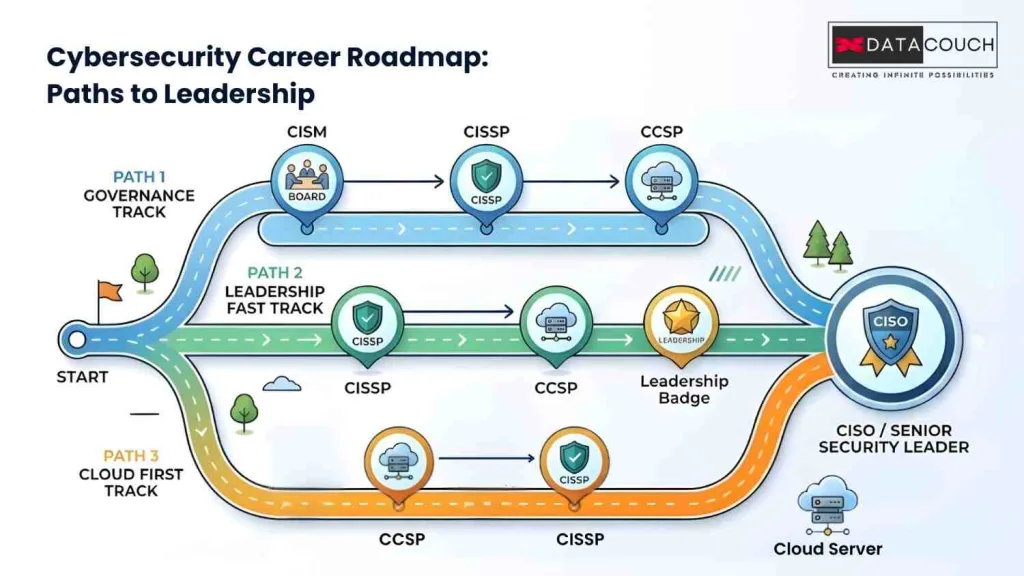
Many senior professionals do not stop at one certification. Here are the three most common certification paths that security leaders follow in 2026.
Path 1 (Governance Track): CISM first, then CISSP, then CCSP. You build governance credibility, then broad security leadership, then cloud specialization.
Path 2 (Leadership Fast Track): CISSP first, then CCSP. You build the broad base, then specialize in cloud. CISSP experience automatically counts toward CCSP eligibility.
Path 3 (Cloud-First Track): CCSP first if you are already a cloud engineer, then CISSP later for leadership credibility. This gives you fast ROI in your current role before stepping into broader leadership.
The Real Total Cost: What Nobody Publishes
Most articles only mention the exam fee. Here is the full picture, including study materials, optional bootcamp costs, and renewal requirements over three years.
| Cost Item | CISSP | CISM | CCSP |
|---|---|---|---|
| Exam Fee | ~$749 | ~$575 | ~$599 |
| Study Materials | $100 - $500 | $100 - $300 | $100 - $400 |
| Bootcamp (optional) | $1,000 - $3,000 | $800 - $2,000 | $800 - $2,500 |
| Annual Renewal Fee | $125/year | $135/year | $135/year |
| CPE Credits (3 yrs) | 120 credits | 120 credits | 90 credits |
| 3-Year Total Cost | $2,000 - $7,000 | $1,600 - $5,000 | $1,800 - $6,000 |
One more thing to budget for: CISSP requires 120 CPE (Continuing Professional Education) credits over three years to maintain the certification. CCSP requires 90. Both also charge annual membership fees. These are not one-time costs. Plan for them.
The AI Factor: How Artificial Intelligence Is Reshaping All Three Certifications
This is a section most comparison guides do not include. But in 2026, it matters a great deal. AI is changing what these certifications actually test and what skills employers expect certified professionals to have. According to ISC2, 73% of security professionals believe AI will create more specialized cybersecurity skill requirements. And 70% are already pursuing AI qualifications alongside their existing certifications. (Source: ISC2 Workforce Study 2025)
CISSP’s April 2024 domain update already includes increased coverage of AI risk assessment and governance. CCSP intersects with AI cloud security through securing large language model (LLM) infrastructure, AI data pipelines, and cloud-based AI deployments. CISM is increasingly relevant for professionals who need to govern AI security programs at the organizational level.
The bottom line: certifications that overlap with AI security governance are the most future-proof choices in 2026. All three qualify, but in different ways. Choose the one that aligns with your role in the AI security chain.
How DataCouch Can Help You Get Certified
If you are serious about earning any of these certifications, the quality of your preparation matters as much as your experience. DataCouch offers structured, instructor-led preparation courses for CISSP, CISM, and CCSP, built specifically for working professionals, IT managers, and enterprise teams. The courses are designed to match the way these exams actually test you, with a focus on governance thinking, risk-based decision-making, and real-world application rather than rote memorization.
Whether you are an IT manager in Pune looking to move into a CISO role, a cloud architect in Bangalore targeting CCSP, or a CTO whose team needs a structured upskilling path, explore DataCouch’s cybersecurity certification programs at cybersecurity digital risk management to find the right fit.
Key Takeaways
- CISSP is the broadest, most universally recognized credential. Best for security architects, consultants, and CISO-track professionals who want maximum career versatility.
- CISM is the governance-first credential for security managers and compliance leaders. It now qualifies as a CISSP experience waiver, making it smarter than ever as a first step.
- CCSP is the cloud specialization credential. Best for cloud-focused professionals and CISSP holders who want to add depth in the fastest-growing area of enterprise security.
- The April 2026 CISSP waiver changes made CISM and CCSP more strategically valuable as stepping stones. CEH, CISA, and OSCP no longer qualify for the waiver.
- Salary ranges from $90K at entry level to $295K+ at the senior end, depending on the cert, role, and location. Total compensation often runs 20%-40% above base for senior holders.
- AI and cloud security are the two most in-demand skills in 2026. All three certifications have growing relevance in this space.
Here is a question worth sitting with: Given your current role and where you want to be in three years, which of these certifications aligns most naturally with the skills gap you need to close? Your answer is the one to pursue first.