
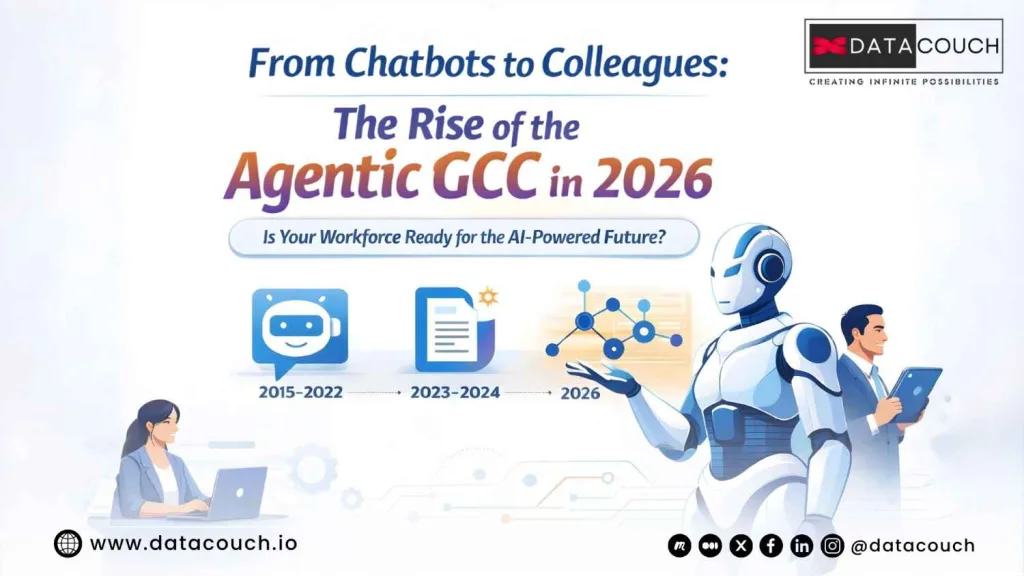
From Chatbots to Colleagues: Why 2026 Is the Year of the Agentic GCC
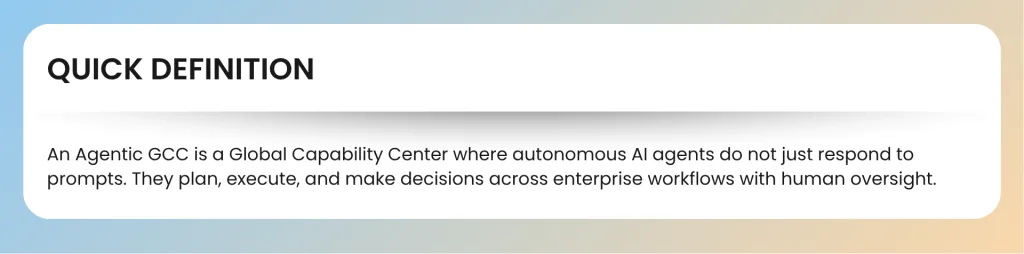
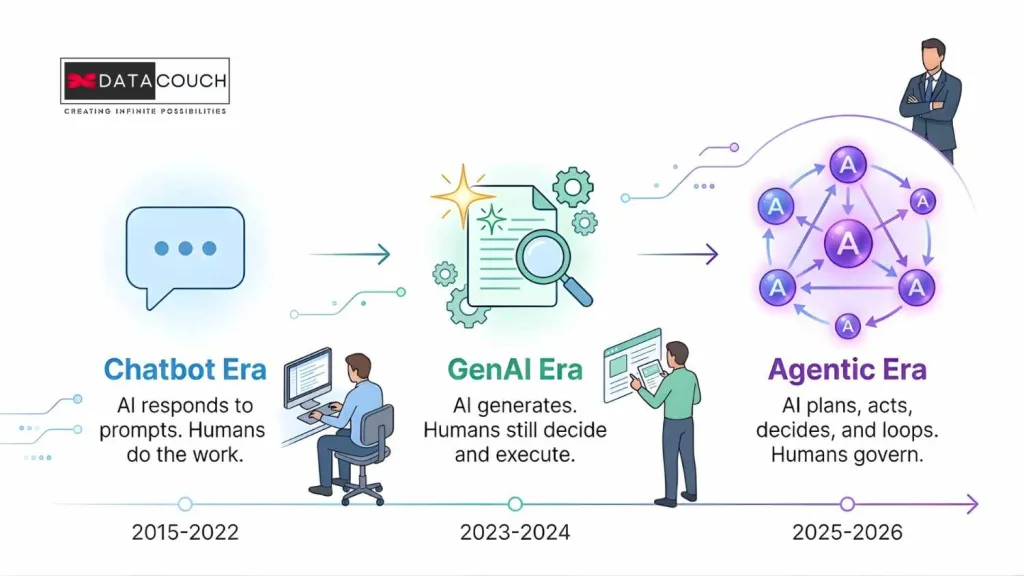
Think back to 2024. Your GCC’s AI tools answered questions, summarized documents, and helped teams write faster. Useful? Yes. But they were still just tools that waited to be told what to do.
2026 is a very different story.
Today, AI agents inside Global Capability Centers do not wait. They monitor pipelines, flag exceptions, trigger approvals, loop back on errors, and close workflows without a human touching every step. That shift, from a chatbot that responds to an agent that acts, is not a software update. It is a whole new way of running a GCC.
And here is the part that most articles skip: the technology is ready. The question is whether your team is.
In this post, we break down what the agentic era actually means for GCC students, working professionals, and enterprise leaders. We will cover what most websites do not tell you: the governance gaps, the identity crisis in GCC workforces, the rise of the Nano-GCC, and what it really takes to be ready.
What Changed and Why 2026 Is the Inflection Point
Let us be honest: GenAI has been the buzzword for two years now. Most GCCs have experimented with chatbots, copilots, and code assistants. So why does 2026 feel different?
Because three things converged at the same time.
- Compute costs dropped. Running autonomous multi-step AI agents at enterprise scale is no longer prohibitively expensive.
- Foundation models matured. The reasoning capability needed for reliable multi-step decision-making is now production-grade, not just research-grade.
- GCC infrastructure caught up. Most major centers now have the data pipelines, cloud platforms, and API layers that agentic systems require to operate.
Here is the surprising truth about what this looks like in numbers:
- 58% of GCCs in India are currently investing in Agentic AI, not just GenAI chatbots. Another 29% plan to within 12 months. (Source: EY GCC Pulse Survey 2025)
- 24% of enterprise tasks are fully automatable today, with another 42% able to be significantly augmented by AI agents. (Source: EY GCC Pulse Survey 2025)
That is not a future forecast. That is what is happening on the ground right now. The question for every GCC leader reading this is simple: where does your center sit on this curve?
Is your GCC team trained for agentic AI or still stuck in the chatbot era?
From Execution Arms to Agent Factories: The GCC Identity Shift
Most GCC blogs describe a two-stage evolution: from back-office support to center of excellence. But there is a third stage now, and it changes everything.
| Then: The Old GCC Model | Now: The Agent Factory Model |
|---|---|
| Large teams handling high-volume, repetitive work | Lean teams orchestrating networks of autonomous agents |
| Cost arbitrage through offshore headcount | Value creation through AI-powered decision automation |
| Training focused on tools and certifications | Training focused on AI governance, oversight, and orchestration |
| Success measured by headcount and SLA compliance | Success measured by innovation output and agent accuracy |
| 18 to 24 months to stand up a new GCC function | Agents can go from concept to production in weeks |
The Rise of the Nano-GCC (Nobody Is Talking About This)
Here is something almost no one in the GCC space is writing about yet: big headcount is becoming a liability, not a strength.
For years, a GCC with 10,000 employees signaled scale and power. But agentic AI is inverting this logic fast. A small, elite team of AI orchestrators can now match or exceed the output of entire operational departments. These are what researchers are starting to call Nano-GCCs: lean, high-output hubs built around R&D, AI innovation, and agent orchestration rather than mass execution.
Think of it this way. An AI agent handles a customer service interaction for as little as 25 to 50 cents per conversation. A human employee, even one based offshore, costs thousands of dollars annually in salary, training, and overhead. Early adopters are already seeing the economics shift in real time, with 88% of businesses using AI agents reporting positive ROI in 2025.
The GCC model is not dying. It is evolving into something more powerful and more focused. The centers that understand this early will attract the best talent and the most strategic mandates from their parent enterprises.
The Silicon Workforce Problem Nobody Is Solving
What most people do not realize is that agentic AI creates a governance crisis that most GCC leaders are not prepared for.
When a multi-agent system has access to 15 enterprise systems and can trigger actions across all of them in a single automated workflow, the stakes of a mistake are not a typo in a document. They are cascading errors across procurement, finance, and customer data simultaneously.
This is what Deloitte’s 2026 Tech Trends report calls the silicon workforce problem: agents are increasingly acting like digital workers, but most organizations have no management structure built for them.
Three Governance Questions Every GCC Needs to Answer Before Deploying Agents
- Decision autonomy thresholds: Which agents can act without human approval? Which workflows require a human checkpoint before execution?
- Audit and explainability trails: Every agent action must be logged, traceable, and reviewable. Not just for compliance but for trust.
- Escalation pathways: When an agent hits an edge case, where does it go? Who is responsible? This must be designed before deployment, not after something breaks.
And here is where the human side of the story gets interesting.
New Roles That Are Already Emerging Inside GCCs
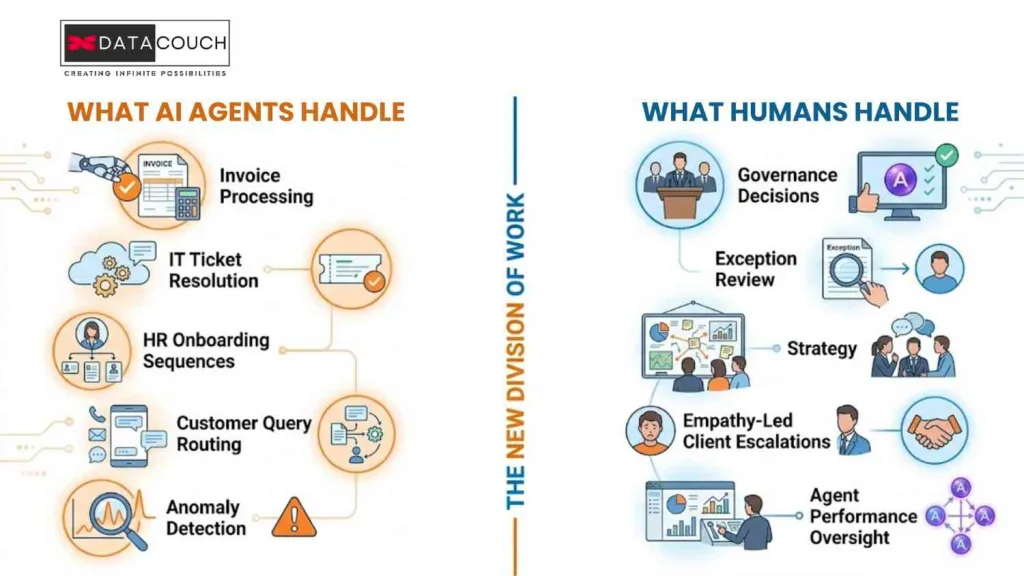
According to IDC’s FutureScape Future of Work 2026, by 2026, 40% of G2000 job roles will involve direct interaction with AI agents. That means GCCs need people in new roles that barely existed 18 months ago:
| Emerging Role | What They Actually Do |
|---|---|
| AI Orchestrator | Designs and manages multi-agent workflows, decides sequencing and handoffs between agents |
| Agent Coach | Tunes agent behavior, monitors output quality, handles edge cases, reduces hallucination risk |
| AI Quality Assurance Lead | Validates agent decisions against business rules and flags where human review is needed |
| Automation Architect | Builds the technical pipeline connecting agents to enterprise systems and data sources |
| AI Ethics and Governance Lead | Ensures responsible AI use, maintains explainability standards, owns the audit log |
None of these roles require you to be an AI researcher. They require people who understand both the business context and the AI system well enough to sit at the intersection. That is an enormous opportunity for working professionals who are willing to reskill now.
Want to become an AI Orchestrator or Agent Coach? Start with the right certification.
Your Workforce Is Not Ready and Here Is the Data to Prove It
Here is the uncomfortable truth that most GCC articles gloss over. Technology adoption in GCCs is outpacing workforce readiness by a wide margin.
- 90%+ of global enterprises will face critical AI-related skills shortages by 2026. Only one-third say they are fully ready for AI-driven ways of working. (Source: IDC Future of Work 2026)
- 71% of GCCs have active reskilling programs in 2025, but the content of most programs has not caught up with what agentic AI actually demands. (Source: EY GCC Pulse Survey 2025)
There is a big difference between reskilling for GenAI tools and reskilling for agentic AI oversight. Using a chatbot to draft an email is one skill. Governing an agent that autonomously manages your entire procure-to-pay cycle is a completely different responsibility.
The Chatbot-to-Colleague Psychological Shift That Training Must Address
Here is something you will not read in most GCC trend pieces: the shift from chatbots to agents changes how people feel about their work.
Chatbots were tools you picked up and put down. Agents feel like colleagues. They are always running, always watching the queue, always acting on behalf of the team. That changes team dynamics, accountability, and even workplace identity.
Research from ADP across 30,000+ respondents found that employees who use AI daily report the highest levels of engagement and motivation. But the same research flagged a risk: early adopters without proper structural support reported a loss of connection to coworkers and a diminished sense of their own productivity. That is not a technology problem. It is a change management and training problem.
GCC leaders who think agentic AI is purely a deployment challenge are going to be surprised by what happens to their team culture six months after go-live.
Three New Competencies Every GCC Professional Needs in 2026
1. AI Literacy Knowing when to trust agent output, when to question it, and how to direct it effectively. PwC frames this as the new baseline, like mastering Excel for a previous generation.
2. Data Literacy Agents run on data. If GCC professionals cannot read, validate, and challenge data inputs and outputs, they cannot govern agents effectively. This applies across engineering, finance, HR, and operations roles.
3. Empathetic Influence As AI handles the logic, humans must handle the emotion. This skill determines who gets promoted from agent operator to agent strategist inside a GCC.
What Separates an Agentic-Ready GCC from One Still Running on Chatbot Thinking
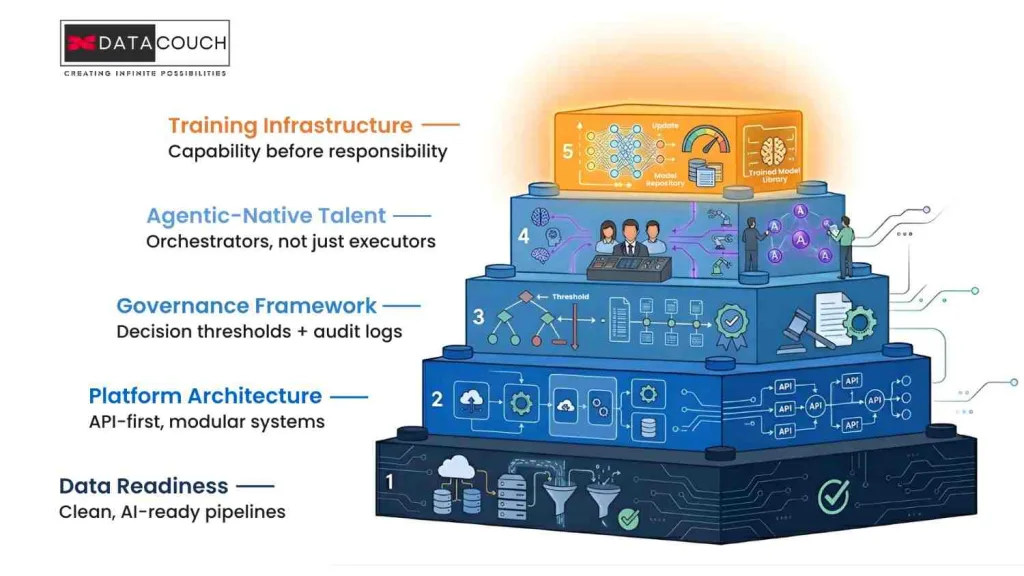
Not every GCC that deploys agents becomes an Agent Factory. Most get stuck at the pilot stage. According to Deloitte’s 2026 research, pilots built through structured partnerships are twice as likely to reach full production deployment compared to those built internally without a framework.
The difference usually comes down to five things:
| # | Pillar | What It Looks Like in Practice |
|---|---|---|
| 1 | Agentic-native talent | Roles shifted toward oversight, judgment, and orchestration, not just execution |
| 2 | Platform and architecture readiness | API-first, modular systems that agents can connect to without custom integration for every workflow |
| 3 | Governance and accountability | Documented decision autonomy thresholds, audit logs, and escalation paths built before deployment |
| 4 | Data readiness | Clean, structured, AI-ready data pipelines. Without this, agent accuracy degrades fast. |
| 5 | Training infrastructure | Structured, role-mapped capability development embedded before production handoff, not retrofitted after |
What most GCC articles do not connect is the link between pillars 4 and 5. Clean data and trained people are the two things that determine whether an AI agent performs at production quality or fails in front of a real customer or a real business process. You can have the best agent architecture in the world and still watch it fail because the data was messy or the team did not know how to intervene at the right moment.
And IDC’s 2026 research backs this up clearly: organizations with mature Agentic Centers of Excellence are 20% more capable of competing on innovation, speed, and service quality compared to those without structured governance and enablement frameworks.
The 2026 Playbook: How to Move Your GCC from Chatbot-Era to Agent-Era
If you are a GCC leader, an enterprise CTO, or a professional building toward these new roles, here is a practical starting point.
Step 1: Audit Your Current AI Deployment
Separate chatbot-era tools (single-step, reactive, human-triggered) from agent-era systems (multi-step, proactive, autonomous). They require completely different governance structures and training investments.
Step 2: Define Decision Autonomy Thresholds Before You Deploy
Document which workflows agents can run without approval and where human checkpoints are mandatory. Do this in writing, with sign-off from legal, compliance, and business leads. This is not bureaucracy. It is the difference between a well-governed agent and a liability.
Step 3: Map Your Workforce Against the Three New Competencies
Run a skills gap assessment across your GCC roles. Which teams have AI literacy? Which have data literacy? Who has the empathetic influence to handle escalations when agents surface issues with real customers? Build your reskilling roadmap from this map, not from generic training catalogs.
Step 4: Train Before You Deploy, Not After
The most common mistake GCCs make with agentic AI is throwing teams into production before they understand how agents fail. Agents do not fail the way software crashes. They fail silently, confidently, and at scale. Teams that are trained to recognize edge cases and intervene at the right moment avoid the kind of cascading errors that make headlines.
Step 5: Build or Commission an Agentic Center of Excellence
Your GCC’s CoE is not a committee. It is the connective tissue that keeps agent innovation from becoming agent chaos. It owns governance standards, tracks agent performance metrics, manages the reskilling roadmap, and bridges the gap between the technology team and the business functions being automated.
The Bottom Line
KEY TAKEAWAYS
- Agentic AI is not an upgrade to chatbots. It is a different operating model. GenAI tools respond. Agentic systems plan, act, and decide.
- 58% of GCCs are already investing in Agentic AI. The early movers are pulling ahead, and the gap is widening.
- The governance crisis is real. Most GCCs have no framework for managing agents as digital workers.
- New roles like AI Orchestrator, Agent Coach, and Automation Architect are not theoretical. They are hiring realities in 2026.
- Training before deployment is not optional. It is what separates a successful Agent Factory from an expensive failed pilot.
- The Nano-GCC is rising. Lean teams with the right skills can now outperform large delivery centers. That changes everything about workforce strategy.
A chatbot answers your question. A colleague anticipates what you need, acts on it, and tells you when something went wrong. The GCCs that win in 2026 will not be the ones with the largest teams or the flashiest AI stack. They will be the ones whose people know how to work alongside agents that never sleep, never forget, and never stop executing.
The technology is already there. The question is whether your GCC team is.
Is your GCC still training people for a chatbot world, or are you building the workforce that can govern and grow an Agent Factory? What is the one capability gap you need to close first?
DataCouch helps GCCs build deployment-ready, agentic-AI-fluent workforces from day one.