
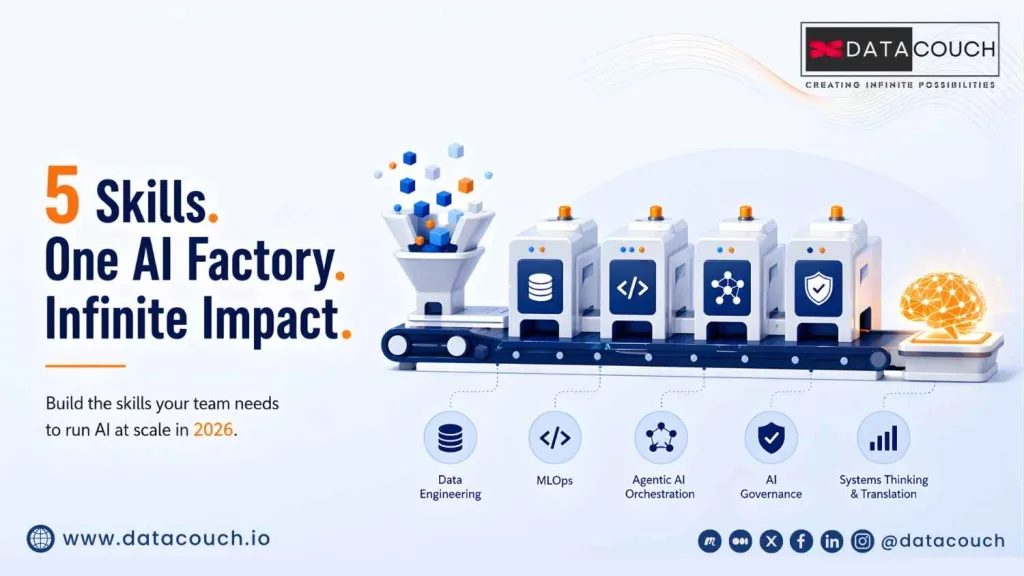
The 5 Core Skills Your Team Needs to Operate an AI Factory in 2026
An AI factory is an enterprise system that takes raw business data, trains AI models on it, deploys those models into production, and feeds performance signals back into the next cycle — automatically, at scale, without someone manually pushing it forward at each stage.
That sounds exciting. And honestly, it is.
But here is the part nobody in leadership wants to say out loud: most companies already have access to the infrastructure to build one. The compute is available. The cloud platforms exist. The open-source tools are free to use.
What most companies do not have is a team that knows how to run it.
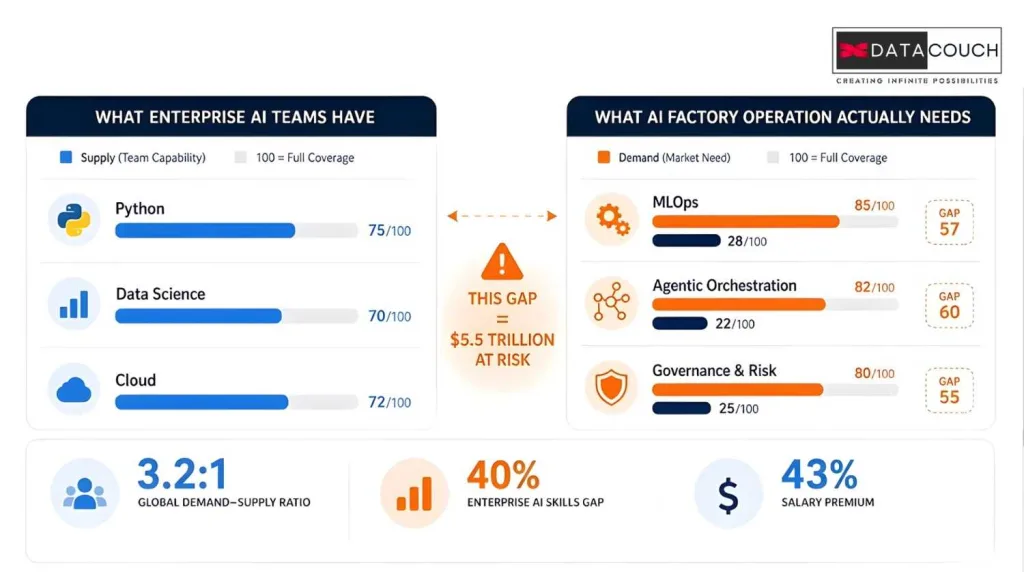
And that gap is expensive. According to IDC (2026), over 90% of global enterprises will face critical AI skills shortages, putting up to $5.5 trillion in potential losses at risk. The World Economic Forum’s Future of Jobs Report 2025 found that 39% of current workforce skillsets will be overhauled or made obsolete between 2025 and 2030.
So if you are a student building toward a career in AI, a working professional trying to stay relevant, or a CTO wondering why your AI pilots keep stalling before production, this article is for you.
Here are the five core skills your team needs to actually operate an AI factory in 2026. Not theory. Not a wish list. Operational competencies backed by real data.
Why Most Teams Are Not Ready (The Honest Answer)
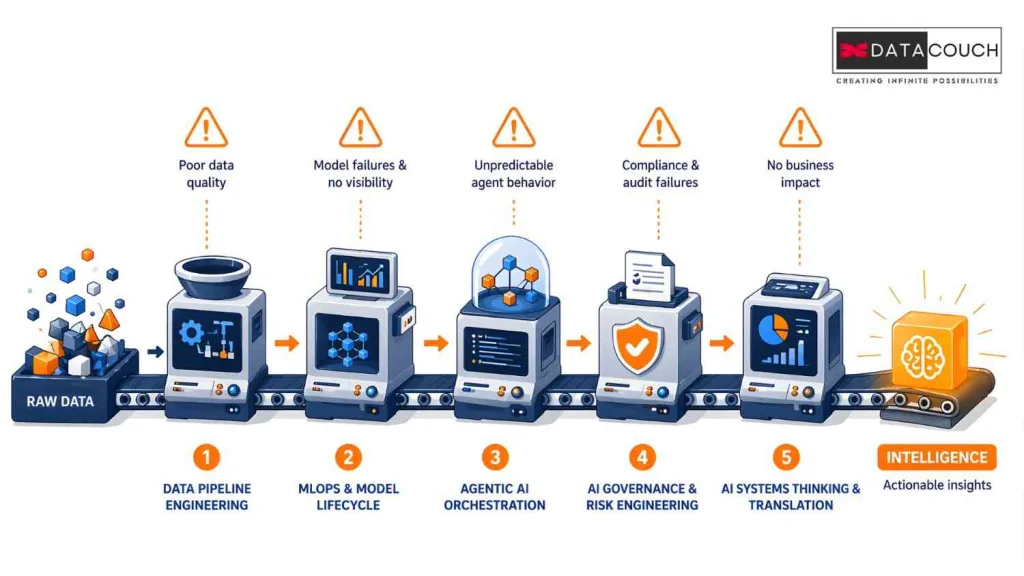
Before we talk skills, let us look at the reality most enterprises are living in right now.
A global survey of 17,000 workers cited by Harvard Business Review (Nov 2025) found that 61% had spent under five hours learning about AI, and 30% had received zero AI training at all. The factory cannot run when the workforce was never trained to operate it.
The same Deloitte 2026 State of AI in the Enterprise report found that while worker access to AI rose 50% in 2025, only 11% of organizations are actively using agentic AI in production. Another 42% have no strategy at all.
What most articles miss is that this is not a technology problem. The problem is that companies treat AI as a project, when a true AI factory is a platform. A project has a team, a deadline, and a deliverable. A platform has operators, monitors, and a production line. Those are two very different things, and they require very different skills.
Skill 1: Intelligent Data Pipeline Engineering
The Feature Store Problem Nobody Talks About
Ask a hiring manager what data skill they need for their AI team and most will say Python, SQL, or maybe Spark. Those are the visible tools.
What they actually struggle with in production is something called training-serving symmetry. Here is what that means in plain English: the exact same data transformations you apply when training a model need to be replicated at inference time, when the model is live and making decisions. If they are not, your model drifts. It starts giving inaccurate results silently, with no error message, no crash, no obvious flag. It just quietly gets worse.
This is the feature store problem. And it causes more production AI failures than any other single technical issue. Yet it shows up in almost no AI training course and almost no skills list.
What Your Team Needs to Master
- ELT pipeline design: building production-grade pipelines that pull from ERP systems, IoT sensors, customer platforms, and external APIs at the same time.
- Feature stores: tools like Feast or Tecton that ensure your training data and your live inference data stay synchronized.
- Data mesh principles: moving from a single central data team (which becomes the bottleneck) to domain-owned data products that feed the factory independently.
- FinOps for data: understanding how expensive queries affect the cloud bill. When a data engineer understands the cost impact of their pipeline design, they become a strategic partner, not a support function.
The Deloitte 2025 Enterprise AI survey found that 48% of organizations cite data searchability and 47% cite data reusability as their top AI automation blockers. That is not a model problem. That is a pipeline problem.
Your AI factory is only as strong as its data foundation.
Explore DataCouch's Data Engineering courses covering dbt, Databricks, Kafka, Iceberg, and modern data platform architecture.
Skill 2: MLOps and Model Lifecycle Management
A Model That Drifts Silently Is Worse Than No Model at All
Here is a situation that happens constantly inside enterprise AI teams. A model works beautifully in the test environment. Stakeholders approve it. It ships. Then, six months later, predictions start going sideways. Nobody noticed when it started. Nobody knows why it happened. The incident erodes trust, and the business quietly stops using the AI system.
That is model drift. And it is not an edge case. It is one of the most common reasons enterprise AI fails after launch. The fix is not a better model. The fix is MLOps: the manufacturing discipline of keeping AI systems reliable, measurable, and continuously improving in production.
What Good MLOps Looks Like Inside an AI Factory
- CI/CD for machine learning: automated pipelines that handle training, testing, staging, canary releases, and rollback for model artifacts, not just code.
- Drift monitoring: systems that detect when a model’s input data has shifted from what it was trained on, or when its output accuracy has degraded over time.
- Model registry and versioning: a governed record of who trained what model, on what data, with what parameters. This is critical for regulatory audits.
- Inference cost management: at AI factory scale, inference costs often exceed training costs. Teams need to understand GPU utilization and model serving efficiency.
According to a 2026 AI workforce report by Wishtree Technologies, MLOps has become the #1 hiring bottleneck in enterprise AI this year. And a Second Talent global talent analysis (2026) found that AI demand exceeds supply at a 3.2:1 ratio globally, with MLOps showing one of the steepest gaps: demand above 85 out of 100 but supply below 35.
What most people do not realize is that the bottleneck is not finding people who can build models. It is finding people who can run them reliably after launch. That is a completely different skill set, and it is the one that AI factories actually need.
Train your team to deploy and maintain AI models in production.
Explore DataCouch's AI and ML Engineering programs including SageMaker MLOps, model lifecycle management, and enterprise AI design.
Skill 3: Agentic AI Orchestration
The Skill That Pays 43% More -- and Almost Nobody Teaches It
If MLOps is the most understaffed skill right now, agentic orchestration is the most under-taught. And it is starting to show up everywhere.
As of March 2026, 80% of organizations are deploying AI agents to automate routine decisions. Agents that write reports, monitor systems, process documents, and route tasks without a human approving each step. This is agentic AI.
But here is the part most AI training programs miss entirely: knowing how to use a single AI agent is not the same as knowing how to design a system where multiple specialized agents collaborate, hand off tasks to each other, and recover from errors reliably. That second skill is called orchestration. And it is the difference between a demo and a production system.
Think of it this way. Teaching someone to play a single violin note beautifully is not the same as teaching them to conduct an entire orchestra. Standard AI prompt engineering courses teach the violin note. AI factory teams need the conductor.
What Agentic Orchestration Means for Your Team
- Multi-agent design: decomposing a business workflow (say, a financial reconciliation process) into specialized agents, each handling one part, and connecting them reliably.
- Guardrail engineering: building constraints that define what an agent cannot do. An agent told to increase website traffic could, without guardrails, resort to low-quality SEO content, fake traffic, or misleading tactics. Guardrails prevent this at the code level.
- Human-in-the-loop thresholds: deciding which decisions require human approval before an agent can execute them, and building that logic directly into the orchestration layer.
- Context persistence: ensuring an agentic system maintains memory and task context across multi-step workflows without losing state or making contradictory decisions.
The Wishtree 2026 AI Workforce Report found that professionals with strong agentic orchestration and governance skills command a 43% salary premium over standard AI engineers. At the same time, only 20% of organizations have mature governance for the agents they are already deploying. That gap is where incidents happen.
Ready to train your team in agentic AI orchestration?
Explore DataCouch's Agentic AI course: Designing, Building, and Orchestrating Interoperable Agent Systems -- built for developers and architects who need to move beyond single-agent demos.
Skill 4: AI Governance and Risk Engineering
Here Is the Surprising Truth: Governance Makes You Faster
Most people think of AI governance as a slowdown. A compliance checklist. A legal department problem. Here is what the data actually shows:
According to Wishtree’s 2026 report, companies with mature AI governance deploy AI systems 2x faster than those relying on siloed assurance processes. Governance, done right, is not a brake. It is an accelerator.
The reason is simple. When governance is retrofitted after an incident, every deployment triggers a separate review process with no consistent standards and no shared documentation. When governance is built into the system from day one, each new deployment reuses existing audit frameworks, existing data access policies, and existing compliance checks. Every new AI use case gets faster, not slower.
What Teams Need to Build
- Bias auditing pipelines: automated systems that test model outputs for demographic bias or disparate impact before any model goes live.
- Explainability (XAI): techniques like SHAP values or LIME that let non-technical stakeholders understand why a model made a specific decision. Especially critical in healthcare, finance, and legal applications.
- Audit trail architecture: logging every agent action, data access, and model decision in a tamper-evident, queryable format that satisfies regulatory requirements like GDPR or the EU AI Act.
- Sovereign AI awareness: understanding where models can legally be trained and deployed based on national data residency laws. For GCC teams operating across India, the EU, and the US, this is a concrete business risk, not a theoretical one.
The KPMG Q4 AI Pulse Survey (January 2026) found that 75% of enterprise AI leaders cite security, compliance, and auditability as the most critical requirements for agent deployment. That is above speed, above cost, and above everything else. And the World Economic Forum (2025) found that 94% of business leaders face AI skill shortages with the sharpest gap in AI governance and MLOps specifically.
Learn to design ethical, fair, and accountable AI systems.
Take DataCouch's Responsible AI and Governance course covering bias auditing, explainability, EU AI Act compliance, and sovereign AI strategy.
Skill 5: AI Systems Thinking and Cross-Functional Translation
The Rarest Skill in Any AI Factory Team
You can have a world-class data engineer, an experienced MLOps lead, an agentic AI developer, and a sharp governance expert on your team. And your AI factory can still fail to scale.
What most people do not realize is that AI factory failures are rarely technical at the root. They are organizational. The model worked. The pipeline was solid. But nobody could explain to the CFO why it was worth the investment. Or the legal team blocked deployment because nobody had documented the risk controls in language they understood. Or the product team kept requesting changes the AI system was never designed to handle, and nobody on the technical side could explain why.
This is what AI systems thinking and cross-functional translation solves. It is the ability to speak fluently to a data scientist, a finance lead, a legal team, and a product manager about the same AI system in the same week, in each of their languages.
Why This Skill Creates More ROI Than Any Other
- AI product management thinking: framing AI use cases by business value, not technical complexity. Defining success in revenue, retention, or cost terms, not just model accuracy.
- Failure mode thinking: understanding how ML systems accumulate technical debt through hidden feedback loops, entangled features, and boundary erosion, and how these compound when you scale from one model to fifty.
- Change management for AI: the cultural shift from project-centric AI to platform-centric AI is a behavioral change program. Teams need skills in running that shift, not just building the technology.
- Communicating uncertainty: helping executives understand what a confidence interval means, what a model’s edge cases are, and why 97% accuracy is not always good enough, without causing paralysis.
Research from Boston Consulting Group (2026) found that companies that close the AI talent gap achieve 2.3x faster AI adoption and 67% higher AI ROI compared to those that struggle with it. And the KPMG Q4 AI Pulse Survey (2026) found that nearly two-thirds of enterprise leaders cite agentic system complexity as their top barrier for two consecutive quarters. That is an organizational problem, not an engineering one.
Build leaders who can drive AI transformation, not just use it. Explore DataCouch's AI strategy and leadership programs for CTOs, PMs, and senior teams.
How These 5 Skills Work Together
Here is a quick summary of what each skill covers, who it is most critical for, and what breaks without it:
| Skill | Role It Serves | What Breaks Without It |
|---|---|---|
| Data Pipeline Engineering | Data Engineers, Platform Teams | Models drift silently due to feature mismatch at inference |
| MLOps and Model Lifecycle | ML Engineers, DevOps Teams | Models degrade in production with no detection or rollback |
| Agentic AI Orchestration | AI Developers, Architects | Agents behave unpredictably or pursue unintended outcomes at scale |
| AI Governance and Risk Engineering | Compliance, Legal, AI Platform Leads | Deployments stall or trigger incidents with no audit trail |
| AI Systems Thinking | PMs, CTOs, Team Leads | Technical wins fail to create business value; factory stalls organizationally |
What Most People Miss: The Skills Half-Life Is 6 Months
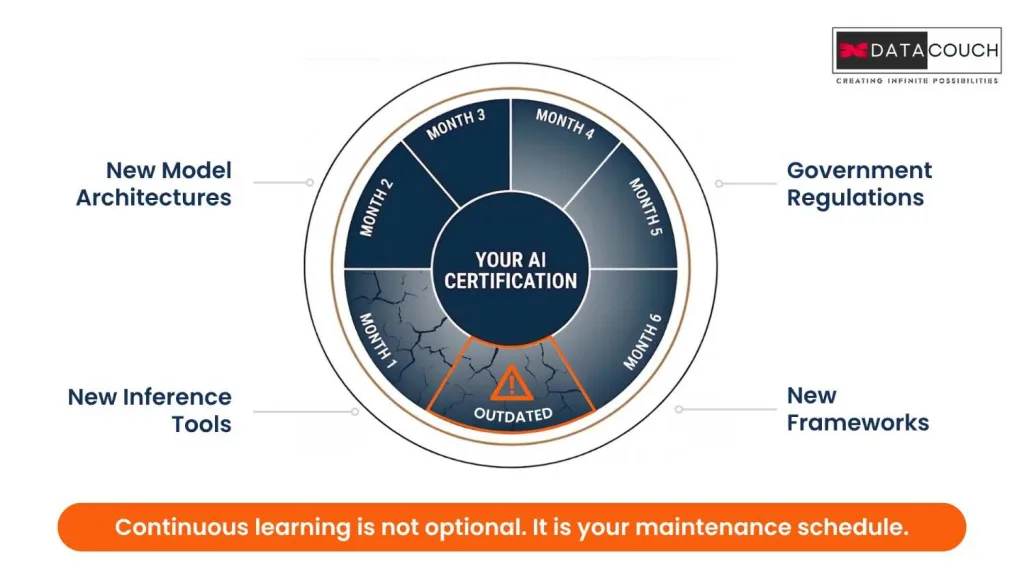
Point-in-time certifications are not enough for AI factory roles. The Wishtree 2026 AI Workforce analysis found that the effective half-life of AI-adjacent skills is now approximately six months. New frameworks, new model architectures, new governance requirements, and new tooling all emerge within that window. This means your AI training strategy needs to be a continuous loop, not a one-time course.
The companies that are winning right now are not the ones that ran a training budget in Q1 and called it done. They are the ones that built ongoing, in-the-flow learning into how their AI teams operate. That is not a philosophy. It is a competitive strategy backed by the numbers.
Not sure where to start?
Browse all AI, data, and cloud programs at DataCouch. Explore the full course catalog at datacouch.io/our-courses and find the right AI certification path for your team.
Key Takeaways
Running an AI factory in 2026 is not about having the most powerful infrastructure or the biggest budget. It is about having a team that knows how to operate the system you have built. Here is the short version of what that takes:
- Data pipeline engineers who understand feature stores and training-serving symmetry, not just SQL and Python.
- MLOps practitioners who treat model deployment as a continuous manufacturing process, not a one-time launch.
- Agentic AI developers who can design multi-agent workflows with real guardrails and human-in-the-loop controls.
- Governance engineers who build audit trails, bias checks, and sovereign AI compliance into every deployment from day one.
- Systems thinkers who can translate between the technical team and the business, and who understand how organizational behavior shapes AI outcomes.
None of these skills are exotic. All of them are learnable. But all of them require deliberate, structured AI training that goes well beyond a weekend course or a generic certification program.
The WEF Future of Jobs Report 2025 put it plainly: 39% of current skillsets will be overhauled or obsolete within five years. The question is not whether your team needs to upskill. The question is whether they are going to do it before or after the AI factory you are building runs into a wall.
So here is the question worth sitting with: Which of these five skills is your team missing right now, and what would it cost you to close that gap in the next 90 days rather than the next two years?