

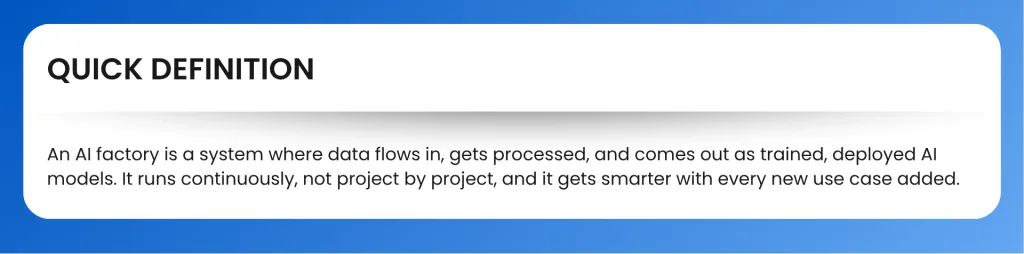
How GCCs Are Building Internal AI Factories: A Playbook for India
Here’s a number that should stop every GCC leader cold.
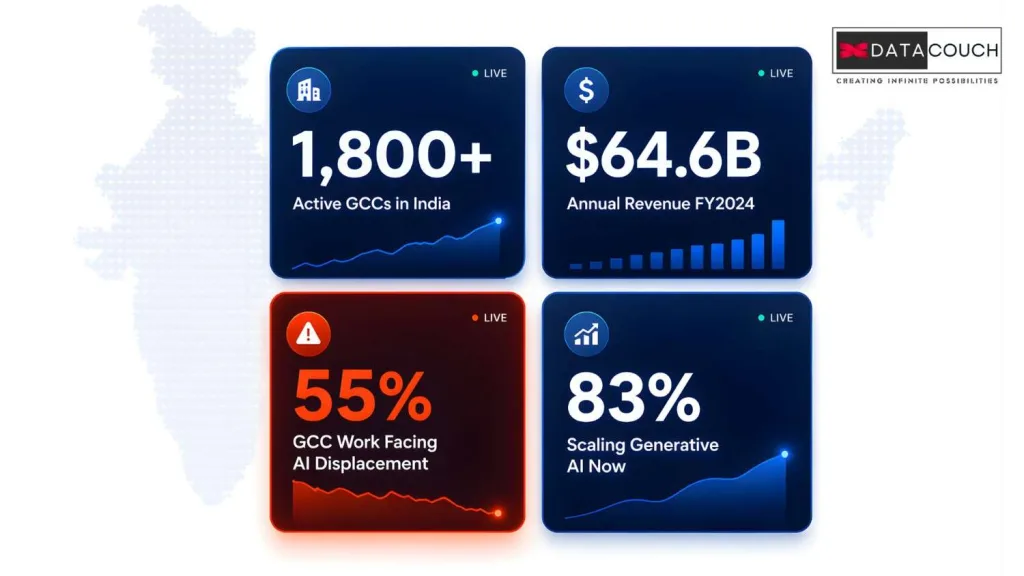
According to the Zinnov-Indiaspora GCC AI Opportunity Report 2026, 55% of India’s GCC work portfolio faces AI displacement. That means more than half the work done inside Global Capability Centers today is at risk of being automated away.
And here’s the twist. The centers that build internal AI capabilities will be the ones doing the automating. The ones that don’t will be automated out.
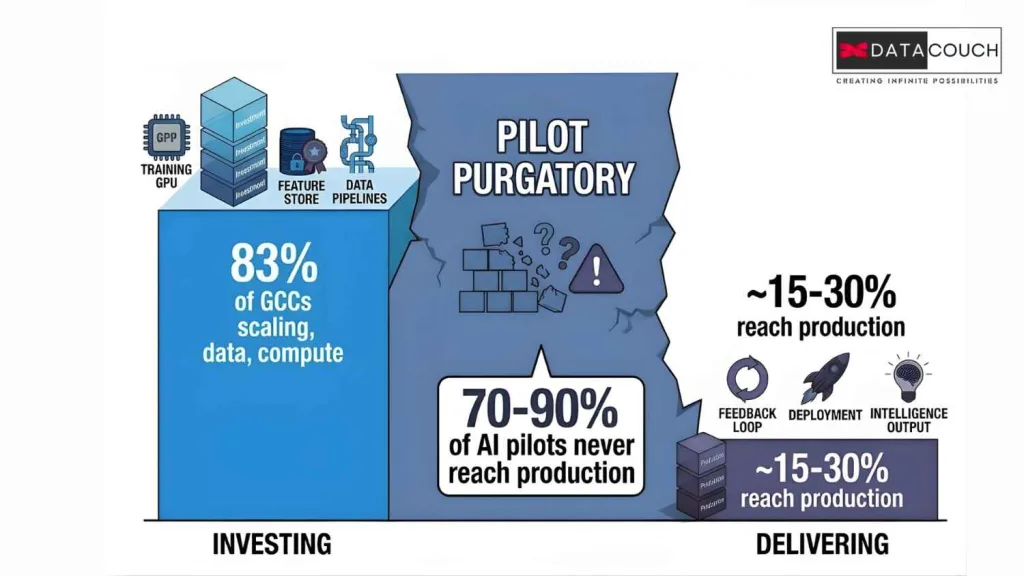
India already hosts over 1,800 GCCs employing nearly 2 million professionals and generating $64.6 billion in annual revenue. The EY GCC Pulse Report 2025 shows 83% are scaling Generative AI and 58% are investing in Agentic AI right now. Yet most of these centers are stuck in pilot mode.
This article breaks down how the top-performing GCCs are moving past experimentation and into real, scalable AI production. It covers the architecture, the operating model, the talent strategy, and the regulatory environment that most GCC strategy pieces completely ignore.
What Is an AI Factory and Why Should GCCs Care?
The term comes from NVIDIA CEO Jensen Huang, who described an AI factory as infrastructure that does not just store or move data but manufactures intelligence, continuously, reliably, and at scale.
For a GCC, that means one governed infrastructure layer where every AI use case runs. Not separate teams building separate models in separate silos. One platform that compounds returns with every new project added.
Why One Platform Changes the Math Completely
Here’s the surprising truth about AI at scale. When you build AI projects one by one, each new project costs roughly the same as the last. When you build an AI factory, each new project costs less than the previous one because the data pipelines, governance frameworks, model registries, and deployment infrastructure already exist.
That compounding effect is the real business case for shifting from projects to platforms. A Fortune 500 real estate GCC that made this shift reported a 35% reduction in cost-to-serve and 40% faster release cycles after moving to an embedded AI platform model.
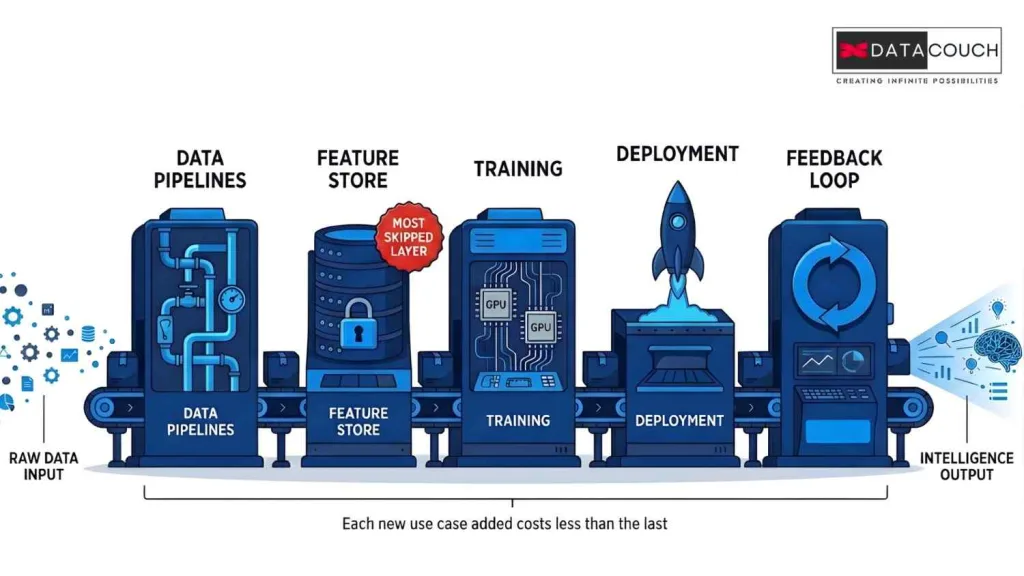
The Five Layers Every Working AI Factory Needs
Most AI content talks about ‘building AI.’ Almost none of it talks about what an AI production system actually contains. Here’s the architecture that separates GCCs with real AI output from those still running proofs of concept.
Layer 1: Intelligent Data Pipelines (Start Here or Fail Here)
Data silos are the first real obstacle every GCC hits. Fragmented data spread across legacy ERPs, cloud warehouses, and SaaS platforms cannot feed an AI factory effectively without a unified data layer underneath.
What most teams miss is that governance needs to be designed in from the start, not added after the pipelines are built. Retrofitting governance onto an existing pipeline is one of the most expensive mistakes a GCC can make. This layer must handle structured, semi-structured, and unstructured sources simultaneously, with both real-time and batch processing accounted for.
Layer 2: The Feature Store (The Layer Nobody Talks About)
This is the most overlooked part of any AI system and the most common reason models fail silently in production.
A feature store ensures the exact same data transformations applied during training are replicated at inference time. When they’re not, the model gets different data than it was trained on. It still runs. It just produces wrong outputs. Quietly. Without error messages. This is called training-inference skew, and it causes more production failures than any engineering team will admit.
If your AI architecture conversations never include the feature store, that is a gap worth fixing immediately.
Layer 3: Model Training and Validation
Distributed compute, hyperparameter tuning, and automated ML sit here. The infrastructure decision that matters most at this layer is the hybrid model: on-premises GPU infrastructure for steady-state workloads at scale, and cloud for experimentation and variable demand.
On-prem wins on cost at scale. Cloud wins on flexibility for new use cases. A hybrid model handles both without forcing an all-or-nothing commitment to either. DataCouch’s AI Factory analysis confirms that infrastructure cost clarity requires separating steady-state workloads from burst and POC workloads in the financial model from day one.
Ready to Build Your AI Infrastructure?
Explore enterprise AI consulting services that help GCCs design, deploy, and govern AI infrastructure the right way.
Layer 4: Deployment and Serving
This layer converts trained models into live production APIs. Container orchestration, load balancing, A/B testing frameworks, and inference optimization through quantization and model distillation all live here.
Real-time inference latency within acceptable bounds is an architectural requirement, not a tuning option. For regulated industries like financial services and healthcare, data staying inside the enterprise perimeter and predictable latency are non-negotiable requirements.
Layer 5: Feedback and Automated Retraining
This layer is what makes an AI factory different from a deployed model. It monitors for model drift and data drift, tracks performance against business SLAs, and triggers automated retraining pipelines when performance degrades.
Without this layer, every deployed model is a countdown timer. It was accurate when you launched it. Every week, it gets a little less accurate. With this layer, the system catches the drift and corrects it without human intervention.
Why Most GCC AI Pilots Never Reach Production
Here’s a number worth sitting with. Between 70% and 90% of AI pilots across enterprises fail to reach production. The BCG-NASSCOM report from June 2025 confirms that while top-performing GCCs have moved beyond pilots, most are still trapped in early-stage experimentation.
The Real Reason AI Pilots Die (It Is Not Technical)
At a YourStory GCC roundtable in March 2026, leaders from logistics, manufacturing, financial services, and analytics gathered to discuss exactly this problem. The conclusion was clear: when accountability sits with the engineering team but the use case is owned by a business leader, pilots collapse the moment they hit real-world complexity.
Variable invoice formats. Noisy customer data. Fluctuating transaction volumes. These are normal production conditions. A pilot built in a clean test environment does not survive them. Without a business leader who owns the outcome, not just the budget, there is nobody to push for the workflow changes needed to make the model work.
What most people don’t realize is that AI failures are organizational problems, not engineering problems.
The Infrastructure Bottleneck Everyone Politely Ignores
Rack densities in enterprise AI environments are climbing toward 500-kilowatt levels. Specialized cooling systems can take months to deploy. Edge inference workloads require facility upgrades that most GCCs have not budgeted for.
Only 42% of GCCs are using advanced cybersecurity frameworks and only 7% have fully embedded CoEs to manage infrastructure risk. Most enterprise governance frameworks were built for traditional systems. Integrating AI requires re-engineering workflows, not simply extending them.
Centralized or Federated: The CoE Design Decision That Separates Fast GCCs from Slow Ones
Building an AI Center of Excellence is not the same as hiring a team of data scientists. It is a structural decision about how your entire organization will consume AI.
Two Models, Very Different Outcomes
| Factor | Centralized CoE | Federated CoE |
|---|---|---|
| Structure | All AI talent in one team | Central team governs; AI engineers embedded in business units |
| Speed | Slower; business units queue for resources | 35% faster AI product launches (NeoIntelli 2025) |
| Governance | Easier to standardize | Standards enforced by platform, not process |
| Bottleneck Risk | High at scale | Low; business units self-serve on a governed platform |
| Best For | Small GCCs (50-200 people) | Large GCCs (500+ people) |
A NeoIntelli analysis from March 2025 found that GCCs using federated CoE models launch AI products 35% faster than those using centralized models. The reason is autonomy: business units embed AI engineers directly into their teams while the central CoE handles governance, platform standards, and shared infrastructure.
The size guidance most articles skip: leading GCCs allocate 5 to 10% of total headcount to CoE functions. For a 1,000-person GCC, that means 50 to 100 dedicated AI infrastructure staff.
Build the AI Skills Your CoE Needs
Explore structured AI training and AI certification programs that give your team the hands-on expertise to run a real AI factory.
The Talent Problem Is Not a Hiring Problem
This is the part most GCC strategy articles get completely wrong. The standard advice is to hire AI talent. The problem is that the AI talent market is broken.
58% of GCCs take more than 45 days to fill critical AI roles. India produces 1.5 million engineering graduates annually, but less than 3% are adequately trained for AI-specific tasks like LLMOps, MLOps, and responsible AI.
Stop Hiring and Start Building
The GCCs outperforming their peers in 2026 are not winning the talent war. They are avoiding it. Instead of competing for scarce external AI talent, they are building it internally through structured AI upskilling programs.
NeoIntelli’s October 2025 research found that purpose-built AI talent flywheels inside GCCs can double the bench of production-ready engineers within 18 months. Strong development programs also improve retention by 30 to 40%, which matters because attrition in GCCs has dropped from 13% in 2023 to 9% in 2025, largely driven by upskilling investment.
The shift in thinking is from ‘hire for credentials’ to ‘hire for learning velocity.’ Adaptability and domain expertise combined with structured AI training produce better production engineers than AI credentials alone.
AI upskilling, structured AI training, and AI certification programs are not HR initiatives. They are infrastructure decisions, as important to your AI factory as the MLOps platform itself.
- Reskilling initiatives have grown to 71% of GCCs in 2025, signaling the shift from external hiring to internal capability building.
- High-demand AI roles inside GCCs right now include LLMOps engineers, MLOps specialists, data engineers, responsible AI experts, and AI product managers.
- Leading GCCs invest 15 to 20% of CoE budget in capability development programs, treating it as infrastructure rather than training expense.
- Employee Value Proposition inside high-performing GCCs now centers on innovation culture and career development, not just compensation.
India's Regulatory Environment Is Actually an Advantage
Almost nobody covers this angle in GCC content. The regulatory environment in India for AI is one of the most favorable in the world for enterprises building at speed.
MeitY released India’s AI Governance Guidelines in November 2025 under the IndiaAI Mission. India deliberately chose a ‘light-touch’ model that prioritizes innovation over restriction, unlike the EU’s binding AI Act. For GCCs building AI capabilities, this creates real operational freedom at the development and experimentation stage.
One Compliance Reality You Cannot Ignore
The Digital Personal Data Protection Act Rules were notified in November 2025, with a compliance deadline of May 2027. AI systems that train on personal data of Indian residents are fully in scope. Penalties reach up to Rs 250 crore (approximately $30 million). Building data governance into your AI factory now, not after deployment, is the only practical path to compliance.
The Infrastructure Advantage Most GCCs Are Not Using
India’s AIKosh platform offers over 38,000 GPUs at subsidized rates, 1,500+ datasets, and 217 AI models as of August 2025. GCCs can access sovereign AI infrastructure alongside their own builds, reducing compute costs during the experimentation phase.
State-level incentives add another layer. Karnataka, Telangana, Maharashtra, and Haryana all have dedicated GCC policies with AI lab infrastructure support. Karnataka’s policy targets 500 new GCCs and 350,000 jobs by 2029 with rental reimbursements and 45-day fast-track approvals.
Key Takeaways for GCC Leaders, Tech Teams, and Anyone Building with AI
- 55% of GCC work portfolios face AI displacement. Building internal AI capability is not a growth strategy alone. It is a survival strategy.
- An AI factory is a platform, not a project. The five layers (data pipelines, feature store, training, deployment, feedback) must all be operational for the system to compound returns.
- 70 to 90% of AI pilots fail to reach production. The reason is almost always organizational, not technical. Business ownership of outcomes matters as much as engineering quality.
- Federated CoE models launch AI products 35% faster. The right operating model is a strategic decision, not an HR one.
- Less than 3% of India’s engineers are AI-ready. Structured AI upskilling, AI training programs, and AI certification pathways inside GCCs are the foundation of your talent strategy.
- India’s regulatory environment is an advantage right now. The DPDPA compliance deadline of May 2027 is real, but the innovation-friendly framework is a structural edge over EU-based operations.
The GCCs pulling ahead in 2026 are not the ones with the biggest AI budgets. They are the ones that stopped treating AI as a series of projects and started treating it as a production system.
Companies like Bosch India now file more patents from Bengaluru than from their Germany headquarters because they treated their GCC as a capability engine, not a delivery arm. The same shift is available to any GCC that builds its AI factory with intention.
What’s the one layer of your current AI setup that you think needs the most work right now? Whether it’s data governance, your CoE structure, or your upskilling program, that’s your starting point.
Start Building Your AI Factory Today
Talk to the DataCouch team about designing a structured AI factory roadmap for your GCC, from MLOps infrastructure to enterprise-wide AI training.