
The AI Factory Stack: Data, Compute, Governance, and the People Layer Most Enterprises Overlook
What is the AI factory stack? The five interdependent layers that together determine whether enterprise AI infrastructure produces intelligence reliably, at scale, and at justifiable cost. Investing in one layer without the others is the single most common reason AI factory deployments underperform.
There is a predictable pattern in enterprise AI factory projects that fail. The organisation invests heavily in GPU hardware. The GPUs arrive, are installed, and sit at single-digit utilisation percentages while the AI initiatives they were supposed to power stall. The infrastructure team concludes that the AI was oversold. The business concludes that the investment was wasted.
Neither conclusion is correct. The hardware was not the problem. The problem was that the organisation invested in one layer of a five-layer system and expected it to perform as if all five were in place.
McKinsey’s 2025 State of AI research found that only 6% of organisations qualify as AI high performers, achieving 5% or more EBIT impact from AI. The common characteristic of those who do is not more powerful hardware. It is a complete stack: data that is governed and ready for AI, compute that is optimally scheduled, a platform that connects data to models, governance that makes outputs trustworthy, and people who are trained to operate all of it. This guide explains what each layer of the AI factory stack requires, what happens when it is incomplete, and how to build the full system.
Why the Stack Model Matters More Than Any Single Layer
The term AI factory was popularised by NVIDIA to describe infrastructure that manufactures intelligence from data the way a physical factory manufactures products from raw materials. Jensen Huang’s formulation emphasises that an AI factory is a complete production system, not a collection of components. The analogy is precise: a factory floor with machinery but no supply chain, no quality control, no trained operators, and no distribution system is not a factory. It is a room full of expensive idle equipment.
The same logic applies to enterprise AI infrastructure. A GPU cluster without governed data pipelines, without an orchestration platform, without behavioural monitoring, and without trained operators is expensive idle equipment. Every layer of the AI factory stack exists to solve a specific production problem. Missing any one of them limits the output of all the others.
78% of organisations now use AI in at least one business function, per McKinsey 2025. But only 6% qualify as high performers, achieving measurable EBIT impact. Gartner’s 2025 research found 45% of high-maturity AI organisations keep their AI projects operational for 3 or more years, versus only 20% of low-maturity organisations. The difference is not the hardware. It is the completeness of the stack.
Source: McKinsey State of AI 2025 / Gartner AI Maturity Research 2025
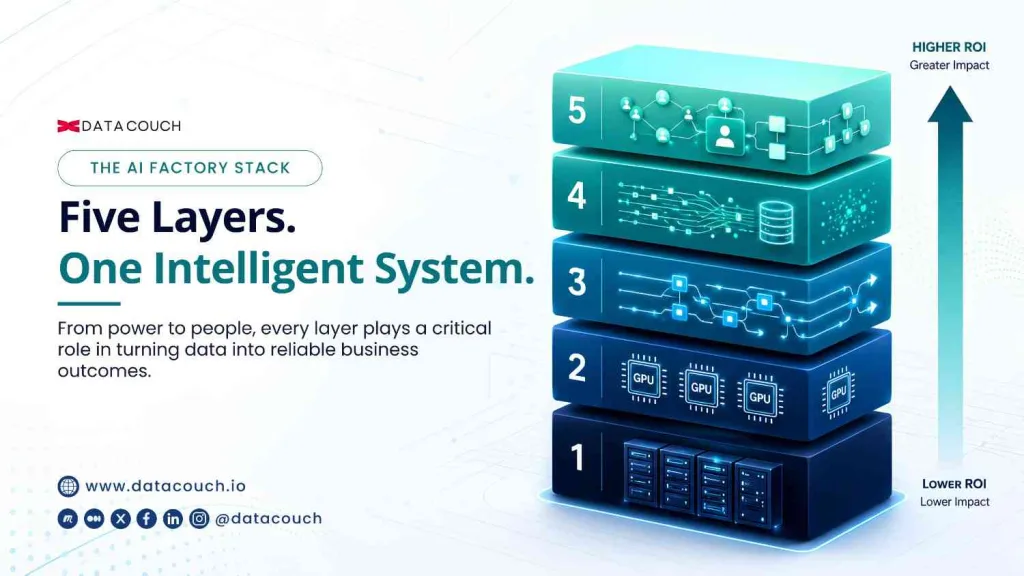
The Five Layers of the AI Factory Stack
Layer 1: Energy and Physical Infrastructure
Power, cooling, space, network connectivity
The physical foundation of the AI factory. GPU clusters consume dramatically more power per rack than traditional servers. Before deploying accelerated compute, enterprises must assess power capacity (AI workloads can require 40 to 100 kilowatts per rack versus 5 to 10 for traditional servers), cooling architecture (air cooling is insufficient for high-density GPU deployments at scale), physical space constraints, and network connectivity to data sources. Organisations that skip this assessment discover the constraint at the worst possible moment: after hardware is installed and ready to run. An underpowered facility cannot run AI workloads at the utilisation rates that justify the hardware investment.
Layer 2: Accelerated Compute: GPUs, DPUs, and Networking
GPU clusters, DPUs, high-bandwidth interconnects, workload scheduling
The compute layer is what most organisations invest in first and most heavily. GPU clusters, DPU networking cards, and high-bandwidth interconnects between compute nodes make up this layer. The critical point that most hardware procurement processes miss is that the compute layer’s performance is entirely dependent on how workloads are scheduled across it. Without an intelligent workload scheduler, priority queuing, per-team quota management, and inter-GPU networking optimised for parallel processing, even the most powerful cluster will run at single-digit utilisation. DataCouch’s manufacturing engagement demonstrated this precisely: the same hardware delivered 5% utilisation before governance and 90% utilisation after it.
Layer 3: AI Platform and Orchestration
Job scheduler, MLOps platform, monitoring, access management
The orchestration layer connects compute to workloads and provides the operational control plane for the AI factory. This layer covers the job scheduler and workload manager, the container and Kubernetes orchestration for AI workloads, the MLOps platform for model training, versioning, and deployment, the monitoring dashboards for compute utilisation and model performance, and the security and access control management for who can run what on which infrastructure. Without this layer, the AI factory has raw power but no operational control. Every workload runs ad hoc, visibility is absent, and governance is impossible.
Layer 4: Data Pipelines and Models
Data pipelines, streaming, governance, knowledge graphs, model training
The data layer is where raw enterprise data becomes the training and inference input that the AI factory processes. This layer covers real-time data streaming pipelines (Confluent or Redpanda for event-driven architectures), federated data access (Starburst for querying across sources without data movement), data governance controls including provenance tracking and access classification, vector databases and knowledge graphs (Neo4j) for retrieval-augmented AI, and the model training, fine-tuning, and deployment workflows that convert governed data into production models. This is the layer most enterprises underinvest in. A GPU cluster with ungoverned, unstructured, or incomplete data pipelines will produce unreliable AI outputs regardless of how powerful the hardware is.
Layer 5: Applications, Agents, and People
AI applications, agentic workflows, user training, governance operations
The output layer of the AI factory: the AI-powered applications, agentic workflows, and decision-support tools that business users interact with. Gartner predicts 40% of enterprise applications will integrate task-specific AI agents by the end of 2026. But this layer has a critical component that NVIDIA’s architecture diagrams do not include: the people who operate, govern, and work alongside the AI. An AI factory where the workforce does not understand how to evaluate AI outputs, identify governance issues, or escalate behavioural anomalies degrades over time. Training at this layer is not optional. It is the mechanism that keeps all the layers below it performing.
DataCouch builds all five layers of the AI factory stack, starting with the ones your organisation needs most.
What Happens When Each Layer Is Incomplete
| Missing Layer | Symptom | Business Impact |
|---|---|---|
| Energy and Physical | GPUs cannot run at rated capacity due to power or cooling constraints. Hardware throttles below specification. | Investment in compute hardware produces less than expected throughput. Upgrade costs arrive before the original investment delivers ROI. |
| Accelerated Compute | Workloads queue sequentially. Multi-GPU training runs slowly or fails. Teams compete for cluster access with no governance. | Low GPU utilisation (typically under 10%). Long training cycle times. High operational frustration. The symptom most organisations misdiagnose as a hardware problem. |
| AI Platform | No visibility into what is running on the cluster. No governance of who can access what. No model versioning or audit trail. | AI systems in production have no lineage. Compliance documentation cannot be produced. Incidents cannot be investigated. Regulatory exposure. |
| Data Pipelines | Models train on stale, incomplete, or ungoverned data. Retrieval systems return irrelevant or hallucinated context. Inference latency is high due to unoptimized data access. | AI outputs are unreliable. Business users stop trusting AI recommendations. AI adoption stalls despite available infrastructure. |
| People and Training | Operators manage AI infrastructure with general IT skills. Business users cannot evaluate AI outputs. Governance degradation begins immediately after deployment. | High incident rate, slow recovery, governance drift. The infrastructure reverts to its pre-engagement state over 12 to 18 months. This is the most common long-term AI factory failure mode. |
Building the Stack: Where to Start
Start With an Honest Gap Assessment
The first step in building the AI factory stack is assessing where each layer currently stands for your organisation. Most enterprises find they have partial investment across multiple layers, with no layer fully complete. A GPU cluster purchased last year may be at Layer 2 without Layer 3 orchestration. A data pipeline project may have addressed parts of Layer 4 without connecting to the compute layer. The gap assessment identifies the highest-leverage next investment.
The Highest-Leverage First Investment Is Often Layer 3 or Layer 4
Organisations that already have GPU infrastructure but low utilisation almost always have a Layer 3 or Layer 4 gap. Adding Layer 3 orchestration (scheduler, quota management, monitoring) to existing hardware frequently produces the largest single utilisation improvement for the lowest incremental cost. This is the pattern observed in DataCouch’s manufacturing engagement: scheduling architecture, networking optimisation, and governance at Layer 3 moved utilisation from under 5% to over 90% on hardware that was already installed.
Layer 5 Is Never the Last Investment
The people layer is not the final step after everything else is built. It must be built in parallel with every other layer. The data engineers who design Layer 4 pipelines need training in AI-specific data governance. The platform engineers who build Layer 3 orchestration need training in MLOps and AI security. The business users who interact with Layer 5 applications need training in how to evaluate AI outputs and when to escalate. Planning the training investment alongside the infrastructure investment, not after it, is the characteristic that separates high-maturity AI organisations from those that stall.
Early AI adopters see 15.2% cost savings and 22.6% productivity improvements on average per McKinsey 2025. High-maturity AI organisations are 45% more likely to keep AI projects in production for 3 years or more. The performance gap between leaders and laggards is widening as successful organisations compound their stack advantages.
Source: McKinsey State of AI 2025 / Gartner AI Maturity Research 2025
We specialise in custom AI programs and globally recognised certification training at scale.
Key Takeaways
- The AI factory stack has five interdependent layers: energy and physical infrastructure, accelerated compute, AI platform and orchestration, data pipelines and models, and applications, agents, and people. Missing anyone limits the output of all the others.
- Most organisations invest heavily in Layer 2 compute and underinvest in Layers 3 and 4. The symptom is low GPU utilisation. The diagnosis is almost always an orchestration or data pipeline gap, not a hardware gap.
- Only 6% of organisations achieve measurable EBIT impact from AI per McKinsey 2025. The common characteristic of those who do is a complete stack, not more powerful hardware.
- The people layer is not the final step. It must be built in parallel with every other layer. Training at Layer 5 is the mechanism that keeps all the layers below it performing over time.
- The highest-leverage first investment for most organisations with existing GPU hardware is Layer 3 orchestration: scheduler, quota management, and monitoring. This consistently produces the largest utilisation improvement for the lowest incremental cost.
- Gartner’s research shows 45% of high-maturity AI organisations keep projects in production for 3 or more years versus 20% of low-maturity ones. Stack completeness determines staying power, not launch speed.
Here is the question worth asking before your next AI infrastructure budget decision: which layer of your AI factory stack is the binding constraint on your current AI output, and is the next investment targeted at that constraint or at a layer that already has sufficient capability?