
The CISO's Guide to AI Governance in 2026: EU AI Act, NIST AI RMF, and What Your Policy Must Cover
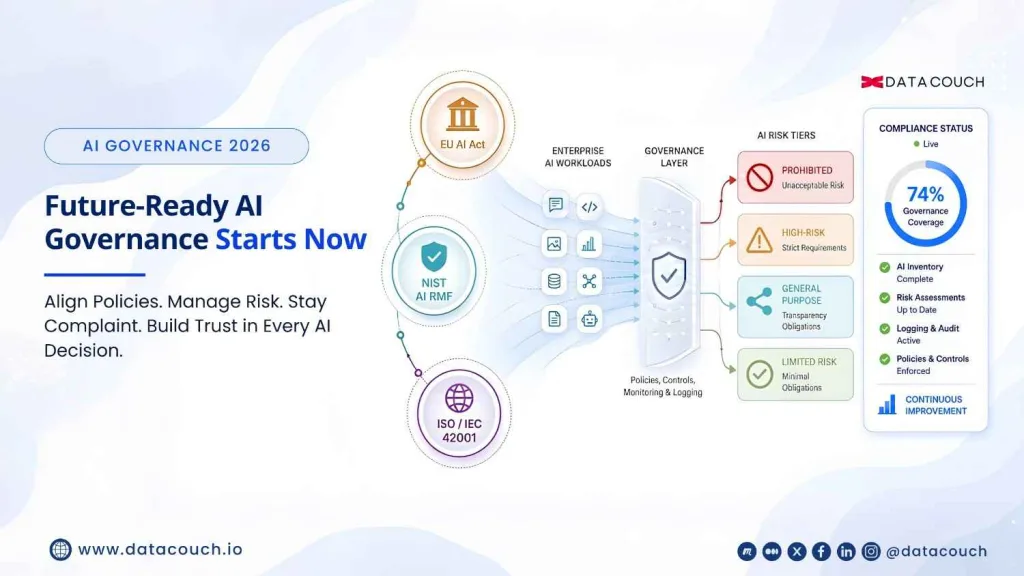
The governance reality in 2026: 74% of organisations have only moderate or limited coverage for technology, model, and third-party risks within their AI governance programs, according to IBM. The EU AI Act August 2026 deadline is not a future planning exercise. It is a current enforcement obligation. Here is what must be in place.
The CISO’s role in AI governance has expanded beyond what most job descriptions currently describe. Two years ago, AI governance was primarily a data privacy and ethics concern. In 2026, it is a regulatory, operational, and security concern simultaneously, and the CISO is being pulled into all three simultaneously.
IBM’s 2025 AI governance research found that nearly 74% of organisations have only moderate or limited coverage for technology, third-party, and model risks within their AI governance programs. Gartner’s 2025 survey of 302 cybersecurity leaders found that 69% either suspect or have direct evidence that employees are using prohibited public GenAI tools. Almost none of those tools have been through a formal AI governance review.
The gap between AI deployment pace and AI governance maturity is the single most consistent finding across every major enterprise AI research report in 2025 and 2026. This guide is for CISOs who need to close that gap before the regulatory and security consequences of not closing it arrive.
The Three Frameworks Every Enterprise AI Governance Program Must Address
Most enterprise AI governance programs in 2026 need to satisfy three frameworks simultaneously. They overlap significantly, but each has distinct requirements, distinct enforcement mechanisms, and distinct organisational implications.
Framework 1: The EU AI Act
The EU AI Act is the world’s first comprehensive binding AI regulation. Its rollout is phased. Prohibited practices were banned outright in February 2025. General-purpose AI model obligations, including technical documentation and copyright compliance, took effect on August 2, 2025. High-risk AI system obligations take effect August 2, 2026. The deadline for AI embedded in regulated products extends to August 2, 2027.
High-risk AI systems include those used in critical infrastructure, biometric identification, employment and recruitment, education and training, law enforcement, border management, and access to essential public services. Any organisation whose AI systems affect EU residents must comply, regardless of where the organisation is headquartered.
EU AI Act high-risk system requirements (Article 12): AI systems must be technically capable of automatic event logging across their full operational lifetime. No manual spreadsheet meets this standard. Core obligations land on August 2, 2026, with penalties up to 7% of global annual turnover.
Source: EU AI Act, Official Journal of the European Union, 2024
What the EU AI Act requires in practice for high-risk AI systems: a risk management system documented across the system lifecycle, data governance controls for training, validation, and testing data, technical documentation maintained per Annex IV, automatic logging with full traceability, transparency information for deployers and users, human oversight measures built into the system design, and a conformity assessment completed before deployment.
Framework 2: NIST AI Risk Management Framework
The NIST AI RMF, released in January 2023 and expanded through 2025, organises all AI risk management into four functions. The framework is voluntary in the US but is now a procurement requirement for federal agencies and is increasingly referenced by regulators, auditors, and enterprise procurement teams as a baseline expectation.
| NIST AI RMF Function | What It Requires | What Must Exist in Your Organisation |
|---|---|---|
| Govern | Establish policies, accountability structures, risk tolerance, and organisational culture for AI risk management | Named executive accountability for AI risk, documented AI governance policy, defined risk tolerance thresholds, and maintained AI inventory |
| Map | Identify context, stakeholders, intended purposes, and potential impacts of each AI system | AI system registry, use case documentation, impact assessments, and stakeholder mapping for each production AI system |
| Measure | Assess risks using quantitative and qualitative tools, including bias testing, explainability review, security testing, and performance benchmarking | Testing protocols, red team exercise results, bias detection outputs, performance monitoring dashboards, explainability documentation |
| Manage | Allocate resources to address identified risks, implement controls, establish incident response, and maintain post-deployment monitoring. | Risk treatment plans, security controls implementation, AI incident response playbook, behavioural monitoring with defined intervention triggers |
Framework 3: ISO/IEC 42001
ISO/IEC 42001, published in 2023, is the first global certifiable standard for an AI management system. Microsoft certified early, signalling where enterprise procurement requirements are heading. ISO 42001 translates AI governance principles into a structured management system with documented controls that can be independently audited and certified. For organisations that need to demonstrate AI governance maturity to procurement teams, regulators, or partners, ISO 42001 certification is increasingly the differentiator.
DataCouch helps enterprises build AI governance frameworks aligned to the EU AI Act, NIST AI RMF, and ISO 42001.
What the CISO Specifically Owns in the AI Governance Operating Model
AI governance is cross-functional. The CIO is the typical executive owner. Legal, compliance, data, engineering, and business leaders all have roles. But the CISO owns specific components that no other function can substitute for.
What Only the CISO Can Own
AI attack surface management: Maintaining visibility into every AI system in production, its data access rights, its external connections, and its vulnerability profile. 69% of cybersecurity leaders have evidence of employees using prohibited public GenAI tools. Without CISO-led AI asset discovery, governance cannot reach the full scope of the risk.
Shadow AI detection and response: Identifying and governing unauthorised AI tool usage before it becomes a breach. Shadow AI incidents added $670,000 to average breach costs per IBM’s 2025 research. Detection, response, and policy enforcement for shadow AI are security functions.
Adversarial testing and red teaming: Ensuring AI systems are tested for prompt injection, jailbreaking, RAG poisoning, and agent privilege escalation before production deployment. This is the Measure function of NIST AI RMF and the technical requirement behind EU AI Act robustness obligations.
AI incident response: Defining the playbook for AI-specific security incidents: a compromised model, a prompt injection attack that caused data exfiltration, or a behavioural drift event that produced harmful outputs. Traditional incident response playbooks do not cover these scenarios.
Third-party AI risk management: Assessing the AI security posture of vendors and partners whose AI systems process your organisation’s data or produce outputs that affect your business decisions. This extends the third-party risk program into AI-specific territory.
The Seven Things Your AI Governance Policy Must Cover in 2026
The minimum viable AI governance policy in 2026 covers seven components. Any policy that omits one of these is incomplete against the EU AI Act, NIST AI RMF, and the practical security requirements of 2026.
Step 1: AI Inventory and Registry
A maintained, current list of every AI system in production: who owns it, what data it accesses, what it is permitted to do, and what its risk classification is. EU AI Act Article 12 requires this. NIST AI RMF’s Govern function requires this. Gartner research shows 40% or more of enterprises will face compliance incidents from shadow AI by 2030 without it.
Step 2: Risk Classification by EU AI Act Tier
Every AI system must be classified against the EU AI Act risk taxonomy: prohibited, high-risk, general-purpose, or limited/minimal risk. High-risk systems require conformity assessments and automatic logging. This classification cannot wait for the August 2026 deadline. Classification must happen now to allow time for compliance engineering.
Step 3: Data Governance for AI
Documenting the provenance, quality, and access controls for every dataset used to train, fine-tune, or feed AI systems in production. EU AI Act Annex IV requirements for data governance are specific: training data must be documented with known collection methodologies, data quality measures, and bias assessment results. This is a technical documentation requirement, not just a policy statement.
Step 4: Automatic Logging and Auditability
Every high-risk AI system must be technically capable of generating automatic event logs across its operational lifetime. EU AI Act Article 12 is explicit: no manual process meets this standard. The logging must cover inputs, outputs, decisions made, and any human review events. This is an architectural requirement that must be built into the system, not added retrospectively.
Step 5: Human Oversight Framework
Defining which AI decisions require human review before execution and at what thresholds. The EU AI Act requires human oversight measures to be built into high-risk AI systems. NIST AI RMF’s Manage function requires defined intervention triggers. For agentic AI systems with real-world permissions, this means specifying exactly which decision types require human approval before the agent acts.
Step 6: AI Incident Response Playbook
A documented response procedure for AI-specific security and governance incidents: model compromise, prompt injection attack, data exfiltration via AI, behavioural drift, shadow AI breach, and regulatory inquiry response. The EU AI Act requires serious incident reporting to national market surveillance authorities. Without a documented playbook, incident response will be improvised under time pressure.
Step 7: AI Security Testing Requirements
Specifying the adversarial testing requirements for each AI system before production deployment and on a defined post-deployment schedule. This links directly to the red teaming program covered in the companion blog. High-risk systems should be tested against the OWASP LLM Top 10 and MITRE ATLAS threat taxonomy. Test results should be retained as compliance evidence.
Gartner predicts more than 40% of enterprises will experience a security or compliance incident linked to unauthorised shadow AI by 2030. Organisations without a maintained AI registry cannot produce the audit evidence required by the EU AI Act when investigators ask for it.
Source: Gartner Enterprise AI Governance Research, 2025 / Atlan AI Registry Research, 2026
We specialise in custom AI programs and globally recognised certification training at scale.
The Governance Maturity Levels: Where Is Your Organisation Today?
| Maturity Level | Characteristics | What Moves You to the Next Level |
|---|---|---|
| Level 1: Ad Hoc (79% of organisations) | No AI asset inventory. No written AI governance policy. No red teaming. Security responds to AI incidents after they occur. Shadow AI is undetected. | Build the AI inventory. Write the governance policy. Classify systems by EU AI Act risk tier. |
| Level 2: Defined | AI asset inventory exists. Policy is documented. Red teaming happens at least quarterly. Prompt injection and jailbreak testing are part of the release cycle. Human oversight requirements are defined. | Deploy automatic logging. Build the AI incident response playbook. Implement behavioural monitoring. |
| Level 3: Managed | Runtime monitoring covers model inputs, outputs, and tool calls. Agent-to-agent interactions are logged and audited. Least-privilege access is enforced per agent identity. Behavioural drift triggers automated alerts. | Automate compliance evidence generation. Achieve ISO 42001 alignment. Build continuous red teaming into the CI/CD pipeline. |
| Level 4:Optimised | Continuous automated maturity scoring. AI security controls are tested in production via adversarial simulation. EU AI Act, NIST AI RMF, and ISO 42001 compliance evidence generated automatically. | Maintain. Adapt governance as the regulatory landscape and threat landscape evolve. |
Level 3 is not a luxury for large enterprises. It is the minimum viable security posture for any organisation running AI agents in production with real-world permissions. Level 2 is the minimum for any organisation subject to the EU AI Act high-risk requirements effective August 2026.
The DataCouch Approach to Enterprise AI Governance
DataCouch’s four-pillar approach applies directly to building the governance capability this regulatory environment requires.
Custom Training: AI governance training for CISOs, security teams, legal, compliance, and operational teams. This covers EU AI Act requirements, NIST AI RMF implementation, shadow AI detection, AI incident response, and AI-specific adversarial testing methodology. Training is tailored to each function’s specific governance responsibilities.
AI Consulting: AI governance framework design, EU AI Act compliance gap assessment, AI inventory and registry design, data governance architecture for AI, and human oversight framework definition. We help organisations move from Level 1 to Level 2 and from Level 2 to Level 3.
Custom AI Solutions: Governed AI deployments with automatic logging, role-based access controls, behavioural monitoring, and compliance documentation built into the system architecture rather than added after deployment.
Custom Coaching: Ongoing support for CISOs and AI governance leads as the regulatory landscape evolves. The EU AI Act, NIST AI RMF, and ISO 42001 are all actively developing. Organisationss need a partner who tracks these changes and helps them adapt their governance programs accordingly.
Key Takeaways
- 74% of organisations have only moderate or limited AI governance coverage, per IBM research. The EU AI Act high-risk deadline of August 2, 2026, makes this gap an active regulatory exposure, not a future planning issue.
- Three frameworks define the 2026 minimum for enterprise AI governance: the EU AI Act (mandatory, enforced), the NIST AI RMF (voluntary but increasingly required by procurement and regulation), and ISO/IEC 42001 (certifiable management system).
- The CISO specifically owns AI attack surface management, shadow AI detection, adversarial testing, AI incident response, and third-party AI risk management. These functions cannot be substituted by legal, compliance, or data teams.
- The seven components every AI governance policy must cover in 2026: AI inventory, EU AI Act risk classification, data governance documentation, automatic logging, human oversight framework, AI incident response playbook, and AI security testing requirements.
- 79% of organisations are at Level 1 AI security maturity: no inventory, no policy, no structured testing. Level 2 is the minimum for EU AI Act high-risk compliance. Level 3 is the minimum for organisations with agentic AI in production.
- Governance without training does not hold. A policy document that no one has read and no team understands does not satisfy regulatory requirements or reduce security risk. Training is the implementation layer of governance.
Here is the question every CISO should be able to answer before the August 2026 deadline: for each high-risk AI system your organisation operates, can you produce the technical documentation, automatic event logs, data governance records, and conformity assessment that an EU AI Act auditor would request on day one of an inquiry?
If any of those elements cannot be produced today, that is the governance gap to close before August arrives.