
AI-103 Certification Guide (2026): Pass the Azure AI Apps & Agents Developer Exam on Your First Attempt
AI-103 – “Developing AI Apps and Agents on Azure” – is Microsoft’s newest role-based exam, awarding the Azure AI Apps and Agents Developer Associate credential. It replaces AI-102 and shifts the focus from individual Azure AI services to Microsoft Foundry, generative AI, RAG, and multi-agent solutions. Expect roughly 40–60 questions in 120 minutes, a passing score of 700/1000, and a fee of $165 USD (discounted during the beta window). Most candidates need 6–10 weeks of preparation combining Microsoft Learn, hands-on Foundry labs, and full-length practice tests.
What Is the AI-103 Certification?
AI-103 is Microsoft’s exam for engineers who build, deploy, and manage AI applications and intelligent agents using Microsoft Foundry (formerly Azure AI Foundry). Passing it earns you the Microsoft Certified: Azure AI Apps and Agents Developer Associate badge.
If AI-102 was about stitching together individual Azure AI services – Vision, Language, Speech, Document Intelligence – AI-103 reflects where the industry actually moved: generative AI, retrieval-augmented generation (RAG), tool-calling, and agentic architectures, all orchestrated through one unified platform.
In practical terms, a certified AI-103 professional can:
- Design and deploy LLM-powered applications and copilots on Azure
- Build agents that call tools, execute functions, and coordinate with other agents
- Ground AI outputs in enterprise data using RAG and Azure AI Search
- Implement computer vision, speech, translation, and document extraction pipelines
- Apply Responsible AI guardrails – content safety, evaluations, tracing, and governance
AI-102 vs AI-103: What Actually Changed?
This is the question working professionals ask first – so here is the complete picture, not just a summary line.
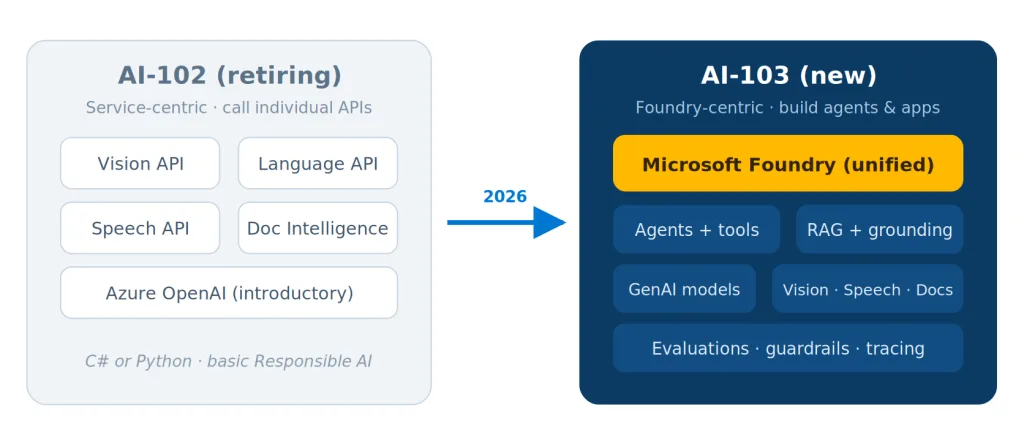
2.1 The platform changed: services → Microsoft Foundry
In AI-102, you provisioned and called separate cognitive services. In AI-103, Microsoft Foundry is the single development surface – Foundry Projects organize your deployments, agents, tools, evaluations, and connected resources, and Foundry Tools expose vision, speech, translation, retrieval, and code execution as capabilities your agents consume. Exam questions assume you navigate this world natively.
2.2 The center of gravity changed: APIs → agents
AI-102 asked “which API returns sentiment?” AI-103 asks “your agent must retrieve policy documents, call a pricing function, and escalate to a human when confidence drops – which orchestration and tool-access configuration meets the requirement?” Agent design, tool-calling, function integration, agent memory, and multi-agent workflows are now central, not peripheral.
2.3 Generative AI went from one topic to the dominant theme
Deploying and consuming LLMs, small models, and multimodal models; prompt engineering; production-grade RAG with Azure AI Search and vector retrieval; and evaluating outputs for fabrication, relevance, and safety – this is the heart of the new exam rather than a chapter at the end.
2.4 Responsible AI grew teeth
AI-102 covered Responsible AI principles at a conceptual level. AI-103 tests implementation: content filters and guardrails, risk detection, safety evaluators, trace logging, provenance metadata, approval workflows, and governing agent behavior with oversight modes and tool-access constraints.
2.5 The language expectation shifted to Python-first
AI-102 accepted C# or Python. AI-103’s official guidance recommends experience developing apps with Python, and the SDK scenarios you’ll reason about (azure-ai-projects and the Foundry SDKs) reflect that.
| Aspect | AI-102 (retiring) | AI-103 (2026) |
|---|---|---|
| Core platform | UIndividual Azure AI services | Microsoft Foundry - unified projects, tools, agents |
| Generative AI weight | Moderate, introductory | Dominant - models, prompting, RAG, evaluation |
| Agents & orchestration | Minimal | ACentral - tool-calling, memory, multi-agent workflows |
| RAG & grounding | Basic "bring your own data" | Production pipelines: retrieval, vectors, Content Understanding |
| Responsible AI | Principles | Implementation - guardrails, evaluators, tracing, governance |
| Languages | C# or Python | Python-first |
| Credential | Azure AI Engineer Associate | Azure AI Apps & Agents Developer Associate |
Already hold AI-102? Here’s your move
Your fundamentals in vision, language, speech, and document processing transfer well – those domains still exist in AI-103, just reframed through Foundry. Budget your extra study time almost entirely on Foundry Agent Service, the Agent Framework, RAG patterns, and evaluation tooling. Candidates coming from AI-102 typically need 3–4 focused weeks on the new material; candidates studying old AI-102 question banks as-is typically fail.
AI-103 Exam Details at a Glance
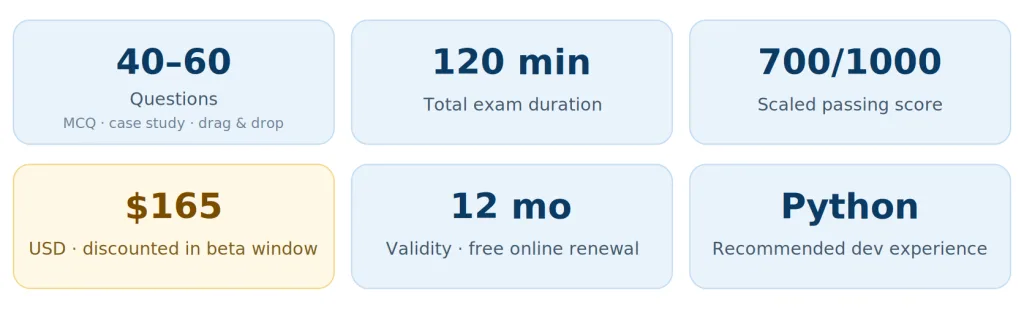
There are no formal prerequisites, though Microsoft recommends hands-on Azure AI experience and Python development skills. If you’re brand new to Azure, the AI-900/AI-901 fundamentals path builds vocabulary that makes AI-103 prep dramatically faster. There is no negative marking – never leave a question blank.
AI-103 Syllabus: The Five Skill Domains
Domain 1 – Plan & Manage an Azure AI Solution
Solution architecture, cost estimation, Foundry Projects, security (managed identity, private networking, keyless credentials), and governance. Expect scenario questions where you pick the right deployment model, tier, or access-control setup – not just define them.
Domain 2 – Implement Generative AI & Agentic Solutions [Heaviest domain]
Deploying and consuming LLMs, small models, and multimodal models; building RAG pipelines; designing tool-augmented workflows and multi-step reasoning; orchestrating agents with the Foundry SDKs; and evaluating outputs for fabrication, relevance, and safety. Master one domain deeply – make it this one.
Domain 3 – Implement Computer Vision Solutions
Image analysis, object detection, OCR, and custom vision models – framed within Foundry Tools and often as capabilities an agent consumes rather than standalone APIs.
Domain 4 – Implement Text Analysis Solutions
Sentiment, entity recognition, key phrases, translation (Azure Translator and LLM-powered flows), speech-to-text and text-to-speech, and integrating speech as an agent modality – including custom speech models.
Domain 5 – Implement Information Extraction Solutions
Document Intelligence, Content Understanding, and multimodal pipelines combining OCR, layout analysis, and field extraction to produce clean, grounded data for agents and RAG.
5. Why Pursue the AI-103 Certification in 2026?
It validates the most in-demand skill set in tech right now
Every enterprise roadmap in 2026 has the same three words on it: copilots, agents, automation. AI-103 is the first Microsoft associate certification purpose-built around that shift. It doesn’t certify that you know what AI is – it certifies that you can ship it.
It's a career multiplier, not just a badge
Certified Azure AI engineers move into roles like AI Application Developer, Agentic AI Engineer, GenAI Solutions Engineer, and AI Consultant. Because AI-103 is brand new, early holders enjoy a scarcity premium – hiring managers see a credential only a small pool of candidates possesses.
DataCouch builds sovereign AI infrastructure specifically for regulated industries, with audit-ready evidence built into the architecture.
The compliance gap is architectural, not procedural: Most healthcare AI failures are not the result of a missing policy document. They are the result of an AI system architecture that was never designed to enforce minimum-necessary access at the infrastructure layer. Writing a HIPAA compliance policy does not change how the AI agent actually queries data. Only the underlying access architecture does that.
Data Residency Within the Regulatory Boundary
For financial services, healthcare, and government, the physical and legal location of data processing determines which regulator has jurisdiction and which laws apply. As covered in detail in our companion Sovereign AI guide, selecting a cloud region within the correct geography is not sufficient if the underlying vendor is subject to a foreign jurisdiction’s legal authority. Sovereign infrastructure for regulated industries means the organisation, not a third party, controls who can access the data under what legal authority.
Continuous Monitoring With Technical Evidence
Every regulated sector covered above now requires monitoring evidence, not monitoring intentions. This means access logs that capture every query an AI system makes against regulated data, with enough granularity to demonstrate to an auditor that access was limited to the designated purpose. Generic cloud AI services frequently log at a level of abstraction (request succeeded or failed) that does not satisfy this requirement. Purpose-built, governed infrastructure logs at the level regulators actually request: what data, accessed by what identity, for what stated purpose, with what outcome.
Named Accountability for Every AI System
The emerging regulatory pattern across financial services, healthcare, and the EU AI Act all converge on the same requirement: a named, accountable individual for each AI system who has the authority to pause, modify, or decommission it. GARP’s February 2026 analysis argues that AI oversight belongs with the board risk committee specifically because AI risk crosses the traditional boundaries between operational, model, and compliance risk. Organisations using shared third-party infrastructure frequently cannot produce this accountability mapping because responsibility is diffused across the vendor relationship.
54% of IT leaders now cite AI governance as a top enterprise risk priority, up from 29% two years earlier. 91% of small companies are considered to be taking significant risks with data security in their current AI governance posture.
Source: AI Governance Solutions for Regulated Industries, Kiteworks, 2026
We specialise in custom AI programs and globally recognised certification training at scale.
The DataCouch Approach for Regulated Industries
Custom Training: Sector-specific AI compliance training for financial services, healthcare, and government teams, covering HIPAA Technical Safeguards, the US Treasury AI Risk Management Framework, and EU AI Act high-risk obligations as they apply to AI infrastructure decisions.
AI Consulting: Sovereign infrastructure design for regulated workloads, compliance gap assessment against sector-specific frameworks, and named accountability mapping for AI systems handling regulated data.
Custom AI Solutions: Governed AI deployments architected for minimum-necessary access, complete audit logging, and data residency requirements specific to each regulated sector, built into the system from the foundation rather than retrofitted.
Custom Coaching: Ongoing support for compliance officers and AI governance leads navigating sector-specific regulatory evolution, including the US Treasury framework, HIPAA guidance updates, and EU AI Act enforcement developments.
Key Takeaways
- Regulated industries face a fundamentally different infrastructure calculus than unregulated enterprises. The risk is not primarily operational. It is regulatory liability that vendors do not share.
- 73% of healthcare AI agent deployments fail HIPAA compliance because standard AI architectures assume broad data access, while HIPAA requires minimum-necessary access enforced at the infrastructure layer.
- Financial services, healthcare, government, legal, and critical infrastructure each face distinct AI infrastructure obligations that converge on the same underlying requirements: data residency, continuous monitoring with technical evidence, and named accountability.
- Policy documentation without technical evidence of enforcement satisfies none of the major regulatory frameworks now in force: not the EU AI Act, not HIPAA, not the US Treasury Financial Services AI Risk Management Framework.
- Compliance failures are increasingly architectural, not procedural. Writing a policy does not change how an AI system actually accesses data. Only sovereign, purpose-built infrastructure does that.
- AI-related compliance failures cost organizations $4.4 billion in 2025. Only 23% of organisations feel confident in their AI governance frameworks. The gap between regulatory requirements and infrastructure reality is the single largest AI risk in regulated industries today.
Here is the question every compliance officer in a regulated industry should be able to answer before approving the next AI deployment: if a regulator audited this system today, could your infrastructure produce technical evidence, not just policy documentation, that access was limited to the designated purpose at every step?
If the answer depends on a vendor you do not control, that is the infrastructure decision to revisit first.