
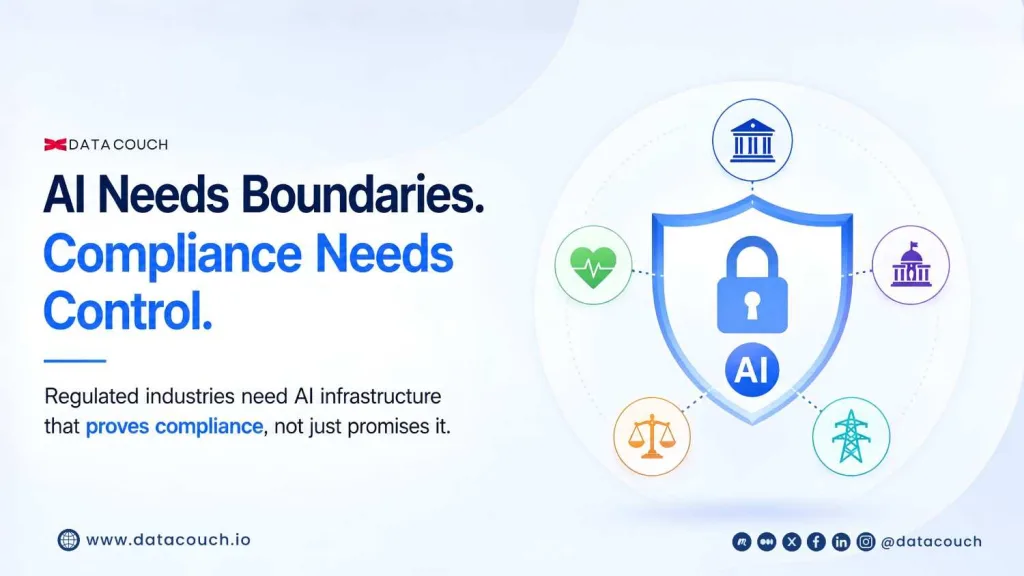
Why Regulated Industries Cannot Afford to Run AI on Someone Else's Infrastructure
The compliance reality for regulated industries in 2026: 73% of healthcare AI agent deployments fail HIPAA compliance because standard AI architectures violate Technical Safeguards mandates. Each violation carries fines up to $1.5 million and breach costs averaging $7.42 million. Borrowed infrastructure is not a cost-saving in regulated industries. It is a liability with a price tag attached.
There is a category error built into how most organisations approach AI infrastructure decisions. They treat the choice between cloud, on-premises, and hybrid as primarily a cost and performance question. For unregulated workloads, that framing is reasonable. For regulated industries, it misses the question that actually determines whether the deployment is legal.
The numbers make the stakes concrete. 73% of healthcare AI agent deployments fail HIPAA compliance because standard AI architectures violate Technical Safeguards mandates, with violations carrying fines up to $1.5 million and breach costs averaging $7.42 million. Financial services experienced 157 AI-related regulatory updates in a single year, nearly doubling previous volumes. Global AI-related compliance failures totalled $4.4 billion in losses across organisations in 2025.
This guide explains why regulated industries face a fundamentally different infrastructure calculus than unregulated enterprises, what specific obligations each major regulated sector faces, and what sovereign infrastructure must look like to satisfy them.
Why the Calculus Is Different for Regulated Industries
Borrowed Infrastructure Means Borrowed Risk
When an unregulated business runs AI on a hyperscaler’s infrastructure, the risk profile is primarily operational: uptime, latency, vendor lock-in. When a financial institution, hospital, or government agency does the same, the risk profile expands to include regulatory liability that the vendor does not share and cannot indemnify against. The regulator holds the deploying organisation accountable, not the cloud provider. A bank cannot tell its regulator that a compliance failure was the cloud vendor’s fault.
The Audit Trail Problem
Regulators in every major regulated sector now require continuous, documented evidence of AI behaviour, not just a policy statement. Policy documentation without technical evidence of enforcement is insufficient under the EU AI Act, HIPAA Technical Safeguards, and the US Treasury’s Financial Services AI Risk Management Framework,k released February 2026. Producing that evidence requires infrastructure-level access to logs, data lineage, and access records that a third-party vendor’s standard service tier frequently does not provide, and that a shared infrastructure model makes structurally difficult to isolate per workload.
The Specific Obligations Each Regulated Sector Faces
| Sector | Primary Regulatory Driver | Specific AI Infrastructure Requirement |
|---|---|---|
| Financial Services | US Treasury Financial Services AI Risk Management Framework (Feb 2026); EU DORA; SR 11-7 model risk management | Continuous monitoring evidence showing agents access only data needed for the designated purpose; named senior manager accountable for each AI system; board risk committee oversight |
| Healthcare | HIPAA Technical Safeguards; FDA AI/ML Software as Medical Device guidance; EU AI Act high-risk classification | Role-based identity verification for every entity accessing PHI; encryption in transit and at rest; audit controls logging every PHI access pattern with technical evidence, not policy statements |
| Government and Public Sector | National data sovereignty laws; EU AI Act Annex III public service classification; FedRAMP (US) | AI systems used in essential public services (credit scoring, benefits eligibility) are classified as high-risk; data residency within national jurisdiction; no foreign vendor data access |
| Legal and Professional Services | Client privilege protections; professional conduct regulations; GDPR/DPDP for client data | Client matter data must not enter shared AI training pipelines; per-matter data isolation; explicit client consent for AI processing of privileged information |
| Critical Infrastructure | EU AI Act critical infrastructure classification; sector-specific operational resilience requirements | AI systems controlling utilities, transport, and energy infrastructure require continuous behavioural monitoring with mandatory incident reporting to the national authorities |
In 2025, nearly all large enterprises experienced financial losses linked to AI risks, including compliance failures totalling $4.4 billion. Only 23% of organisations feel confident in their AI governance frameworks. Global spending on AI governance and compliance is projected to reach $2.54 billion in 2026 and grow to $8.23 billion by 2034.
DataCouch builds sovereign AI infrastructure specifically for regulated industries, with audit-ready evidence built into the architecture.
Why HIPAA Failures Are So Common in Standard AI Architectures
Healthcare offers the clearest illustration of why generic AI infrastructure fails regulated industries by default, not by exception.
73% of healthcare AI agent deployments fail HIPAA compliance because the standard AI agent architecture assumes broad data access for flexibility: an agent that can query patient records, scheduling systems, and billing data simultaneously to answer questions more usefully. HIPAA’s Technical Safeguards require the opposite assumption: minimum necessary access, role-based identity verification at every access point, and complete audit logging of every PHI touch. Retrofitting these constraints onto a flexible-by-design agent architecture after deployment is far more difficult and expensive than designing for them from the start.
The compliance gap is architectural, not procedural: Most healthcare AI failures are not the result of a missing policy document. They are the result of an AI system architecture that was never designed to enforce minimum-necessary access at the infrastructure layer. Writing a HIPAA compliance policy does not change how the AI agent actually queries data. Only the underlying access architecture does that.
What Sovereign Infrastructure Must Provide for Each Compliance Requirement
Data Residency Within the Regulatory Boundary
For financial services, healthcare, and government, the physical and legal location of data processing determines which regulator has jurisdiction and which laws apply. As covered in detail in our companion Sovereign AI guide, selecting a cloud region within the correct geography is not sufficient if the underlying vendor is subject to a foreign jurisdiction’s legal authority. Sovereign infrastructure for regulated industries means the organisation, not a third party, controls who can access the data under what legal authority.
Continuous Monitoring With Technical Evidence
Every regulated sector covered above now requires monitoring evidence, not monitoring intentions. This means access logs that capture every query an AI system makes against regulated data, with enough granularity to demonstrate to an auditor that access was limited to the designated purpose. Generic cloud AI services frequently log at a level of abstraction (request succeeded or failed) that does not satisfy this requirement. Purpose-built, governed infrastructure logs at the level regulators actually request: what data, accessed by what identity, for what stated purpose, with what outcome.
Named Accountability for Every AI System
The emerging regulatory pattern across financial services, healthcare, and the EU AI Act all converge on the same requirement: a named, accountable individual for each AI system who has the authority to pause, modify, or decommission it. GARP’s February 2026 analysis argues that AI oversight belongs with the board risk committee specifically because AI risk crosses the traditional boundaries between operational, model, and compliance risk. Organisations using shared third-party infrastructure frequently cannot produce this accountability mapping because responsibility is diffused across the vendor relationship.
54% of IT leaders now cite AI governance as a top enterprise risk priority, up from 29% two years earlier. 91% of small companies are considered to be taking significant risks with data security in their current AI governance posture.
Source: AI Governance Solutions for Regulated Industries, Kiteworks, 2026
We specialise in custom AI programs and globally recognised certification training at scale.
The DataCouch Approach for Regulated Industries
Custom Training: Sector-specific AI compliance training for financial services, healthcare, and government teams, covering HIPAA Technical Safeguards, the US Treasury AI Risk Management Framework, and EU AI Act high-risk obligations as they apply to AI infrastructure decisions.
AI Consulting: Sovereign infrastructure design for regulated workloads, compliance gap assessment against sector-specific frameworks, and named accountability mapping for AI systems handling regulated data.
Custom AI Solutions: Governed AI deployments architected for minimum-necessary access, complete audit logging, and data residency requirements specific to each regulated sector, built into the system from the foundation rather than retrofitted.
Custom Coaching: Ongoing support for compliance officers and AI governance leads navigating sector-specific regulatory evolution, including the US Treasury framework, HIPAA guidance updates, and EU AI Act enforcement developments.
Key Takeaways
- Regulated industries face a fundamentally different infrastructure calculus than unregulated enterprises. The risk is not primarily operational. It is regulatory liability that vendors do not share.
- 73% of healthcare AI agent deployments fail HIPAA compliance because standard AI architectures assume broad data access, while HIPAA requires minimum-necessary access enforced at the infrastructure layer.
- Financial services, healthcare, government, legal, and critical infrastructure each face distinct AI infrastructure obligations that converge on the same underlying requirements: data residency, continuous monitoring with technical evidence, and named accountability.
- Policy documentation without technical evidence of enforcement satisfies none of the major regulatory frameworks now in force: not the EU AI Act, not HIPAA, not the US Treasury Financial Services AI Risk Management Framework.
- Compliance failures are increasingly architectural, not procedural. Writing a policy does not change how an AI system actually accesses data. Only sovereign, purpose-built infrastructure does that.
- AI-related compliance failures cost organizations $4.4 billion in 2025. Only 23% of organisations feel confident in their AI governance frameworks. The gap between regulatory requirements and infrastructure reality is the single largest AI risk in regulated industries today.
Here is the question every compliance officer in a regulated industry should be able to answer before approving the next AI deployment: if a regulator audited this system today, could your infrastructure produce technical evidence, not just policy documentation, that access was limited to the designated purpose at every step?
If the answer depends on a vendor you do not control, that is the infrastructure decision to revisit first.