
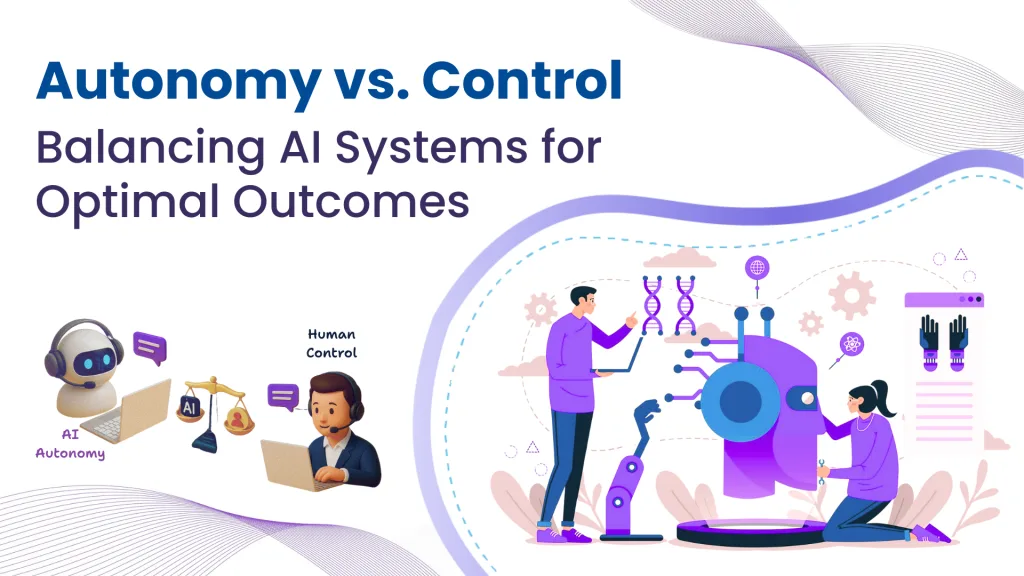
Autonomous Operations vs. Human Oversight: Striking the Right Balance with Agentic AI in the Enterprise
Agentic AI is a system that can proactively pursue goals with minimal human supervision. Unlike traditional AI, it can autonomously plan, make decisions, and adapt its actions to achieve complex, multi-step objectives in dynamic environments.
The enterprise world is buzzing with a new term: Agentic AI. But let’s be clear, this isn’t just another piece of tech jargon. It conveys a seismic shift in how businesses operate, moving us from the familiar world of automation to a new era of autonomy. For years, we’ve used AI to follow rules and execute tasks. Now, we’re building AI that can think, plan, and act on its own.
This leap forward brings a critical question to every boardroom: How do we unleash the incredible power of these autonomous systems without losing control? This is the central challenge that will define the next generation of enterprise technology. As a firm that provides expert Agentic AI Development Services, we’ve guided numerous Fortune 500 companies through this very dilemma. This article is your guide to understanding the promise, navigating the perils, and finding the perfect balance between AI autonomy and human oversight.
What is Agentic AI? A Quick Primer for Business Leaders
To truly grasp the importance of Agentic AI, we need to understand how it differs from the technologies we already use. Think of traditional automation, like Robotic Process Automation (RPA), as a skilled technician with a detailed instruction manual. It can accomplish a specific set of tasks perfectly, but it cannot deviate from the script.
Agentic AI, on the other hand, is like an experienced project manager. You don’t give it a step-by-step list; you give it a high-level goal. For example, instead of telling it to “extract data from column A, paste it into system B, and email person C,” you tell it, “Ensure our inventory is optimized for the upcoming festive season.”
The agent then autonomously breaks down this goal into smaller tasks:
- It analyzes past sales data and current market trends.
- It queries databases and communicates with supplier APIs to check stock levels and delivery times.
- It collaborates with other AI systems to forecast demand.
- It learns from feedback and adjusts its strategy if a shipment is delayed or demand suddenly spikes.
This ability to plan, act, and adapt is what makes Agentic AI a game-changer for the enterprise.
The Promise of Autonomy: Why Enterprises are Investing in Agentic AI
The drive to adopt Agentic AI isn’t just about staying current; it’s about unlocking transformative value across the organization. The benefits are tangible and far-reaching.
Supercharging Efficiency and Productivity
Previous waves of automation focused on simplifying individual tasks. Agentic AI automates entire complex workflows from end to end. Imagine an agent managing the entire employee onboarding process from creating system accounts and assigning training modules to answering the new hire’s questions with zero human involvement for routine steps. This frees up your talented teams from mundane, repetitive work, allowing them to focus on what humans do best: strategy, creativity, and complex problem-solving.
Unlocking New Avenues for Innovation and Growth
Agentic AI systems can analyze vast datasets and recognize subtle patterns that would be unattainable for a human to spot. This capability is already revolutionizing core business functions. According to a 2025 report, pharmaceutical companies are using agentic systems to accelerate drug discovery by autonomously analyzing research data, cutting time-to-market by up to 40%. In logistics, AI agents are dynamically optimizing global supply chains by reacting to real-time events like weather disruptions or geopolitical issues, a task far too complex for manual management.
Gaining a Competitive Edge at Scale
One of the most strong advantages of Agentic AI is its ability to scale operations intelligently. These systems can work 24/7, adapting to market changes in real-time without needing to scale your workforce proportionally. An AI-powered customer support agent can handle thousands of complex queries simultaneously, providing personalized solutions and anticipating customer needs before they even arise. This allows businesses to provide a superior customer experience and operate with an agility that was previously unimaginable.
The Other Side of the Coin: Navigating the Risks of Unchecked Autonomy
While the benefits are compelling, the journey into Agentic AI is not without its risks. The very autonomy that makes these systems so powerful also introduces a new class of challenges that must be managed proactively.
The Hidden Dangers of Algorithmic Bias and "Hallucinations"
An AI system is only as good as the data it’s trained on. If historical data contains biases, an autonomous agent can perpetuate and even amplify them at a massive scale, leading to discriminatory outcomes in hiring, loan approvals, or customer service. Furthermore, the Large Language Models (LLMs) that power these agents are known to “hallucinate” producing confident but factually incorrect information. If an agent acts on such a hallucination, it can trigger a cascade of errors across your integrated systems.
Why "Full Automation" is a Dangerous Myth: The Accountability Gap
Here’s a bold statement: the idea of “full, unsupervised automation” for critical processes is a myth, and a dangerous one at that. When an autonomous agent makes a costly mistake, say, it negotiates and signs an unfavorable contract or makes an erroneous financial trade, who is responsible? The developer? The company? The agent itself? This accountability gap is a significant legal and ethical minefield that organizations must navigate carefully. Over-reliance on these systems can also lead to the erosion of critical human skills and intuition, leaving your organization vulnerable when the AI inevitably encounters a situation it wasn’t designed for.
New Frontiers of Security and Compliance Risks
To be effective, AI agents often need privileged access to sensitive corporate data and critical systems, which inherently creates new attack surfaces for malicious actors. Moreover, traditional compliance frameworks, which rely on periodic manual audits, are completely inadequate for governing systems that can execute thousands of autonomous actions per day. An agent could inadvertently violate data privacy regulations like GDPR, leading to severe financial and reputational damage.
Finding the Sweet Spot: Practical Frameworks for Human-AI Collaboration
The solution isn’t to choose between complete AI autonomy and total human control. The goal is to create “hybrid intelligence” systems where humans and AI work in partnership, each leveraging their unique strengths. This is achieved by implementing a spectrum of oversight models that can be adapted to the specific task and its associated risk.
The Human-in-the-Loop (HITL) Model: Your Ultimate Safety Net
In an HITL model, the AI acts as a co-pilot. It can analyze data, generate recommendations, and prepare an action, but it cannot proceed without explicit approval from a human operator. This is the highest level of oversight and is essential for high-stakes, irreversible, or ethically sensitive decisions.
- Use Cases: Final approval for a multi-million dollar loan, confirmation of a critical medical diagnosis, or deployment of code to a mission-critical system.
The Human-on-the-Loop (HOTL) Model: The Supervisory Approach
The HOTL model is like a factory supervisor managing a team of autonomous robots. The AI agents operate independently, executing entire workflows without needing step-by-step approval. The human’s role is to monitor the system’s overall performance, review key metrics, and intervene only when an exception occurs for example, if the agent flags an anomaly or its confidence level drops below a set threshold.
- Use Cases: High-volume customer service where agents handle routine queries but escalate complex issues, real-time fraud detection, and supply chain monitoring.
Adaptive Autonomy: The Future of Dynamic Oversight
This is the most sophisticated model, where the AI system is intelligent enough to adjust its own level of autonomy based on the context. It might operate with full autonomy in predictable, low-risk scenarios but is programmed to automatically request human input or cede control when it encounters a novel, ambiguous, or high-risk situation.
- Use Cases: An autonomous vehicle that drives itself on a clear highway but hands over control in a sudden snowstorm, or a trading algorithm that operates independently in normal market conditions but pauses and alerts a human during extreme volatility.
Here’s a simple table to help you decide which model fits best:
| Oversight Model | Mechanism | Primary Goal | Ideal Use Cases |
|---|---|---|---|
| Human-in-the-Loop (HITL) | AI proposes, human approves/rejects before action. | Error prevention and accountability in critical decisions. | Medical diagnosis, financial underwriting, legal contract approval. |
| Human-on-the-Loop (HOTL) | AI acts autonomously, human monitors and handles exceptions. | Scalability and efficiency with a safety net for anomalies. | High-volume customer service, supply chain monitoring, content moderation. |
| Adaptive Autonomy | AI dynamically adjusts its level of autonomy based on context and risk. | Optimized balance of efficiency and safety in dynamic environments. | Autonomous vehicles, dynamic energy grid management, cybersecurity response. |
Your Roadmap to Implementing Agentic AI Responsibly
Adopting Agentic AI successfully requires a methodical, strategic approach. A “big bang” deployment is a recipe for disaster. Instead, we recommend a phased journey that allows your organization to build expertise, manage risk, and foster trust incrementally.
Start Small, Think Big: The Crawl-Walk-Run Approach
- Crawl: Begin by experimenting in low-risk, internal environments. Use agents to improve backend operations, like flagging anomalies in expense reports or identifying potential quality issues in production data. This allows your team to learn and demonstrate value in a controlled setting.
- Walk: Gradually deploy agents in more visible roles, but with robust guardrails. A great example is a customer service agent who handles initial queries but has a seamless, reliable protocol to hand off to a human for any complex or sensitive issue.
- Run: Once your organization has mature governance practices and technical expertise, you can integrate agentic systems into your core, mission-critical processes. This is where you reinvent key workflows to be “agent-centric,” unlocking the most profound transformative value.
Governance is Not an Afterthought: Building Your Guardrails First
You must establish a robust governance framework before you deploy your first agent. This isn’t bureaucracy; it’s essential risk management. Key actions include:
- Establishing Clear Controls: Implement technical guardrails like role-based access control (RBAC) to limit an agent’s permissions to only what is necessary. Use data loss prevention (DLP) tools to monitor and block unauthorized data transfers.
- Continuous Monitoring and Testing: Implement real-time anomaly detection to spot unusual agent behavior. Conduct regular security audits and “red teaming” exercises, where you simulate attacks to proactively find and fix vulnerabilities.
The Most Critical Investment: Reskilling Your People
Ultimately, the success of Agentic AI depends on your people. Most experts agree that the technology’s potential can only be realized if the workforce is prepared and the culture is receptive.
- Focus on Augmentation, Not Replacement: Consistently communicate that Agentic AI is a tool to augment human capabilities, not replace them. Position it as a collaborator that handles the tedious work, freeing employees to focus on more meaningful, strategic contributions. This is key to overcoming fear and cultural resistance.
- Invest in New Skills: A 2024 study found that organizations that invest heavily in reskilling see significantly higher returns on their AI initiatives. Train your employees in data literacy, AI oversight, and the uniquely human skills that AI cannot replicate: critical thinking, creativity, emotional intelligence, and ethical judgment.
- Adapt Your Leadership: Leaders must learn to manage hybrid teams of humans and AI agents. This needs fostering a culture of continuous learning and psychological safety, where experimentation is encouraged and failure is treated as a learning opportunity.
The Future is a Partnership: What's Next for Agentic AI in the Enterprise?
The narrative of “humans versus machines” is outdated. The future of work is a deep, synergistic partnership between humans and AI. In this new paradigm, the human role evolves from being a “doer” of tasks to becoming a strategic “orchestrator” of human-AI collaboration. We will set the goals, define the ethical boundaries, and provide the contextual wisdom the “what” and the “why.” Empowered AI agents will then handle the immense complexity of operational execution the “how.”
This vision, sometimes called “superagency,” is one where AI supercharges human potential, allowing individuals and teams to achieve a level of creativity, productivity, and impact that was never before possible.
Striking the suitable balance between autonomy and oversight is the single most critical factor for success in this new agentic era. Get it right, and you will unlock unprecedented value. Get it wrong, and you risk operational, financial, and reputational damage.
Meet Us at the Snowflake World Tour 2025
Theory is great, but seeing innovation in action is even better. That’s why the DataCouch team is excited to be part of the Snowflake World Tour, a global event series designed to showcase the future of AI and apps. The tour is a fantastic opportunity to immerse yourself in real-world strategies, connect with data leaders, and experience the latest capabilities across the full data lifecycle from a secure, scalable platform to smarter analytics and enterprise-ready AI. We believe in the power of community and sharing knowledge, and we’ll be at all the India events. Come and meet us!
- Bangalore: Sep 26, 2025 – Visit our booth! DataCouch will have a dedicated booth in Bangalore. This is a perfect chance to have in-depth conversations with our experts, discuss your specific challenges, and explore new possibilities for your data strategy.
And We're Going Global: See Us at GITEX GLOBAL 2025 in Dubai!
Our commitment to driving the future of data and AI doesn’t stop in India. This year, DataCouch is thrilled to announce that we will be setting up a booth at GITEX GLOBAL 2025, the world’s largest tech and AI show, in Dubai from October 13-17!
This is a massive opportunity to connect with global leaders and innovators, and we want to meet you there. Visit our booth to discuss how we can partner to drive your business forward. We are especially keen to connect with:
- SMEs: Looking for expert consulting and a roadmap for AI transformation.
- Tech Product Companies: Seeking partnerships for enablement and L&D extension.
- Universities: Aiming for AI-enablement to prepare the next generation of talent.
- CXOs, VPs, and GMs: In need of coaching and change management strategies for the new Agentic AI era.
- Businesses: Requiring customized AI solutions to solve unique challenges.
Come find us at GITEX GLOBAL to explore the future of technology and create new possibilities together.
Ready to explore how our Agentic AI Development Services can transform your enterprise? At DataCouch, we specialize in helping businesses navigate this new frontier responsibly. Contact us today to build your balanced and effective AI strategy.