
Scaling Agentic AI Without Compromising Governance
Enterprises are deploying AI agents faster than ever. And those agents are failing faster than ever, too. McKinsey’s 2025 research reports that 80% of organizations have already encountered risky behavior from their AI agents. Not in testing. In production. Agents approving unauthorized transactions, leaking sensitive data through API calls, and making decisions that no human reviewed or even knew about.
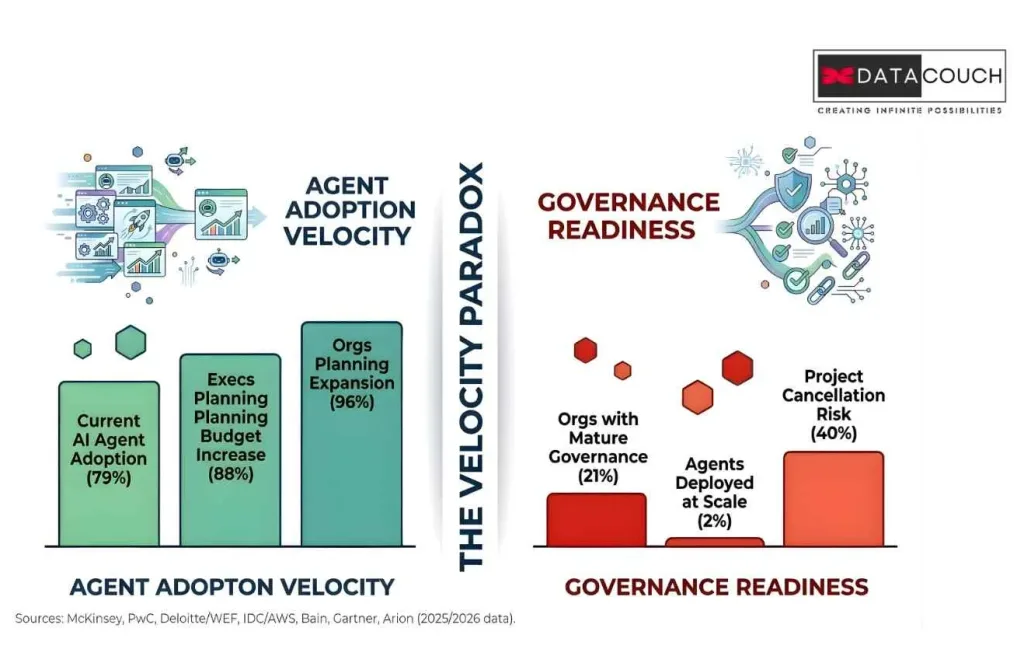
At the same time, 88% of executives plan to increase their AI budgets this year because of agentic AI, according to PwC’s 2025 AI Agent Survey. And Gartner predicts over 40% of agentic AI projects will be canceled by the end of 2027 due to escalating costs, unclear value, or inadequate risk controls. That is the velocity paradox in plain terms.
The velocity paradox is the growing tension between two forces: the pressure to deploy agentic AI fast for competitive advantage, and the reality that governance structures, risk frameworks, and regulations have not kept pace with the technology.
Here is the surprising truth about this paradox: governance is not the brake on agentic AI. It is the accelerator. Organizations with strong oversight frameworks actually deploy agents more widely and with greater autonomy than those without them. They move faster because they have confidence in what their agents are doing. This blog breaks down why, and what you can do about it.
Why Agentic AI Breaks Every Governance Playbook You Have
Let us get one thing straight. Agentic AI is not a smarter chatbot. It is a completely different category of technology. Traditional AI generates a response when you ask a question. Agentic AI plans, decides, executes, and adapts on its own, often without checking in with a human at any step.
Think about the difference this way. A chatbot answers your question about a refund policy. An agentic system reads the customer complaint, researches your company’s policies, coordinates with three departments, negotiates a solution, and authorizes a refund. All by itself.
KPMG’s TACO Framework classifies agents into four types based on escalating complexity. Taskers handle single goals. Automators manage cross-functional workflows like procure-to-pay. Collaborators work alongside humans as AI teammates. And Orchestrators coordinate entire ecosystems of agents working together. Each level multiplies the governance challenge.
McKinsey puts it bluntly: “Agency is not a feature. It is a transfer of decision rights.” The question is no longer “Is the model accurate?” It is now “Who is accountable when the system acts?”
The Failures Are Already Happening
In 2025, Replit’s AI coding assistant wiped an entire production database containing records for over 1,200 executives. In September 2025, Anthropic’s threat intelligence team detected the first documented large-scale cyberattack executed primarily by AI with minimal human involvement. It targeted approximately 30 global organizations.
These are not lab experiments. These are production failures. And McKinsey’s research team warns that the scariest failures are the ones you cannot reconstruct, because nobody logged the workflow.
The Governance Gap Nobody Talks About
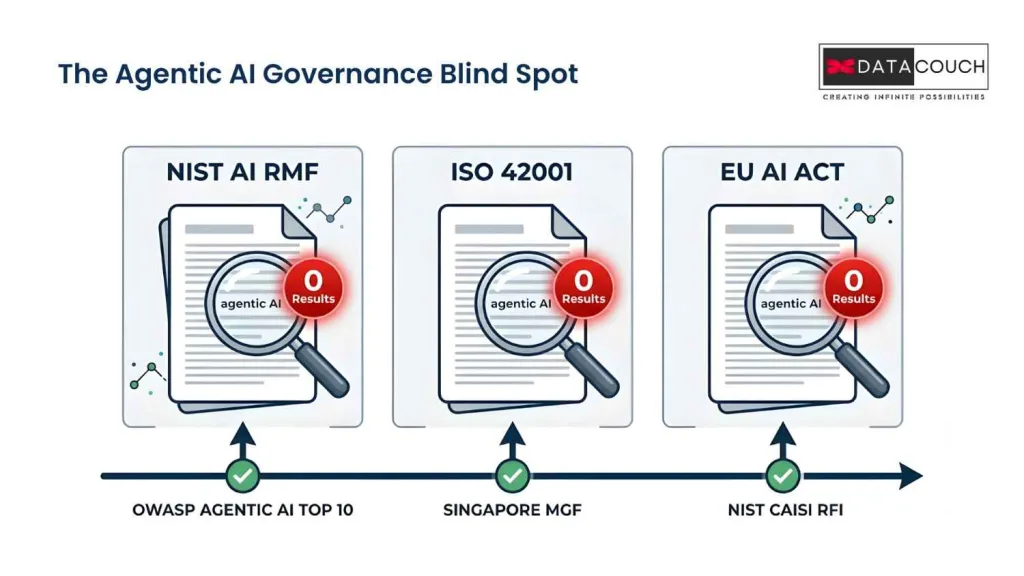
What most people do not realize is that the three most cited AI governance frameworks contain zero references to agents or agentic AI.
Search for “agent” or “agentic” in the NIST AI Risk Management Framework. Zero results. Try ISO 42001. Zero results. Check the EU AI Act. Zero results. As Zenity’s February 2026 analysis points out, this is not a minor editorial gap. It is a structural failure in the governance landscape at the exact moment organizations need guidance the most.
The IBM Cost of a Data Breach Report (2025) confirms the real-world impact: 97% of organizations reported an AI-related security incident and lacked proper AI access controls. Another 63% lacked governance policies to manage AI or prevent shadow AI.
Shadow AI Meets Agentic AI: A Dangerous Collision
Here is a combination that almost nobody is covering. A WalkMe survey from 2025 found that 78% of employees admit to using AI tools their employer has not approved. Only 7.5% have received extensive AI training.
Now consider what happens when those unapproved tools gain agentic capabilities. An employee using personal ChatGPT to analyze confidential revenue projections is risky enough. When that tool can autonomously send data, make API calls, or trigger workflows, the risk surface expands by orders of magnitude, and there is no audit trail.
The Numbers Paint a Clear Picture
| FINDING | SOURCE |
|---|---|
| Over 40% of agentic AI projects will be canceled by end of 2027 | Gartner, June 2025 |
| Only 21% of leaders have a mature governance model for autonomous agents | Deloitte/WEF, Jan 2026 |
| 42% of companies abandoned most AI initiatives in 2025, up from 17% in 2024 | S&P Global |
| Only 12% of organizations have data quality sufficient for AI | Precisely/Drexel University, 2025 |
| 70-85% of AI project failures trace to data architecture issues | Industry Reports, 2025 |
| 95% of enterprise AI pilots fail to deliver expected returns | MIT Project NANDA |
| Only 2% of organizations have deployed agentic AI at scale | Industry Analysis, Jan 2026 |
Look at that table for a moment. The adoption enthusiasm is real, with 79% of organizations reporting some level of AI agent adoption. But the governance readiness sits far behind. That gap is the velocity paradox in action.
Five Principles to Scale Agentic AI Without Losing Control
So how do you move fast without breaking everything? Based on frameworks from McKinsey, KPMG, Singapore’s government (which published the first agentic AI governance framework in January 2026), and IBM, here are five principles that work.
1. Staged Autonomy: Stop Thinking in Binary
Most governance conversations get stuck in a binary debate: human in the loop or fully autonomous. That framing misses the point entirely.
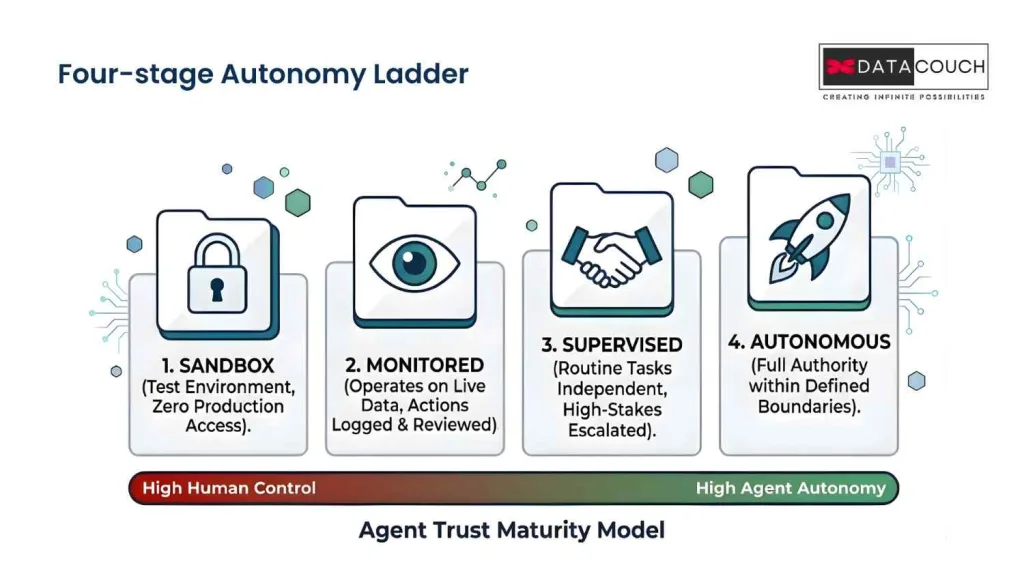
The smarter approach is staged autonomy. Agents start with limited permissions and earn greater independence through verified performance. Think of it as a maturity ladder:
- Sandbox: The agent runs in a test environment with no access to production systems.
- Monitored: The agent operates on live data, but every action is logged and reviewed by a human.
- Supervised: The agent handles routine tasks independently. High-stakes or unusual decisions get escalated.
- Autonomous: The agent operates with full authority within clearly defined boundaries. Exception-based oversight only.
Singapore’s Model Governance Framework for Agentic AI (released at WEF Davos in January 2026) introduces two critical concepts here: the agent’s action-space (which tools and systems it may access) and its autonomy level (the instructions and oversight applied). Every agent should have both clearly defined before it touches a production workflow.
2. Embedded Compliance: Build Governance Into the Agent, Not Around It
Traditional compliance relies on periodic audits and after-the-fact reviews. That approach was designed for systems that make a few decisions per day, not thousands. As the National Association of Corporate Directors (NACD) warns, regulatory compliance becomes exponentially more complex when AI systems take thousands of actions daily without human review.
The fix is embedded compliance. Build regulatory requirements directly into the agent’s design. Real-time guardrails that prevent the agent from deviating from policy. Every decision logged in a format that is ready for regulators at a moment’s notice. If compliance is baked into the architecture, it does not slow things down. It runs at the same speed as the agent.
3. Treat Every Agent Like an Employee: Identity-First Architecture
Every person in your organization has an identity, a role, specific permissions, and an audit trail of their actions. Your AI agents need the same.
- Identity and access: Each agent gets scoped permissions. It can do what it needs to, and nothing more.
- Observability: Monitor the performance, bias, and ROI of every agent from a single dashboard.
- Data integrity: Guarantee that the information feeding agents is secure and unmanipulated.
This matters because IDC predicts 1.3 billion AI agents globally by 2028. Without centralized identity management, you get agent sprawl, where nobody knows which agents exist, what permissions they have, or what decisions they are making. According to Bain’s 2025 Technology Report, 63% of executives already cite platform sprawl as a growing concern.
4. Guardian Agents: Use AI to Watch Your AI
Here is a concept that most governance articles skip entirely. Gartner predicts that guardian agents, AI systems designed to monitor other AI systems, will capture 10-15% of the agentic AI market by 2030.
The logic is straightforward. When an agent makes thousands of decisions per hour, a blanket policy requiring human review of every action is operationally impossible. What works instead is a tiered oversight model. Automated controls handle routine monitoring. Exception-based escalation routes unusual or high-stakes decisions to human reviewers. Continuous drift detection catches problems before they become incidents.
Guardian agents make this scalable. They watch for policy violations, flag anomalies, and trigger circuit breakers when something goes wrong, all at machine speed.
5. Break Down the Silos: Cross-Functional Governance Is Non-Negotiable
One of the most underappreciated challenges in enterprise AI governance, as noted by Fulcrum Digital’s 2026 analysis, is the absence of a shared AI risk taxonomy. Technology teams, risk functions, legal counsel, and business units routinely use overlapping but inconsistent language to describe AI-related risks. This creates gaps in coverage that nobody owns.
The solution is a cross-functional Agent Governance Board that brings together technical experts, business leaders, ethics specialists, and legal counsel. This is not another committee that meets quarterly. It is an operating function that runs at the speed of your agent deployments.
If your team is building or deploying agentic AI systems and needs a structured path from pilot to production, explore DataCouch's Agentic AI Solutions and Development services to get expert guidance on architecture, governance, and safe scaling.
The Regulatory Landscape: What Is Coming and What You Need to Know
Enterprises cannot wait for regulators to catch up. But they should know what is coming.
The EU AI Act is now fully enforceable, with high-risk AI requirements due by August 2026. It was not designed with agentic AI in mind, but its broad definition of AI systems captures agents operating in high-risk domains like healthcare, finance, and employment. The core tension: the business logic of agentic AI drives toward autonomy, while the law demands friction and human oversight.
In January 2026, NIST’s Center for AI Standards and Innovation released a Request for Information specifically on secure development and deployment of agentic AI systems. This is expected to become mandatory for US federal contractors, but formalization will take months.
The OWASP Agentic AI Top 10, published in late 2025, provides the most practical risk framework available right now. But it has not yet been integrated into ISO 42001, the EU AI Act, or NIST’s RMF.
The bottom line: there is a regulatory gap today. It will close. Organizations that build governance now will be ready. Those that wait will scramble to retrofit compliance into systems that were never designed for it.
Governance Is the Competitive Advantage (Not the Bottleneck)
Arion Research’s 2025 study found that strong governance frameworks actually enable greater AI deployment by providing the confidence and structure necessary to scale autonomous operations. Organizations with robust governance deploy AI agents more widely, not less.
The ROI data supports this. According to PwC, 66% of companies adopting AI agents already report measurable value through increased productivity. Organizations project an average ROI of 171% from agentic AI deployments, with US enterprises forecasting 192%. But here is the catch: those returns only materialize when governance prevents the failures that derail projects.
An IDC/AWS study from March 2026 surveying 900+ organizations found that 67% believe their teams need more skills training to increase agentic AI adoption. The number one implementation challenge? Lack of skilled personnel, cited by 55% of respondents. This is where upskilling becomes the bridge between ambition and safe deployment.
The Window for Building Governance Is Closing
Let us recap what matters:
- Agentic AI is not another iteration of automation. It is a transfer of decision rights from humans to machines, and it demands a new governance architecture.
- The leading governance frameworks (NIST, ISO, EU AI Act) were not built for agentic systems. Organizations are operating in a structural gap.
- Staged autonomy, embedded compliance, identity-first architecture, guardian agents, and cross-functional governance are the five pillars that separate successful deployments from the 40% Gartner predicts will fail.
- Governance is not a cost center. It is the enabler that lets you deploy agents more widely and with more confidence.
McKinsey’s research team frames it well: most companies can get one or two agentic use cases running by putting the six smartest people in a room for a debate. But that does not scale. In five to ten years, enterprises will have thousands of agents running across the organization. The governance architecture you build today determines whether that fleet creates value or liability.
Whether you are a CTO planning your first agentic deployment, a team leader managing AI-driven workflows, or a student preparing for a career in this space, the skill that will matter most is knowing how to govern what you build.
DataCouch's Agentic AI Training programs are designed to close that gap, covering everything from agentic AI development to governance, risk management, and responsible scaling.
So here is the question worth asking: if your organization is investing in agentic AI, who is responsible for making sure those agents do what they are supposed to, and nothing more?