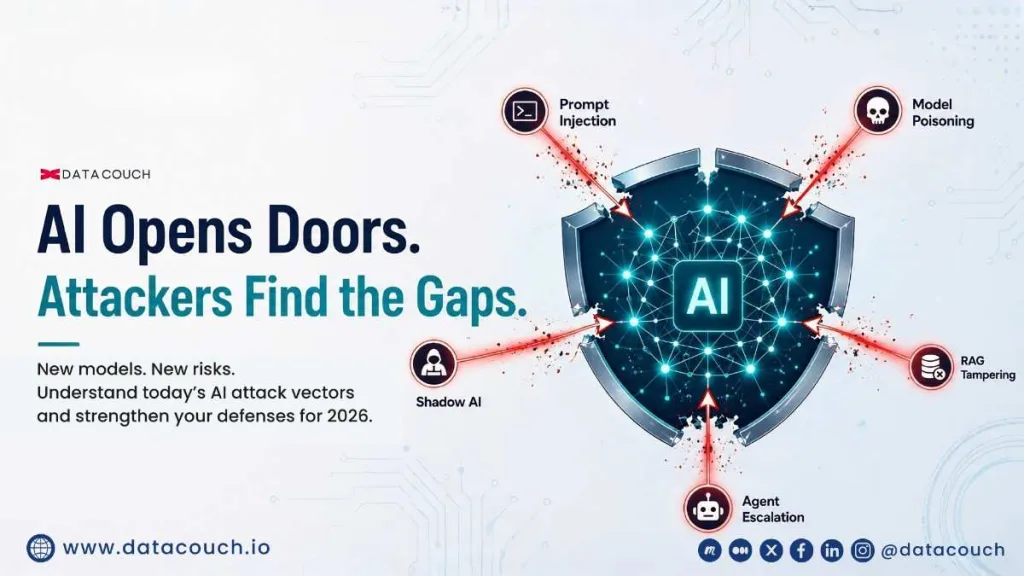
Why AI is the biggest new attack surface your security team isn't ready for
What is an AI attack surface? Every AI system you deploy, from a chatbot to an agentic workflow, creates new entry points for attackers that your existing firewalls, antivirus, and DLP tools were not designed to detect or block.
Your security team knows SQL injection. They know phishing. They know how to respond to a ransomware alert at 22 am What most security teams are not trained for is the entirely new category of vulnerabilities that AI systems introduce.
This is not a warning about AI in the future. In 2025, prompt injection attacks alone caused an estimated $2.3 billion in losses globally. Current detection tools catch only 23% of sophisticated injection attempts. And Gartner has identified AI-specific threats as the number one emerging risk category for enterprises in 2026.
The problem is not that AI security is impossible. The problem is that most organizations are defending AI systems with tools and training designed for a different threat model. This guide explains what the new attack surface actually looks like, why traditional defenses miss it, and what your team needs to do differently.
AI Did Not Just Change Your Defenses. It Changed the Attack.
For decades, cybersecurity was built on a principle: protect the perimeter, secure the endpoints, monitor the network. AI breaks all three of those assumptions simultaneously.
Your AI System Is Both a Target and a Weapon
Attackers are using AI to scale phishing campaigns, generate convincing deepfakes, and identify vulnerabilities faster than human security teams can patch them. At the same time, AI-powered attacks are 72% more common in 2026 than they were just one year ago. The AI models your organization deploys are also under attack, not through your network, but through the inputs they process and the data they learn from.
Here is the core insight that most security briefings miss: AI attacks operate at the semantic layer, not the code layer. A traditional SQL injection exploits how software processes characters and syntax. A prompt injection exploits how an AI processes meaning and instruction. Your firewall cannot tell the difference between a legitimate user query and a malicious one that is designed to override the model’s behavior.
The Five AI Attack Vectors Your Security Team Needs to Know Now
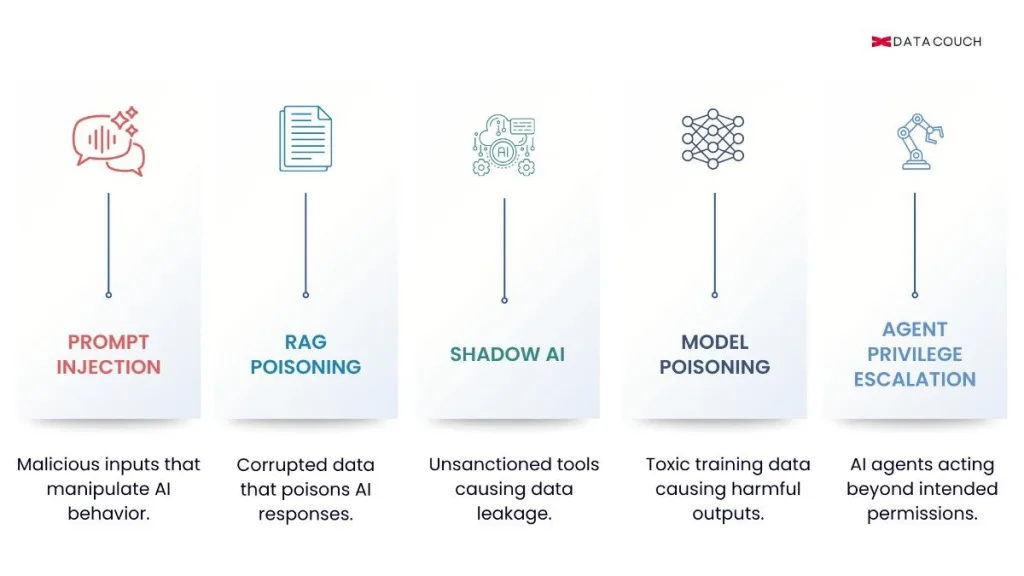
1. Prompt Injection: The Number One AI Vulnerability
Prompt injection is ranked number one on the OWASP Top 10 for LLM Applications 2025, appearing in over 73% of production AI deployments assessed during security audits. An attacker embeds malicious instructions inside content that the AI is asked to process: an email, a document, a web page. The AI cannot tell those instructions apart from legitimate ones and executes them.
In 2026, a documented zero-click attack against a major enterprise AI assistant worked like this: an attacker sent a crafted email to anyone in the organization. When any user later asked the AI assistant a question, it retrieved the poisoned email, executed the embedded instructions, and exfiltrated sensitive data via an image URL, all without a single click from the victim.
Prompt injection attacks caused an estimated $2.3 billion in losses globally in 2025. Current detection tools only catch approximately 23% of sophisticated injection attempts.
Source: Recorded Future / Practical DevSecOps AI Security Report, 2026
2. RAG Poisoning: When Your AI Knowledge Base Becomes the Threat
Retrieval-Augmented Generation (RAG) systems power most enterprise AI assistants. They work by pulling documents from your knowledge base to answer questions. Research published in 2026 found that just five carefully crafted documents injected into an AI knowledge base can manipulate that AI’s responses 90% of the time. An attacker does not need access to your model. They need access to any content that your model’s retrieval system indexes.
A poisoned document planted in a corporate knowledge base might instruct the AI to redirect financial approvals, share confidential HR records, or subtly alter compliance guidance. The AI presents this as authoritative because, to it, the document looks authoritative.
3. Shadow AI: The Threat Already Inside Your Organization
The most widespread AI security threat is also the least technical. 77% of enterprise employees who use AI have pasted company data into a chatbot query, and 22% of those instances included confidential personal or financial data. They are not doing this maliciously. They are doing it because the tool is helpful, and no one told them the data does not stay private.
Organizations with high levels of shadow AI usage faced an average of $670,000 more in data breach costs compared to those with governed AI policies. 1 in 5 organizations reported a breach directly caused by shadow AI usage.
4. Model Poisoning: Attacking the AI Before It Reaches You
Studies from Columbia, NYU, and Washington University found that as few as 50,000 fake articles added to a public training dataset were enough to corrupt medical AI models. The Turing Institute found that very small quantities of poisoned information corrupted even the largest models. A poisoned model looks identical to a clean one on standard benchmarks but behaves differently on specific inputs designed by the attacker.
If your organization uses a publicly available foundation model, fine-tunes it on external data, or relies on a third-party AI provider, the model’s training provenance is a security question, not just a technical one.
5. Agentic AI: The Highest-Stakes Attack Surface of 2026
According to Gartner, more than 80% of enterprises will have deployed some form of autonomous AI agents in production by the end of 2026. An AI agent does not just answer questions. It takes actions: sends emails, queries databases, executes code, and interacts with APIs. An agent with real permissions that receives a malicious prompt instruction does not push back. It executes.
In 2026, GitHub Copilot’s CVE-2025-53773 vulnerability (CVSS score 9.6) allowed hidden prompt injection in pull request descriptions to enable remote code execution. This was not theoretical. It was a production vulnerability in one of the most widely used developer AI tools in the world.
Why Traditional Security Tools Miss AI-Specific Threats
Here is the core problem. Every AI attack vector has a traditional security equivalent that your team knows how to handle. But the AI version operates differently, at a layer that existing tools were not designed to inspect.
| Threat Type | Traditional Security | AI-Specific Version | Why Traditional Defenses Miss It |
|---|---|---|---|
| Injection attack | SQL injection in databases | Prompt injection in LLMs and AI agents | SQL injection targets code syntax. Prompt injection operates at the semantic layer; it manipulates meaning, not structure. Firewalls cannot read intent. |
| Data poisoning | Malware in the software supply chain | Training data or RAG knowledge base poisoning | Just 5 crafted documents can manipulate AI responses 90% of the time (MDPI, 2026). No antivirus scans training sets. |
| Insider threat | Employee misuse of systems | Shadow AI employees using unapproved AI tools | 77% of employees have pasted company data into an AI chatbot (LayerX, 2025). No DLP policy covers semantic data leakage. |
| Privilege escalation | Exploiting system permissions | AI agent permission escalation in agentic workflows | An AI agent with read/write access can be instructed to act beyond scope by a hidden prompt in an email or document. |
| Supply chain attack | Compromised software libraries | Compromised AI models or fine-tuned backdoors | Poisoned models look identical to clean ones on standard tests but trigger on specific inputs planted by attackers. |
Does your security team have AI-specific training?
We can help build that capability.
The Skills Gap Is the Real Vulnerability
The technology to defend AI systems exists. The people trained to use it do not. Only 24% of enterprises have a dedicated AI security governance team. AI red-teaming demand is projected to surge 35% by 2028, with almost no supply of trained practitioners to meet it.
What Most People Don't Realize: AI Security Is a Training Problem First
The organizations suffering the most AI security incidents are not the ones with the weakest technology. They are the ones whose teams do not understand how AI systems process input, where they are vulnerable, or how an attacker approaches them differently from a traditional application.
Shadow AI is a training problem: employees use unapproved tools because they were never told why the policy exists or what the real risk is. Prompt injection succeeds because developers build AI applications without understanding how input validation works at the semantic layer. Model poisoning goes undetected because no one on the team knows what behavioral drift looks like or how to monitor for it.
Governance solves the policy layer. Training solves the human layer. You need both.
What Your Organization Needs to Do Right Now
There is no single tool that makes AI secure. The defense is a practice built across five layers. Here is what each one covers and where DataCouch’s consulting and training work fits into each.
| Layer | What It Covers | DataCouch Role |
|---|---|---|
| Data Governance | Data policy, access controls, provenance tracking, and shadow AI audit | Governance framework design, policy review, and AI access control architecture |
| AI Security Training | Upskilling security and development teams on prompt injection, RAG risks, and agentic AI vulnerabilities | Custom AI cybersecurity training programs and certification delivery |
| Red Teaming | Adversarial testing of AI models, RAG pipelines, and agentic workflows before production deployment | AI red team consulting, threat modeling, and penetration test preparation |
| Model Monitoring | Behavioral drift detection, output anomaly monitoring, and access log review | Monitoring architecture design and tooling selection across partner platforms |
| Governance Policy | AI-specific security policies, incident response playbooks, and regulatory compliance (EU AI Act, NIST AI RMF) | Policy design, compliance gap analysis, and Trusted AI governance frameworks |
Three Immediate Actions Any Organization Can Take This Week
- Audit your AI tool inventory: List every AI tool in use across your organization, including tools employees are using without approval. You cannot govern what you cannot see.
- Map your AI attack surface: For each AI system in production, document: what data feeds it, who has access to it, what actions it can take, and how its outputs are validated. This is your threat model.
- Run one AI-specific red team exercise: Add prompt injection testing to your next penetration test. Ask your red team to attempt indirect prompt injection through documents, emails, and form inputs that your AI assistant processes.
We specialize in custom AI programs and globally recognized certification training at scale.
No AI Policy Without a Data Policy. This Applies to Security Too
DataCouch’s foundational position on AI adoption applies directly to cybersecurity. Before you deploy an AI system into any business function, three questions must be answered with complete honesty.
What data feeds this AI system? If the training data or retrieval data has unknown provenance, you have no way to know whether it has been tampered with. Data lineage is a security requirement.
Who has access to this AI system, and what can it do? Unauthenticated access to an AI system with write permissions is an open door. Role-based access controls must extend to AI agents with the same rigor applied to human users.
How will you detect when the AI is behaving unexpectedly? Behavioral drift is the AI equivalent of an insider threat. If you have no monitoring in place, you will not know the model has been compromised until after the damage is done.
The EU AI Act enforcement deadline is August 2026. NIST AI RMF and ISO 42001 now mandate specific controls for prompt injection prevention and detection. Regulatory compliance on AI security is no longer optional for any organization operating in regulated markets. Organizations that have not started their governance review are already behind the deadline.
How DataCouch Approaches AI Cybersecurity Enablement
We do not offer a single AI security product. We build capability across the four pillars that make AI adoption secure over time: Custom Training, AI Consulting, Custom AI Solutions, and Custom Coaching.
Custom Training AI-specific cybersecurity programs covering prompt injection defense, RAG security, shadow AI governance, and agentic AI risk. Delivered to security teams, development teams, and business users at the level of understanding each group needs.
AI Consulting Governance framework design, AI attack surface mapping, data policy review, and compliance readiness assessment for the EU AI Act, NIST AI RMF, and ISO 42001.
Custom AI Solutions Secure-by-design AI deployments with access controls, behavioral monitoring, and data provenance tracking built in from architecture, not added after deployment.
Custom Coaching: One-on-one and team coaching for CISOs, security architects, and AI leads on how to approach AI threat modeling, red team preparation, and governance policy design.
Key Takeaways: What to Remember Before You Close This Tab
- AI attacks operate at the semantic layer, not the code layer. Traditional firewalls, antivirus, and DLP tools were not designed to detect them.
- Prompt injection is the number one LLM vulnerability in 2026, appearing in over 73% of production AI deployments and causing $2.3 billion in losses globally in 2025.
- RAG poisoning means your AI knowledge base is now part of your threat surface. Five crafted documents can manipulate AI responses 90% of the time.
- Shadow AI is already inside your organization. 77% of employees have pasted company data into an AI chatbot. This is a training problem, not just a technology problem.
- Agentic AI raises the stakes dramatically. Agents with real permissions that receive malicious instructions do not push back. They execute.
- Only 24% of enterprises have a dedicated AI security governance team. The skills gap is the vulnerability.
- The defense is a practice across five layers: data governance, AI security training, red teaming, model monitoring, and governance policy.
Here is the question worth asking before your next AI deployment: Does your security team know how to test this system for prompt injection, how to monitor it for behavioral drift, and how to respond when it is compromised in a way that leaves no firewall log?
If the answer is not a confident yes, that is the gap to close first.