
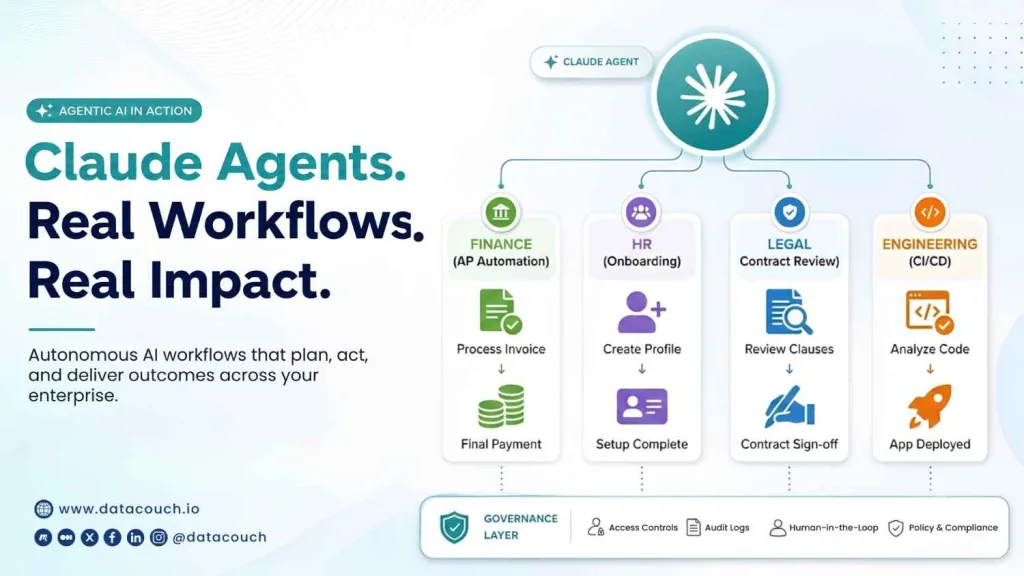
Building Agentic Workflows With Claude: What You Need to Know Before You Deploy
What is an agentic AI workflow? An AI agent that does not just respond to questions but plans a sequence of actions, selects and uses the right tools for each step, executes those actions across real enterprise systems, reviews its own outputs, and adapts when something does not work as expected, often without requiring human approval at every step.
Most enterprise AI deployments today are conversational. A user asks a question. The AI responds. The user reviews the response and decides what to do with it. This is AI as an advisor.
Agentic AI is fundamentally different. An agentic workflow means the AI does not just advise. It acts. It reads the document, drafts the email, sends it to the right person, logs the action in the CRM, checks whether a response arrived, and follows up if it did not. It does all of this based on a goal the user stated at the start of the workflow, without requiring step-by-step instructions at each stage.
Gartner predicts that 40% of enterprise applications will integrate task-specific AI agents by the end of 2026, up from less than 5% today. McKinsey’s 2025 State of AI found that 23% of organisations are already scaling agentic AI in at least one business function, with 39% actively experimenting. The shift from AI as advisor to AI as actor is underway. The question for enterprise teams is not whether to adopt agentic AI, but how to do it safely.
What Makes Claude Particularly Suited for Enterprise Agentic Workflows
Tool Use: The Foundation of Agentic Capability
Claude’s tool use capability allows it to call external functions, APIs, and services as part of completing a task. In an agentic workflow, tool use is what allows the agent to take real actions: querying a database, calling a REST API, searching the web, writing to a file system, or triggering a downstream service. Claude’s tool use design includes explicit logging of every tool call made, which is a foundational requirement for enterprise auditability.
Computer Use: Interacting With Interfaces That Have No API
Claude’s computer use capability allows it to interact with software interfaces directly: clicking, typing, reading screens, and navigating applications the same way a person would. This matters for enterprise automation because many of the systems organisations need to automate do not have public APIs: legacy ERP systems, proprietary internal tools, and vendor software with limited integration options. Computer use extends agentic workflows into systems that traditional RPA and API-based automation cannot reach.
Model Context Protocol: Connecting Claude to Your Enterprise Systems
The Model Context Protocol is an open standard developed by Anthropic that defines how AI models connect to external data sources, tools, and services. MCP allows enterprise teams to build governed connectors between Claude and their specific systems, including internal databases, proprietary APIs, document management systems, and communication platforms, with standardised authorisation, logging, and access control built into the protocol.
Long Context: Completing Workflows That Require Full Document Understanding
Many enterprise agentic workflows require the agent to understand the full content of a document before taking action: reviewing a contract before flagging clauses, analysing a financial report before generating commentary, reading a support history before drafting a resolution. Claude’s 200,000-token context window allows it to complete these workflows without the chunking and summarisation steps that introduce errors in shorter-context models.
Gartner predicts 40% of enterprise applications will integrate AI agents by the end of 2026, up from under 5% in 2025. McKinsey found that 23% of organisations are already scaling agentic AI, with 39% experimenting. Organisations with agentic AI in production report 55% expecting high cost and productivity improvements.
Five Enterprise Agentic Workflows You Can Build With Claude Today
| Workflow | What the Agent Does | Teams That Use It |
|---|---|---|
| Contract review and flagging | Reads the full contract, identifies non-standard clauses against a defined playbook, flags items for legal review with specific clause citations, and routes to the appropriate reviewer based on contract type and value | Legal, procurement, finance |
| Customer support resolution | Reads the full support ticket history, queries the product database for relevant known issues, drafts a resolution response, escalates to a specialist if the issue matches defined escalation criteria, and logs the outcome in the CRM | Customer success, operations |
| Financial report commentary | Reads the full financial report, compares metrics to prior period and defined benchmarks, drafts a commentary narrative for each section, flags anomalies for management review, and formats the output in the required report template | Finance, FP&A, investor relations |
| Engineering code review | Reviews pull request code changes against the codebase context and style guide, identifies potential bugs and security issues, suggests improvements with specific line references, and posts structured review comments | Engineering, DevSecOps |
| Onboarding workflow automation | Reads the new hire's role profile, generates a personalised onboarding checklist, creates accounts in required systems, schedules introductory meetings with relevant team members, and sends welcome communications | HR, IT operations |
DataCouch helps enterprises design, govern, and deploy agentic AI workflows safely and at scale.
The Governance Requirements That Agentic AI Makes Non-Negotiable
Agentic AI raises the governance stakes significantly compared to conversational AI. When an AI agent takes real actions across real systems, the governance framework must address questions that do not arise in a conversational context.
Define the Scope Before You Define the Workflow
Every agentic workflow must have a clearly defined scope: what actions can the agent take, what systems can it access, what data can it read and write, and what decisions require human review before execution. An agent with undefined scope will eventually take an action that was not intended. Defining scope is not a constraint on the agent’s usefulness. It is the condition that makes the agent deployable in a production environment.
Human-in-the-Loop Is Not Optional for High-Stakes Decisions
Agentic AI governance requires identifying which decision points in a workflow require human review before the agent proceeds. For contract clauses above a certain value, for customer escalations above a certain sensitivity level, for any financial transaction above a defined threshold, the agent should present its recommendation and pause for approval rather than executing autonomously. The granularity of human-in-the-loop requirements depends on the risk profile of the specific workflow, not a general policy applied uniformly.
Every Action Must Be Logged and Explainable
An agentic workflow that cannot produce a full audit trail of every action taken, every tool called, every decision made, and every output generated is not suitable for regulated enterprise environments. Claude’s tool use design logs every tool call explicitly. Enterprise agentic deployments should extend this logging to include the reasoning that led to each decision, the data sources consulted, and the human review points where applicable. This logging is the evidence that satisfies regulatory audit requirements and the diagnostic tool that enables continuous improvement.
Test for Failure Before Deploying for Success
Agentic workflows fail in ways that conversational AI does not. An agent can take a sequence of individually reasonable actions that collectively produce an unintended outcome. Before any agentic workflow reaches production, it must be tested with adversarial inputs: what happens if the input document is malformed, if an external API returns an unexpected response, if the agent encounters a scenario outside its defined scope? Red-team testing of agentic workflows is the enterprise equivalent of the prompt injection testing described in our AI Cybersecurity guide.
The DataCouch Approach to Agentic AI Deployment
DataCouch’s agentic AI engagements follow the same four-pillar structure applied across all our AI deployments, with specific adaptations for the higher governance requirements of autonomous systems.
Custom Training: Agentic AI literacy programs for the teams that will work alongside and manage agentic workflows. This covers how agents make decisions, how to review agent outputs critically, what the escalation path is when an agent encounters a scenario outside its scope, and how to interpret audit logs for governance and compliance purposes.
AI Consulting: Agentic workflow design, scope definition, human-in-the-loop requirement mapping, audit logging architecture, and governance framework development specific to the regulatory requirements of each industry and use case.
Custom AI Solutions: End-to-end agentic workflow development using Claude’s tool use, computer use, and MCP capabilities, with enterprise-grade logging, access controls, and failure handling built into every workflow from design, not added after deployment.
Custom Coaching: Ongoing support for AI leads, engineering teams, and governance officers as agentic workflows scale and the Claude platform evolves. Agentic AI is advancing faster than any other category of AI capability. Organisations need a partner who tracks that evolution and helps them adapt their deployments accordingly.
Key Takeaways
- Agentic AI is not a smarter chatbot. It plans, decides, executes, and adapts across real enterprise systems without step-by-step human instruction. The governance requirements are fundamentally different from conversational AI.
- Claude’s tool use, computer use, MCP integration, and 200,000-token context window provide a comprehensive technical foundation for enterprise agentic workflows across a wide range of business functions.
- 40% of enterprise applications will integrate AI agents by the end of 2026, per Gartner. 23% of organisations are already scaling agentic AI. This is not a future planning exercise. It is an active deployment challenge.
- Scope definition, human-in-the-loop requirements, audit logging, and adversarial testing are the four governance requirements that every enterprise agentic workflow must address before production deployment.
- The highest-value enterprise agentic workflows cover contract review, customer support resolution, financial report commentary, engineering code review, and HR onboarding automation, all achievable with Claude’s current capability set.
- Agentic AI governance requires the same foundational position as all AI governance: no AI workflow without a data policy, no autonomous agent without a defined accountability chain, and no production deployment without a human review framework.
Here is the question to ask before your organisation’s first agentic workflow goes live: if this agent takes an action that produces an unintended outcome, can you identify exactly what decision the agent made, what data it used to make it, and who in the organisation is accountable for that outcome?
If the answer is no, that is the governance gap to close before the workflow deploys.