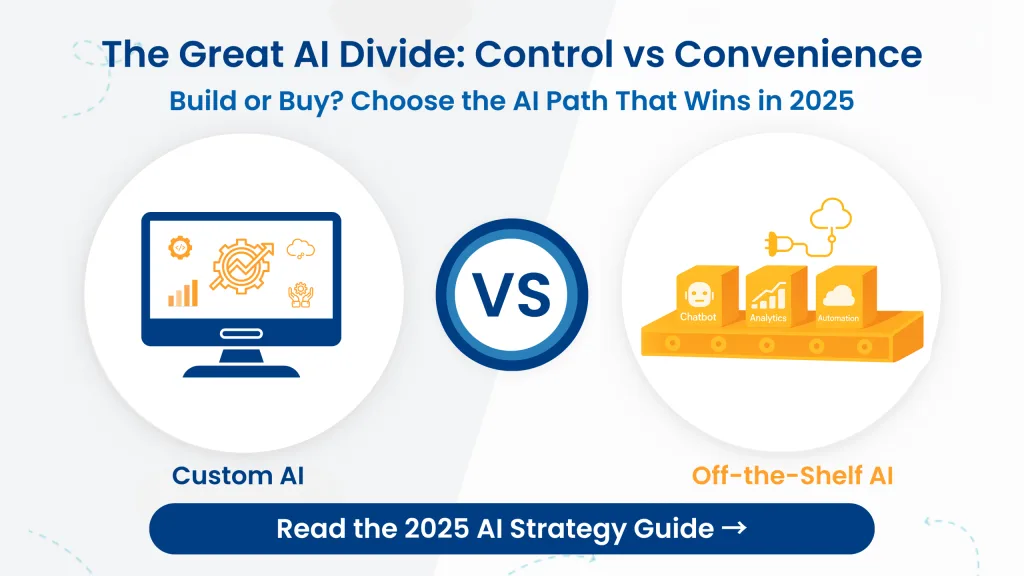
Custom AI Agent vs. Off-the-Shelf Platform: Which is Right for Your Business?
An AI agent is smart software that works on its own. It can figure out what’s going on, make choices, and handle complex jobs to reach a goal, all without much help from a person.
Deciding to use AI is no longer a question of if, but how. As businesses look past simple automation, they face a big choice: should you build your own AI agent from scratch, or buy one that’s ready to go? This is more than just a tech decision. It’s a major business move that will affect how you compete, work, and grow.
Getting this wrong can cost you. A recent MIT study from 2025 found that a shocking 95% of AI projects don’t actually help a company’s profits. But here’s the interesting part: the study also showed that companies that “buy” or partner on AI solutions are twice as successful as those who try to “build” everything themselves.
In this guide, we’ll help you make that choice. We’ll look at the good and bad of each option, give you a simple framework to follow, and show you how to pick the path that brings real value to your business.
The AI World in 2025: It's Not Just Chatbots Anymore
To make a smart choice, you need to know what today’s AI can do. People throw around the term “AI” for everything, but the technology has grown into different levels of smarts and independence.
So, What's an AI Agent? (And Why Is It Different?)
Not all automated tools are the same. Knowing the difference between bots, assistants, and true agents helps you put your money in the right place.
- Bots: These are the most basic. Bots are simple programs that follow a script to do the same task over and over. They don’t learn or remember anything.
- AI Assistants: Think of Siri or Google Assistant. They understand what you say and can help with simple jobs, but you’re still in charge and telling them what to do.
- AI Agents: This is a big leap. An AI agent can see what’s happening, think about its options, and act on its own to reach a goal. It has a memory, so it learns from what it does and gets better over time.
- Agentic AI: This is the big picture. It’s a whole system where many different AI agents work together to run a complete business process from start to finish. A powerful Large Language Model (LLM) acts as the “brain,” figuring out the plan and telling the other agents what to do.
When a company talks about “agentic AI,” it shows they’re thinking big—not just about automating one task, but about changing how their whole business works.
The Real World of AI: Big Risks, Big Rewards
The AI market is huge and growing fast. The AI software market is anticipated to be worth $126 billion in 2025. A recent report from Forbes found that 83% of companies say AI is a top priority for them.
But all that money and excitement don’t guarantee success. That 95% failure rate from the MIT study is a serious warning. It shows that getting AI right is hard. That’s why the “build vs. buy” decision is so important. It’s the first step toward being one of the 5% of companies that actually make money from AI.
The "Buy" Option: What Are Off-the-Shelf AI Platforms?
The “buy” path means you license a ready-made AI tool from another company. These platforms are designed to be fast and easy to set up, offering a fast way to start using AI.
What Are These Ready-Made AI Tools?
Off-the-shelf AI tools are products you can start using almost immediately. They are built to solve common problems that many businesses have.
Here are some common examples:
- Ready-to-use chatbot templates for answering customer questions.
- Tools that check social media for positive or negative comments.
- AI features that plug right into software you already use, like Salesforce or HubSpot.
- Automated systems for customer support.
The Good Stuff: Fast, Simple, and Cheaper to Start
For many businesses, especially smaller ones, buying an AI tool is a great option for a few reasons:
- Get Started Fast: You can get a ready-made tool working in days or weeks, not months. This is great if you have an urgent need or just want to test an idea.
- Easier on the Wallet Upfront: You usually pay a monthly or yearly subscription instead of a huge upfront cost. This makes it easier for businesses on a budget to get started.
- No Maintenance Headaches: The company that sells the tool handles all the updates, security, and fixes. This frees up your team from a lot of technical work.
- Easy for Anyone to Use: Most of these tools are designed for people who aren’t tech experts. They have simple screens and are easy to learn.
The Bad Stuff: The Hidden Problems with "Easy" AI
The “buy” path looks simple, but it has some hidden traps that can cause problems and cost you more down the road.
- The “Customization” Trap: Vendors say their tools are “customizable,” but this often just means you can make small tweaks. If you need a real change to fit how you work, you’ll likely have to pay their expensive consultants to do it for you.
- You’re Stuck with What They Offer: You can only use the features the vendor gives you. This means you might have to change your business process to fit the tool, instead of the other way around.
- The Shock of Scaling: Many tools charge you based on how much you use them. If your AI tool becomes a big hit, your small monthly bill can suddenly become a giant expense, punishing you for your success.
- Your Data Isn’t Really Yours: When you use someone else’s tool, your company’s private data is stored on their servers. You don’t have full control over it, which can be a tremendous risk, especially if you’re in an industry with strict data rules.
- It’s Hard to Leave: Once you’re set up with a vendor, switching to a different one can be very difficult and expensive. This “vendor lock-in” means you’re stuck with their pricing and whatever new features they decide to build.
The "Build" Option: Creating Your Own Custom AI Agent
The “build” path means you create an AI system from scratch, either with your own team or with a partner like DataCouch. This approach treats AI as a key business asset you own, not just a tool you rent.
What Is a Custom AI Agent?
A custom AI agent is an AI system built just for your business. It’s designed to work exactly the way you do, connect perfectly with your other software, and learn from your private company data. It’s a digital part of your business that helps you stand out from the competition.
Here’s what makes it special:
- It’s built to do exactly what you need.
- You own everything—the code, the AI model, and the data.
- It’s made to connect smoothly with all your other systems.
- It grows with your business, on your terms.
The Good Stuff: Control, a Competitive Edge, and Lasting Value
Building your own AI is a big project, but the benefits can be huge.
- You’re in Complete Control: Every part of the AI is designed for your business. You decide how it works, what it does, and how it changes over time.
- Your Data Stays Safe and Sound: All of your important business and customer information stays on your own systems. This is a must-have for businesses in industries with strict rules, like healthcare or finance.
- Get an Edge Over Your Competition: A custom AI agent is something your competitors can’t just go out and buy. By training it on your own data, you create a smart system that gives you a unique advantage.
- A Smarter Investment Over Time: The upfront cost is higher, but you don’t have to pay monthly fees that go up as you grow. A custom agent is an asset that becomes more valuable over time and can save you more money in the long run.
The Bad Stuff: The Reality of a Big Tech Project
Building your own AI isn’t for everyone. You need to be realistic about what it takes.
- It Costs More to Start: Creating a custom agent requires a big investment upfront. A simple agent might cost $5,000, but a complex one for a large company could cost over $500,000.
- It Takes Longer to Build: A custom project is a marathon, not a sprint. It can take around 3 to 18 months to get it built and working.
- You Need Experts: You need a team of skilled data scientists and AI engineers. For most companies, this means finding a partner that specializes in agentic AI development services.
- You’re in Charge of Upkeep: You have to handle all the maintenance, updates, and retraining yourself. This usually costs about 15-25% of the original build cost each year.
The Strategic Showdown: A Head-to-Head Comparison
Let’s put the two options side-by-side to see the differences clearly.
Comparison Table: Build vs. Buy at a Glance
| Feature | Custom AI (Build) | Off-the-Shelf AI (Buy) |
|---|---|---|
| Initial Cost | High upfront cost ($50k - $500k+) | Low monthly fee (starts free, can be $40k+/year) |
| Total Cost | High but you can control it. | Can get very expensive as you grow, with hidden fees. |
| Time to Launch | Long (3–18 months) | Fast (Days to weeks) |
| Customization | Unlimited. Built just for you. | Very limited. You have to work the way the tool works. |
| Scalability | Built to grow with you. | Limited. Can get pricey when you need more power. |
| Data Control | You own and control all your data. | Your data is on the vendor's servers, which can be a risk. |
| Competitive Edge | High. You have something unique that no one else has. | Low. Your competitors can use the same exact tool. |
Why "Good Enough" AI Can Be a Ticking Time Bomb
Many businesses choose off-the-shelf tools because they seem “good enough” for now. But this can cause big problems later. A generic tool will never understand your business’s special language or processes. As you grow, you’ll hit a wall where the tool holds you back, and you’ll be forced to make a difficult and expensive switch.
The Decision Framework: How to Choose the Right Path for Your Business
The best choice depends on your business. Ask yourself these four questions to figure out which path is right for you.
Question 1: Is This AI for Your Secret Sauce or a Simple Task?
This is the most important question. If the AI is for something that makes your business special and helps you beat the competition, you need to own it. In that case, you should build a custom solution. If it’s for a simple, common task like an internal help desk, then an off-the-shelf tool is the smarter choice.
Question 2: Do You Work in a Special Way?
Do you have unique ways of doing things or special data that no one else has? If so, a generic tool won’t be able to use that to your advantage. A custom agent can be prepared on your data and taught your business rules, turning what makes you special into a real advantage. If your processes are pretty standard, an off-the-shelf tool should work just fine.
Question 3: What Can You Realistically Afford?
You have to be honest about your resources. If you have a small budget, a tight deadline, and no AI experts on your team, you should probably lean toward an off-the-shelf solution. If you have the money, time, and access to experts, then the custom path is a great option that can deliver more value in the long run.
Question 4: Do You Handle Sensitive Information?
This can be a deal-breaker. If you’re in an industry like healthcare or finance with strict rules, you need to have full control over your data. Giving sensitive information to a third-party vendor is often too risky. In these situations, a custom solution is usually the only way to make sure you’re following all the rules.
Beyond Build or Buy: The Smart Middle Ground—The Hybrid Model
The choice isn’t always just “build” or “buy.” There’s a third option that’s becoming very popular because it offers the best of both worlds: the hybrid model.
What is the Hybrid Approach?
The hybrid model mixes buying and building. You start with a powerful, ready-made AI “brain” from a big company like Google or OpenAI. Then, you build a custom layer on top of it. This custom part is trained with your own business data, which teaches the general AI all the specifics about how your business works.
The Best of Both Worlds? Pros and Cons of Hybrid AI
- Pros: This approach is much faster than a full custom build (usually 2-6 months instead of 6-18+). It’s also cheaper because you’re not building the core AI from scratch. But it performs much better than a generic tool because it’s been trained on your data. You also keep control over your data and the custom parts that make you unique.
- Cons: It’s still a technical project. You need experts who know how to do this kind of work. You also still depend on the company that provides the core AI “brain,” so you’re subject to their pricing and any changes they make.
When a Hybrid Solution is Your Smartest Move
The hybrid model is perfect when a ready-made tool isn’t powerful enough, but a full custom build is too expensive or would take too long. It’s great for creating specialized agents, like a law firm training an AI on its past cases or a marketing team creating an AI that writes in its specific brand voice.
Your Next Steps: How to Start Your AI Journey
Getting started with AI should be a step-by-step process. Don’t try to do everything at once.
A Phased Approach to Adopting AI
Here’s a simple, three-phase plan to get started and reduce risk:
- Phase 1: Experiment & Learn (0-6 Months): Start with low-risk, off-the-shelf tools for simple tasks. Use this time to learn, show some quick wins, and figure out how to measure success.
- Phase 2: Strategize & Specialize (6-18 Months): Use the hybrid model for a more important project where your own data can give you an edge. This is where you start to see real, unique value.
- Phase 3: Differentiate & Own (18+ Months): Once you’ve had some success, invest in a full custom build for something that is core to your business and will set you apart from everyone else.
Finding the Right Partner for Agentic AI Development Services
For most companies, building a custom or hybrid solution means finding a good partner. Here’s what to look for:
- They care about your business goals, not just the tech. A good partner will want to know what you’re trying to accomplish and how you’ll measure success.
- They have experience with complex projects. They should be able to understand how you work and figure out the best way to automate it.
- They support you from start to finish. Look for a partner who will help you with everything from planning to building, testing, and improving the AI over time.
- They build AI you can understand. You should always know why your AI makes the choices it does. A good partner will be transparent and build systems that people can trust.
The Takeaway: Which AI Path is Best for You in 2025?
Choosing between building, buying, or blending is one of the biggest decisions your business will make. There’s no one-size-fits-all answer, only the answer that’s right for you.
- Choose Off-the-Shelf (Buy) when you need to move fast, your needs are standard, and your budget is tight. It’s great for testing ideas and automating simple tasks.
- Choose Custom (Build) when the AI is a key part of what makes you special, your work is unique, and you need top-notch security. It’s a long-term investment in something only you will have.
- Choose Hybrid when you need something more powerful than a generic tool but can’t commit to a full custom build. It’s a smart balance of speed, power, and control.
Based on the data, the best advice for most businesses is to “buy or partner first and build only when you absolutely have to”. By starting with proven solutions, you give yourself a much better chance of success.
Ready to see how a custom or hybrid AI agent can change your business and give you a real competitive edge?
Contact the experts at DataCouch today for a strategic consultation.