
The EU AI Act Compliance Deadline Is Here: What Every Enterprise Must Have in Place by August 2026
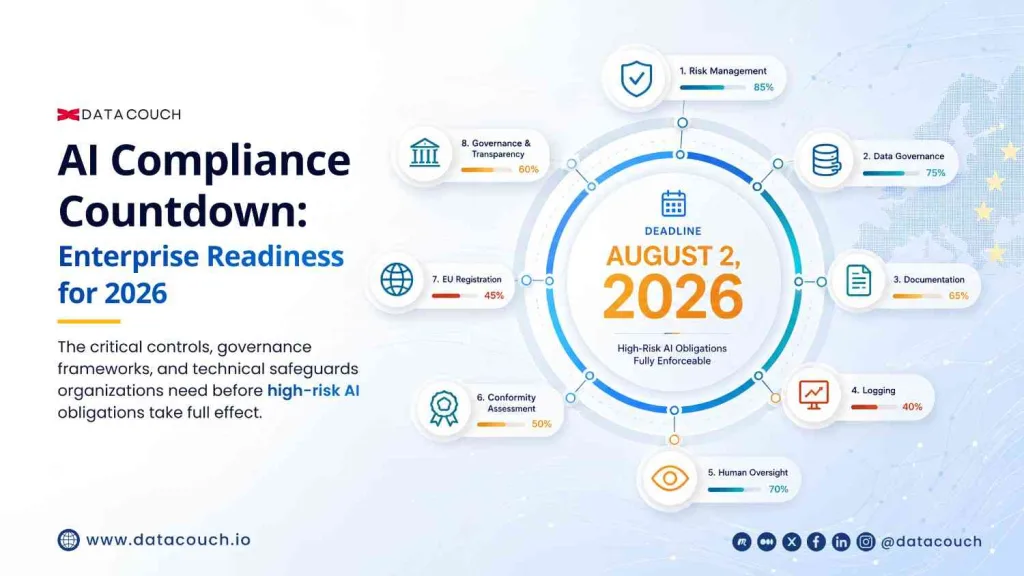
The date that defines enterprise AI compliance in 2026: August 2, 2026, is the date on which the full obligations for high-risk AI systems under the EU AI Act become enforceable. Organisations that are not ready on that date are not behind schedule. They are in violation.
The EU AI Act is not a future regulation. It entered into force on August 1, 2024. The prohibited practices have been enforced since February 2025. The general-purpose AI model obligations, including technical documentation and copyright compliance, have been in effect since August 2, 2025.
August 2, 2026, is the next and most consequential milestone: the date on which the full compliance obligations for high-risk AI systems become enforceable across all sectors, for all organisations whose AI systems operate in or produce outputs that affect the European Union.
The regulation applies extraterritorially. Any organisation, regardless of where it is headquartered, must comply if its AI systems are used within the EU or produce outputs that affect EU residents. A US-based company using AI for loan approvals that serves European customers falls within scope, even if the AI models run on servers outside Europe. The penalties for non-compliance reach up to 35 million euros or 7% of global annual turnover, whichever is higher.
This guide provides a precise compliance checklist for organisations that provide or deploy high-risk AI systems. It covers what each obligation requires in practice, which articles govern it, and what must be in place before August 2, 2026.
The EU AI Act Timeline: What Is Already Enforceable
August 2024 AI Act enters into force
The regulation becomes EU law. The four-year implementation window begins. All organisations operating AI systems that could fall within scope should begin gap assessments now.
February 2, 2025, Prohibited AI practices banned
AI systems that pose unacceptable risks are banned outright: social scoring systems, real-time biometric surveillance in public spaces (with narrow exceptions), subliminal manipulation, and AI systems exploiting vulnerable populations. Any organisation using these practices must have ceased by this date.
August 2, 2025, GPAI model obligations and governance infrastructure
General-purpose AI model providers (foundation model developers) must have technical documentation and copyright compliance in place. National AI authorities and the European AI Office must be operational. Conformity assessment bodies must be certified.
August 2, 2026 HIGH-RISK AI SYSTEM OBLIGATIONS FULLY ENFORCEABLE
The most critical deadline for enterprises. All requirements for high-risk AI systems under Annex III become fully enforceable. Penalties begin. This includes risk management, data governance, technical documentation, automatic logging, transparency, human oversight, conformity assessment, and EU database registration.
August 2, 2027 AI in regulated products
High-risk AI systems embedded in products covered by EU harmonisation legislation (medical devices, machinery, vehicles) face obligations from this date. These organisations have additional time but should be planning now.
Which AI Systems Are High-Risk Under Annex III
The most important compliance decision every organisation must make is whether its AI systems qualify as high-risk under the EU AI Act’s Annex III classification. High-risk classification triggers the full set of Article 9 to Article 15 obligations.
| Annex III Category | Examples of High-Risk AI Systems | Who Is Most Affected |
|---|---|---|
| Biometric identification | Real-time and post-hoc biometric identification, emotion recognition systems | Financial services (KYC), HR technology, security systems |
| Critical infrastructure | AI managing electricity grids, water supply, transport networks, and digital infrastructure | Energy, utilities, transportation, telecommunications |
| Education and training | AI determining access to educational institutions, assessing student performance, and monitoring during exams | EdTech, universities, professional certification bodies |
| Employment and workforce | AI screening CVs, making hiring recommendations, evaluating employee performance, assigning tasks | HR technology, gig economy platforms, workforce management systems |
| Essential public services | AI is used in credit scoring, life and health insurance risk assessment, and eligibility for public benefits | Financial services, insurance, government agencies |
| Law enforcement | AI for risk assessment of individuals, polygraph testing, evidence reliability, and crime prediction | Police, judiciary, and criminal justice systems |
| Migration and border control | AI for visa assessment, asylum eligibility, and risk assessment of individuals at borders | Immigration authorities, border management agencies |
| Administration of justice | AI is used in dispute resolution, assisting courts, and influencing judicial decisions. | Legal technology, court systems, arbitration platforms |
If your organisation provides or deploys AI systems in any of these categories affecting EU residents, August 2, 2026, is your enforcement date. The classification decision itself must be documented. Organisations that incorrectly classify a high-risk system as lower risk face the same penalties as those who knew it was high-risk and did not comply.
DataCouch helps enterprises complete EU AI Act gap assessments, risk classification, and compliance framework design.
The Eight Obligations Every High-Risk AI Provider Must Fulfil
The EU AI Act imposes eight specific technical and organisational obligations on providers of high-risk AI systems. Each one has a corresponding article, specific requirements, and what the regulation calls for in concrete operational terms.
Obligation 1 Risk Management System (Article 9)
A documented risk management system covering the full lifecycle of the AI system: identification and analysis of known and reasonably foreseeable risks, estimation and evaluation of risks that may emerge during use, evaluation of risks from user misuse, and measures to address identified risks. The risk management system must be reviewed and updated when the AI system is modified or new risks emerge. This is not a one-time risk assessment. It is a documented, iterative process that must remain active throughout the system’s operational life.
Obligation 2 Data Governance (Article 10)
Training, validation, and testing data must meet specific quality requirements: relevant, representative, and free from errors to the extent possible. Organisations must document collection methodologies, data selection criteria, data preparation and processing operations, and known limitations or biases. For organisations using third-party AI models, this obligation extends to documenting what training data the provider used and what known biases or limitations exist.
Obligation 3 Technical Documentation (Article 11, Annex IV)
Comprehensive technical documentation must be drawn up before the system is placed on the market and kept updated throughout its lifecycle. Annex IV specifies what must be documented: general description of the AI system, description of its elements and development process, information on monitoring and maintenance, description of the validation and testing procedures and results, and information provided to deployers.
Obligation 4 Automatic Logging (Article 12)
High-risk AI systems must be technically capable of automatic event logging across their full operational lifetime. The logs must enable monitoring of system operation, identification of risks, and post-hoc investigation of incidents. The logging capability must be inherent to the system design: no manual process meets this standard. Organisations that have deployed AI systems without automatic logging must retrofit this capability before August 2, 2026.
Obligation 5 Transparency to Deployers (Article 13)
Providers must supply deployers with clear, comprehensive information about the AI system’s intended purpose, level of accuracy and performance metrics across demographic groups, expected system lifetime, maintenance and care requirements, human oversight measures built into the system, and limitations on use. This information must enable deployers to fulfil their own compliance obligations.
Obligation 6 Human Oversight (Article 14)
High-risk AI systems must be designed to enable effective human oversight by natural persons during the period of use. This includes the ability for designated persons to interrupt or override the system, understand its limitations and capabilities, recognise situations where human intervention is needed, and interpret outputs correctly. Human oversight measures must be built into the system design, not added as a procedural afterthought.
Obligation 7 Conformity Assessment (Article 43)
Before a high-risk AI system can be placed on the market or put into service, it must undergo a conformity assessment demonstrating that it meets EU AI Act requirements. For most Annex III systems, this is a self-assessment supported by the technical documentation required under Article 11. For biometric identification systems, third-party assessment by a notified body is required. The conformity assessment must be completed and CE marking applied before deployment.
Obligation 8 EU Database Registration (Article 71)
Providers of Annex III high-risk AI systems must register the system in the EU AI database before placing it on the market. The database is publicly accessible. Registration requires information about the provider, the system, its intended purpose, and its geographical scope of use. Deployers of certain high-risk systems in the public sector must also register their use.
EU AI Act Article 99 penalties for high-risk AI system non-compliance: up to 30 million euros or 6% of total worldwide annual turnover for infringement of prohibited practices; up to 15 million euros or 3% for other AI Act obligations; up to 7.5 million euros or 1% for incorrect or misleading information to authorities. The regulation applies to all organisations whose AI systems affect EU residents.
Source: EU AI Act, Regulation (EU) 2024/1689, Official Journal of the European Union
The Compliance Gap Most Organizations Have Not Yet Closed
Automatic Logging Is the Most Common Technical Gap
Article 12 requires that high-risk AI systems be technically capable of automatic event logging. In practice, this is the requirement that most organisations in the early stages of EU AI Act compliance discover they have not met. AI systems deployed in 2023 and 2024, before the August 2026 deadline was imminent, were frequently built without automatic logging because it was not a deployment requirement at the time. Retrofitting automatic logging into a production AI system is a non-trivial engineering project that requires planning, development time, and testing before August 2026.
Technical Documentation Is Underestimated in Scope and Time
The technical documentation requirement under Annex IV is more comprehensive than most organisations expect. It is not a product specification. It is a full system dossier covering development methodology, validation results, performance benchmarks across demographic groups, known limitations, and maintenance procedures. For organisations with multiple high-risk AI systems, each one requires separate documentation. Beginning this process in Q1 2026 does not leave sufficient time to complete it properly before August.
Conformity Assessment Requires a Named Responsible Person
The EU AI Act requires providers to designate a responsible person for conformity assessment. In practice, this means the organisation must identify who is accountable for each high-risk AI system’s compliance, who will sign the declaration of conformity, and who will represent the organisation in interactions with national market surveillance authorities. Organisations that have not yet named this person for each system are not yet on the compliance path.
We specialise in custom AI programs and globally recognised certification training at scale.
The August 2026 Compliance Checklist
| Compliance Item | Status Required by August 2, 2026 | Who Is Responsible |
|---|---|---|
| AI system inventory and risk classification | Complete inventory of all AI systems with documented classification under EU AI Act risk tiers | CIO and CISO jointly; AI Governance Lead |
| Risk management system documented | Article 9 risk management system is in place and actively maintained for each high-risk system | AI system owner; Compliance team |
| Data governance documentation | Article 10 data documentation is complete, including collection methodology, quality measures, and known limitations | Data engineering lead; Compliance team |
| Technical documentation complete | Annex IV documentation is complete for each high-risk AI system | AI development lead; Technical product owner |
| Automatic logging operational | Article 12 automatic event logging is built into each high-risk system and tested | Platform engineering; Security team |
| Deployer information prepared | Article 13 transparency documentation is ready to provide to deployers | Product team; Legal team |
| Human oversight mechanisms designed and tested | Article 14 human oversight is built into system design, not added procedurally | AI development team; Operations team |
| Conformity assessment complete | Self-assessment or third-party assessment completed; CE marking applied where required | AI Governance Lead; Legal team |
| EU database registration complete | Article 71 registration submitted to the EU AI Office database | Legal and compliance team/td> |
| Incident reporting procedure documented | Post-market monitoring system and serious incident reporting procedure in place | AI Governance Lead; Security team |
How DataCouch Supports EU AI Act Compliance
AI Governance Consulting: EU AI Act gap assessment, risk classification under Annex III, conformity assessment support, technical documentation design, and compliance framework development aligned to the full Article 9 to 15 obligation set.
Custom Training: EU AI Act compliance training for legal, compliance, engineering, data, and security teams. Covers obligation-by-obligation requirements, practical implementation, and the ISO 42001 management system that provides structural alignment with AI Act requirements.
Custom AI Solutions: Governed AI deployments with automatic logging, human oversight mechanisms, access controls, and technical documentation built into the system architecture, ensuring compliance is embedded at design rather than retrofitted before the deadline.
Custom Coaching: Ongoing support for AI Governance Leads and CISOs navigating the post-August 2026 enforcement environment, including post-market monitoring requirements, incident reporting procedures, and adaptation as the European AI Office issues additional guidance.
Key Takeaways
- August 2, 2026, is not a planning date. It is an enforcement date. Organisations that are not compliant on that date are in violation of a binding EU regulation with penalties reaching 7% of global annual turnover.
- The EU AI Act applies extraterritorially. Any organisation whose AI systems produce outputs affecting EU residents must comply, regardless of where it is headquartered or where its servers are located.
- The eight obligations for high-risk AI providers are: risk management system, data governance, technical documentation, automatic logging, transparency to deployers, human oversight, conformity assessment, and EU database registration.
- The three most common compliance gaps are: automatic logging not built into existing systems, technical documentation underestimated in scope, and no named responsible person for conformity assessment.
- ISO 42001, the international standard for AI management systems, provides a structured framework that aligns with EU AI Act Article 17 quality management requirements. Implementing ISO 42001 is the most efficient path to documented, auditable compliance.
- Organisations that have not yet completed their AI system inventory and Annex III risk classification should do so immediately. Every other compliance obligation depends on knowing which systems are in scope.
Here is the question every executive responsible for AI systems affecting EU residents must answer today: for each AI system your organisation provides or deploys, is it classified under Annex III, does it have a complete risk management system, and is the automatic logging requirement met?
If any of those three answers is no, August 2, 2026, is closer than the compliance work that remains.