
From Delivery to Innovation: Building Digital DNA in GCCs
What Is a Global Capability Centre? A Simple Definition
A global capability centre (GCC) operates as a dedicated hub where companies establish teams to manage specific business functions, from IT services and data engineering to customer support and product development. These centres, mostly located in India and other emerging markets, historically focused on cost savings through skilled offshore talent. Today, the story changed dramatically. GCCs transformed into strategic innovation partners driving enterprise digital transformation. A GCC means building capabilities beyond simple delivery: it means creating an organizational DNA that breathes innovation, embraces emerging technology, and powers business growth from the ground up.
DataCouch understands this shift better than most. For nearly a decade, DataCouch worked with Fortune 500 companies establishing and evolving their GCCs from traditional delivery models into innovation powerhouses. The journey requires more than hiring talent: it demands structured enablement, strategic certification programs, and cultural transformation embedded at every level.
Understanding Global Capability Centers in 2026
The numbers tell a compelling story. India now hosts over 1,800 global capability centres generating $64.6 billion in annual revenue. By 2030, that number grows to 2,100 centres creating $100 billion in value annually. But here’s the uncomfortable truth: only 15% of these centres have reached true innovation status. The remaining 85% remain trapped in delivery-focused operations, fighting talent retention and competing on cost instead of capability.
What does this mean for your organization? It means the GCC model you built five years ago no longer works. The global employability test for GCC professionals now evaluates innovation thinking, not just execution capability. Companies spending on GCC enablement without strategic direction waste millions yearly. Worse, they lose talented professionals to competitors who offer growth beyond project delivery.
This is where Digital DNA becomes essential. Digital DNA represents the organizational culture, governance structure, technology foundation, and talent capabilities that allow GCCs to lead innovation rather than just execute tasks. It’s not a program. It’s not a training initiative. It’s the fundamental operating system of how a modern GCC functions.
What Is GCC: The Full Form and Business Meaning
Let’s clarify the terminology first. GCC stands for Global Capability Centre (sometimes written as Global Capability Center in American English). The full form appears simple, but the business meaning runs deep. A global capability centre represents a strategic business unit handling critical organizational functions from a remote location, typically in lower-cost geographies like India.
However, the modern meaning extends far beyond offshore outsourcing. Today’s GCC definition includes:
- Delivery Excellence: Executing projects and services with operational maturity
- Innovation Leadership: Creating new products, solutions, and intellectual property
- Talent Development: Building emerging skills and developing future company leaders
- Strategic Partnership: Influencing corporate strategy, not just executing it
- Digital Transformation: Leading enterprise adoption of emerging technologies like AI and cloud computing
When business professionals ask “What is a global capability center?” they often expect a simple answer about cost savings and offshore teams. The actual answer matters far more: a GCC is your company’s innovation laboratory, talent factory, and strategic advantage all rolled into one.
DataCouch helps organizations move from the first definition to the second. Through structured training programs, enterprise certifications, and strategic enablement frameworks, DataCouch transforms how GCCs operate, what they deliver, and how they contribute to corporate success.
The Delivery Trap: Why Traditional GCCs Fall Behind
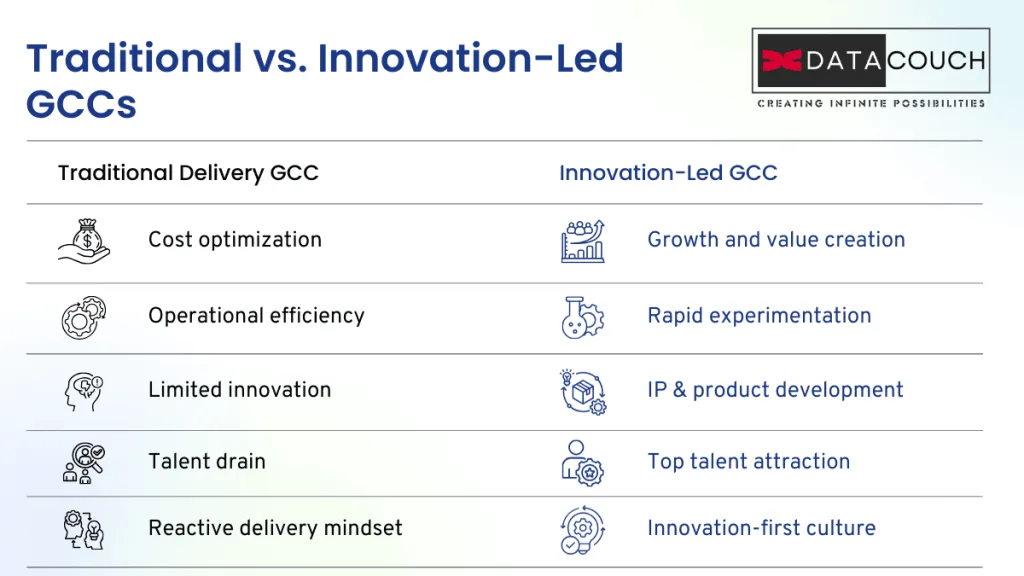
Here’s the uncomfortable reality most organizations won’t acknowledge: pure delivery excellence creates a ceiling, not a floor. A GCC focused solely on project delivery, cost optimization, and operational efficiency builds a competent but commoditized operation. Every competitor can match your cost structure. Every talent market has similar capabilities. Every project outcome follows predictable patterns.
This delivery-first mindset creates real business problems:
- Talent Drain: Your best people leave for roles offering innovation, growth, and strategic responsibility
- Margin Compression: Competing on cost means racing to the bottom while your margins evaporate
- Strategic Irrelevance: Your GCC becomes a cost centre managed by procurement, not a strategic asset managed by the C-suite
- Limited Innovation: You execute others’ ideas rather than generating your own intellectual property
- Technology Lag: You adopt technology 12-18 months after industry leaders, not leading adoption
The experience in GCC roles matters tremendously. A talented engineer working on delivery projects for five years gains deep execution skills but limited strategic thinking. They learn how to manage timelines and budgets, not how to identify market opportunities or solve unmet customer needs. When these professionals encounter companies building true innovation cultures, they leave your GCC behind.
This exodus costs real money. Replacing a mid-career GCC professional runs $30,000-50,000 in recruitment, onboarding, and lost productivity. Losing five people annually drains $150,000-250,000 from your budget. But the hidden cost (lost innovation, delayed projects, institutional knowledge walking out the door) runs far higher.
Building Digital DNA: The DataCouch Approach to GCC Transformation
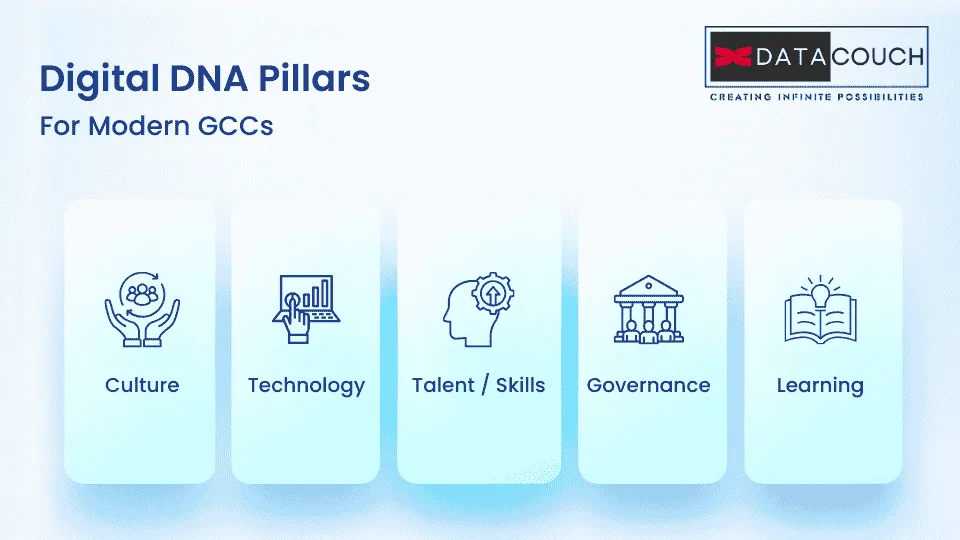
Digital DNA means embedding innovation into your organizational foundation. It requires five simultaneous shifts working together:
Cultural Transformation: Moving from execution-focused mindset to innovation-first thinking. This means empowering associates to identify problems, propose solutions, and lead change initiatives. It means celebrating intelligent failures as learning opportunities. It means creating psychological safety where people experiment with emerging technologies without fearing consequences for things that don’t work.
Technology Foundation: Establishing infrastructure enabling rapid experimentation. Cloud-native architecture. AI-first platforms. Data engineering capabilities. These aren’t nice-to-have technologies (they’re baseline requirements for any GCC claiming innovation status). Seventy percent of GCCs now invest heavily in Generative AI. Sixty-one percent are adopting AI for code generation. Sixty-five percent use AI for design and prototyping. If your GCC hasn’t started this journey, you’re already behind.
Talent Capability: Building the emerging skills your organization needs for competitive advantage. This requires strategic training, external certifications, academic partnerships, and deliberate career pathing. DataCouch specializes exactly here (designing comprehensive enablement programs that transform how teams think about technology, innovation, and business value creation).
Governance Structure: Creating decision-making frameworks balancing centralized strategy with local autonomy. Hybrid governance allows your headquarters setting quarterly innovation themes while your GCC leadership decides implementation approach. This prevents both the stifling centralization killing innovation and the fragmented decentralization losing strategic alignment.
Learning Culture: Treating continuous upskilling as organizational hygiene, not a periodic budget item. Seventy-eight percent of modern GCCs cite AI and emerging technology upskilling as their top priority. This isn’t optional. Companies investing in structured learning programs now build defensive advantages as the talent market tightens.
DataCouch delivers Digital DNA transformation through integrated training, enablement, and certification programs purpose-built for GCCs. Rather than generic corporate training, DataCouch designs solutions addressing specific GCC challenges: how to build innovation while maintaining delivery excellence, how to attract and retain top talent through growth opportunities, how to adopt emerging technology strategically, and how to transform organizational culture toward experimentation and learning.
What GCCs Need to Evolve: Requirements for Modern Centres
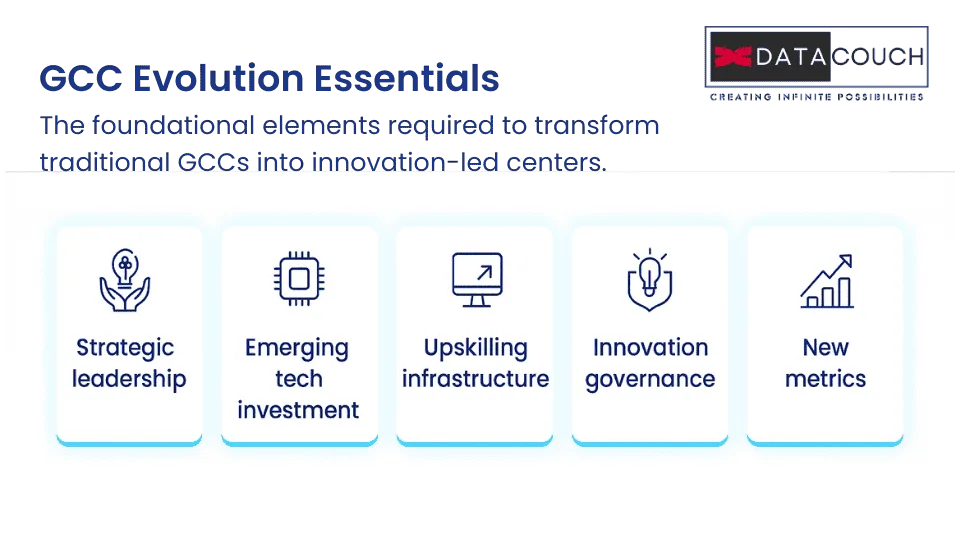
Building a modern GCC demands specific requirements your traditional offshore delivery centre never needed:
Strategic Leadership Structure: Your GCC leader must influence corporate strategy, not just execute operational plans. This requires someone with P&L responsibility, vendor relationship management, technology expertise, and business acumen. DataCouch works with organizations identifying and developing these leaders through specialized executive development programs.
Investment in Emerging Technology: Budget no longer concentrates on people and infrastructure. Modern GCCs invest thirty to forty percent of budgets in technology capability (AI platforms, cloud infrastructure, data engineering systems, security frameworks). Companies not making this investment cannot credibly claim innovation aspirations.
Upskilling and Enablement Infrastructure: Your GCC needs formal training programs, certification pathways, learning management systems, and coaching infrastructure. Ad-hoc skill development doesn’t scale. DataCouch delivers comprehensive enablement programs including structured curriculum, hands-on labs, industry certifications, and ongoing coaching ensuring teams consistently upgrade capabilities.
Innovation Governance Framework: You need clear processes determining which ideas get funded, how success gets measured, and how innovations scale across your enterprise. Without this, innovation becomes random pet projects rather than systematic competitive advantage.
Organizational Design Supporting Innovation: Traditional hierarchies kill innovation. Modern GCCs adopt flatter structures, cross-functional teams, and matrixed accountability enabling rapid collaboration and decision-making.
Performance Metrics Beyond Delivery: Moving from purely cost and delivery metrics to balanced scorecards measuring innovation velocity, IP creation, talent advancement, technology adoption, and business impact. DataCouch helps organizations design these measurement systems ensuring your GCC gets managed toward the outcomes you actually want.
GCC Enablement Through Strategic Training and Certification
Here’s where most GCC transformation efforts fail: leaders underestimate the enablement challenge. They assume intelligent people automatically think differently in new environments. That’s wrong. Human beings require structured learning experiences, practice time, feedback loops, and reinforcement building new capabilities. Your GCC professionals need deliberate training moving them from execution-focused thinking to innovation-focused thinking.
DataCouch delivers GCC enablement across four dimensions:
Technical Enablement: Training teams on emerging technologies (cloud architecture, AI platforms, data engineering, DevOps, cybersecurity). These aren’t theoretical courses. DataCouch provides hands-on labs, virtual environments, and real-world problem simulations helping professionals build practical capability they apply immediately.
Business Enablement: Teaching technical professionals how to think about business challenges, customer problems, market opportunities, and organizational strategy. A brilliant engineer understanding business context becomes an innovation leader.
Leadership Enablement: Developing the next generation of GCC leaders who can balance strategic alignment with local autonomy, manage performance while building culture, and drive innovation while maintaining delivery excellence.
Certification Programs: Providing industry-recognized credentials validating new capabilities. Global employability increasingly depends on relevant certifications. DataCouch offers comprehensive certification pathways helping professionals demonstrate mastery of critical capabilities their organizations depend on.
The GCC training landscape changed fundamentally. Generic corporate training doesn’t work. Online GCC enablement programs requiring significant self-motivation often fail because professionals already working under delivery pressure find it hard to prioritize learning. DataCouch designs blended enablement combining instructor-led workshops, hands-on labs, virtual collaborative sessions, and self-paced learning allowing professionals to develop capability without sacrificing current delivery commitments.
Global Capability Centres in India: The Advantage Factor
Why does India host ninety-two percent of global capability centres? Several advantages drive this concentration:
Talent Availability: India produces over fifteen million engineering graduates annually. The sheer volume creates a talent advantage no other geography matches. But quantity alone doesn’t explain GCC concentration. Quality matters equally. Indian professionals increasingly demonstrate innovation capability, strategic thinking, and global perspective matching professionals anywhere in the world.
Cost Structure: While wage inflation continues in India, cost advantages remain meaningful compared to North America or Western Europe. More importantly, India’s cost structure allows companies to invest profits back into enablement, technology, and growth rather than consuming margins through unnecessary overhead.
Timezone Advantage: India’s timezone enables follow-the-sun development models (when your North American teams finish, Indian teams seamlessly continue work). This compressed delivery timeline provides competitive advantage.
Maturity Infrastructure: India developed GCC ecosystem maturity over three decades. Best practices emerged. Vendor ecosystems developed. Universities aligned curricula to industry needs. Professional associations maintained standards. This maturity creates advantages for companies establishing GCCs in India versus building from scratch elsewhere.
English Language Proficiency: India’s English-speaking professional population means minimal language barriers in global organizations.
But here’s the critical insight: these advantages only matter if you build authentic innovation and strategic partnership into your GCC model. Purely delivery-focused offshore centres in India face exactly the same talent and margin pressure as delivery-focused centres anywhere else. The real advantage emerges when companies transform Indian GCCs into innovation laboratories benefiting from India’s talent depth, cost structure, and mature ecosystem all together driving genuine competitive advantage.
Online GCC and GCC as a Service: New Models Reshaping the Industry
The traditional GCC model required significant upfront investment (physical office space, hiring managers, HR infrastructure, corporate services). This created high barriers to entry and significant fixed costs.
New models emerging in 2026 reshape how companies access GCC capabilities:
Online GCC Models: Instead of building dedicated physical centres, companies contract with service providers managing distributed GCC professionals across multiple locations. This model provides flexibility, scalability, and reduced infrastructure investment. However, it requires even stronger cultural frameworks and enablement infrastructure ensuring distributed teams maintain alignment and quality.
GCC as a Service: Companies providing fully managed GCC operations including hiring, training, management, and service delivery. Organizations focused on core business outsource entire GCC functions. This model works for companies lacking GCC expertise but still requires strategic oversight ensuring the service provider understands your innovation objectives.
DataCouch increasingly supports both models. Traditional captive centres remain prevalent for companies with significant scale and strategic requirements. But increasingly, DataCouch helps organizations design hybrid models combining captive teams handling core strategic work with service provider relationships handling surge capacity or specialized skills.
These new models create interesting implications for enablement and training. When you don’t directly employ GCC professionals, training responsibility becomes unclear. DataCouch helps organizations clarify these responsibilities, designing training frameworks ensuring GCC professionals (regardless of employment model) continuously develop capability supporting your strategic objectives.
GCC in IT Industry: Where Digital DNA Actually Matters
The IT industry created GCCs. Accenture, TCS, Infosys, and Wipro (these companies built business empires on GCC delivery models). But today’s IT industry faces existential pressure from AI commoditizing traditional services while simultaneously creating massive demand for AI implementation expertise.
GCC in IT industry now faces clear bifurcation:
Traditional Services Track: Companies continue IT delivery (custom software development, infrastructure management, application support). These services become increasingly commoditized as automation and AI handle routine work. Margins compress. Competition intensifies. Talent struggles to find meaningful growth. This track represents declining opportunity.
Innovation and Transformation Track: Companies building AI solutions, digital transformation expertise, emerging technology capabilities. These firms command premium pricing because they solve problems competitors haven’t solved yet. Margins expand. Demand grows faster than supply. Talent finds meaningful work building genuinely new capabilities. This track represents an expanding opportunity.
Where do most GCCs in IT land? Trapped between the two tracks, unable to fully commit to either. This creates the worst possible position (compressed margins from commoditized services combined with inability to command innovation premiums).
GCCs building authentic Digital DNA make the decisive choice. They commit to innovation track. They invest in capability, not service margins. They measure success by IP creation and market impact, not just delivery metrics. DataCouch helps IT-focused GCCs make this transition through specialized training programs, emerging technology enablement, and strategic certification designed specifically for IT professionals advancing toward innovation leadership.
Your GCC Transformation Roadmap: From Delivery to Innovation
Transformation doesn’t happen randomly. Successful GCCs follow disciplined roadmaps:
Phase One (Foundation, Months 1-3): Assess current state. How far along your maturity journey? Identify capability gaps. Define strategic objectives. What does your innovative GCC look like in three years? DataCouch helps organizations conduct comprehensive diagnostics identifying where enablement investments generate maximum impact.
Phase Two (Infrastructure, Months 4-8): Build technology foundation. Deploy cloud platforms, AI capabilities, data systems. Establish learning infrastructure (training programs, certifications, coaching). Design governance frameworks clarifying decision-making authority. Launch first innovation projects creating momentum and demonstrating commitment.
Phase Three (Scaling, Months 9-15): Expand successfully piloted programs. Scale innovation pipeline. Build strategic partnerships. Grow emerging technology capabilities. Launch certification programs ensuring team members develop recognized credentials. DataCouch’s comprehensive training and enablement solutions accelerate scaling without sacrificing quality.
Phase Four (Optimization, Months 16-24): Refine processes based on learning. Implement AI-driven governance. Establish innovation culture as a normal operating mode. Develop internal trainers and coaches reducing external dependency. Create revenue streams from innovations validating business models.
Phase Five (Maturity, Year 3+): Your GCC operates as a true innovation hub with a venture mindset. Multiple cross-functional teams explore emerging opportunities. Global leaders emerge from your GCC. Patents and IP accumulate. Your GCC drives enterprise strategy, not just executes it.
DataCouch supports organizations through every phase providing training, enablement, and certification ensuring teams develop the capability required at each stage. Rather than generic training, DataCouch designs phase-specific programs addressing precise challenges your organization faces.
For example, Phase Two requires technical training on cloud architecture, AI platforms, and modern development practices. Phase Three requires business enablement teaching professionals how to commercialize innovations. Phase Four requires leadership development building the next generation of strategic leaders. DataCouch’s modular approach means you access exactly the training your organization needs at each moment rather than paying for programs addressing challenges you haven’t reached yet.
The Future Belongs to Innovative GCCs
The global capability centre model isn’t dying. It’s evolving. Organizations building authentic Digital DNA into their GCCs access genuine competitive advantages:
Talent Advantage: Top professionals increasingly seek roles offering innovation, learning, and strategic impact over pure compensation. GCCs offering these opportunities attract and retain exceptional talent other companies lose.
Cost Advantage: Automation and AI, when properly implemented, reduce routine work freeing humans for higher-value innovation. Your technology investments generate meaningful margins superior to pure labour arbitrage.
Innovation Advantage: GCCs breeding innovation cultures generate intellectual property, new business models, and competitive advantages pure delivery centres never create.
Strategic Advantage: GCCs influencing corporate strategy rather than executing others’ plans help your organization navigate market disruption, identify emerging opportunities, and maintain competitive advantage.
Building this future requires commitment. It requires investment in training, enablement, and strategic certification. It requires leadership willing to transform organizational culture. It requires patience building capability that takes time to develop.
This is where DataCouch makes a critical difference. DataCouch brings two decades of experience transforming GCCs from traditional delivery centres into innovation powerhouses. DataCouch understands emerging technology deeply (AI, cloud, data engineering, DevOps, cybersecurity). DataCouch designs training specifically addressing how to embed these capabilities into organizational DNA. DataCouch helps organizations measure success beyond delivery metrics, capturing innovation impact in ways traditional GCC metrics miss.
Your choice is clear: continue managing your GCC as a delivery centre competing on cost and efficiency in increasingly commoditized markets, or invest in Digital DNA transformation positioning your GCC as the innovation engine powering your organization’s future growth.
The most successful global organisations made their choice already. They’re building Digital DNA in their GCCs right now. DataCouch stands ready helping your organization join them (transforming your GCC from delivery excellence into genuine innovation leadership).
Ready to transform your GCC? Start with a strategic assessment identifying your current maturity, capability gaps, and transformation roadmap. DataCouch delivers this assessment plus comprehensive training, enablement, and certification helping your organization build Digital DNA into every level. Contact DataCouch today exploring how Global Capability Centre transformation can become your competitive advantage.
The 5 Simple FAQs:
1: What does “Digital DNA” actually mean in simple terms?
Digital DNA means building a company culture where innovation, technology, and learning work together naturally. It’s not a technology tool you buy, but rather how your GCC team works daily.
2: What is a GCC and who works there?
A GCC is an office location where companies establish dedicated teams to handle specific business functions like IT services, customer support, or data analysis. Most GCCs are in India.
3: Why do some GCCs succeed while others struggle?
Successful GCCs focus on helping teams learn, innovate, and grow careers. Struggling ones focus only on cost savings, causing talented people to leave.
4: How long does it take to transform a GCC into an innovation center?
Meaningful progress within 12 months. Full maturity takes 3-5 years of consistent investment in training, technology, culture, and leadership.
5: Does my company need a GCC or is it only for large organizations?
All company sizes benefit from GCCs. Smaller companies start with focused teams and grow gradually. The approach differs but benefits apply everywhere.
Tags:
- ai adoption, Capability Building, Change Management, Digital DNA, digital transformation, Enablement, Enterprise Strategy, Future of Work, GCC, GCC Transformation, Global Capability Centre, Governance, India GCC, Innovation, Innovation Strategy, Leadership Development, Organizational Culture, Talent Development, Tech Transformation, upskilling