
The "Value Engineering" Approach to Snowflake Consulting: How We Guarantee Measurable Impact
Value Engineering for Snowflake is a systematic method to maximize the business value from your data cloud investment. It focuses on achieving essential data functions at the lowest possible cost, without ever sacrificing performance, quality, or reliability.
Is this you? You’ve invested in the Snowflake Data Cloud, drawn in by its promise of infinite scale, incredible power, and game-changing simplicity. You were sold a vision of smashing data silos, accelerating analytics, and building the future of AI on a single, unified platform.
And yet, the reality feels… different.
The monthly bills are creeping up, sometimes spiking without warning. Critical dashboards that need to be snappy are frustratingly slow. Your data team seems to be constantly firefighting, tuning queries, and resizing warehouses, stuck in a reactive loop of “optimization” that never seems to end.
If this sounds familiar, you’re not alone. Many organisations find themselves in this exact spot, caught in the gap between Snowflake’s immense potential and their day-to-day operational reality.
The problem isn’t the platform. The problem is the approach.
Reactive, ad-hoc optimization is a losing game. What you need is a systematic, proactive discipline designed to build value into your data ecosystem from the ground up. At DataCouch, we call this Value Engineering. It’s a proven methodology that we have adapted specifically for Snowflake data cloud consulting, and it’s how we move beyond just cutting costs to guaranteeing a measurable, positive impact on your business.
The Snowflake Paradox: Why Your Powerful Data Cloud Feels Expensive and Slow
Snowflake is, without a doubt, a revolutionary platform. Companies like the NYSE have saved over 50% on reporting workloads, and Pfizer processes data four times faster. The technology is brilliant. So why do so many data leaders privately admit to feeling a constant sense of “cost anxiety”?
This is the Snowflake Paradox. The very features that give the platform its incredible flexibility—like the separation of storage and compute and a pay-as-you-go model—are the same features that can cause costs to spiral and performance to lag if not managed with an engineering discipline.
The Cost Conundrum: When "Pay-As-You-Go" Becomes "Pay-Way-More"
The most common challenge we see is unpredictable and escalating costs. The usage-based model is a double-edged sword. Without strict governance, it’s incredibly easy to overspend. A mid-sized business can easily rack up a ₹25,00,000 ($30,000) monthly bill if its warehouses are left unchecked.
Here’s where the value typically leaks:
- Inefficient Queries: The classic culprit. A simple SELECT * query on a multi-terabyte table is like leaving a tap running. It forces Snowflake to scan huge volumes of unnecessary data, burning through expensive compute credits for no reason.
- Warehouse Wastage: Virtual warehouses are often configured based on guesswork. An oversized warehouse sitting idle still costs you money. An undersized one creates queues and frustration. Without an intelligent strategy for sizing, scaling, and auto-suspension, you are guaranteed to be wasting money.
- The Black Box Bill: Many businesses get “bill shock” at the end of the month because they have no idea who or what is driving consumption. Without clear tracking that attributes costs to specific teams, projects, or dashboards, there is no accountability, and “hidden expenses” can multiply quickly.
The Performance Puzzle: Infinite Scale, Finite Patience
The second major pain point is performance. You’ve invested in a platform known for its massive parallelism, yet users are complaining about slow dashboards and queries that take forever to run. How is this possible?
- Poor Data Layout: The single biggest factor for query speed in Snowflake is its ability to “prune” data—that is, to avoid scanning data it doesn’t need. This depends entirely on how your data is physically organised. Without strategic data clustering, Snowflake is forced to perform massive, slow, and expensive table scans for even simple requests.
- The Wrong Tool for the Job: Snowflake is a beast for complex analytical queries. It is not designed to be a backend for a high-concurrency, low-latency web application. Trying to serve thousands of simultaneous small requests from an app directly from Snowflake will lead to terrible response times and an astronomical bill.
- Logic Bottlenecks: Badly written joins that create huge intermediate datasets or a failure to filter data early in a query can bring the system to a crawl, wasting both time and credits.
Why Most "Optimization" Efforts Fail Small Businesses and Enterprises Alike
Many consultancies will offer to “optimize” your Snowflake environment. They’ll come in, tune a few of your most expensive queries, suggest resizing a warehouse, and call it a day.
This is like putting a small bandage on a deep wound.
It’s a reactive, short-term fix that doesn’t address the root cause. The costs will inevitably creep back up because the underlying system of work—the processes, the architecture, the governance—hasn’t changed. To achieve lasting results, you need to stop playing whack-a-mole with problems and start re-engineering the system for value.
What is Value Engineering? (And Why It's Not Just Cost-Cutting)
Value Engineering (VE) is a systematic, organised, and function-oriented methodology with one goal: to provide necessary functions at the lowest possible lifecycle cost without jeopardizing quality, reliability, or performance.
It’s a powerful discipline that forces a fundamental shift in thinking. Instead of just asking, “How can we make this cheaper?” VE asks, “What is the essential function this provides, and is there a better, more efficient way to achieve it?”
A Quick History Lesson: From WWII Scarcity to Cloud Efficiency
The concept of VE isn’t new. It was born out of necessity at General Electric during World War II. With materials and resources being scarce, engineers had to find creative ways to deliver the same product function with cheaper, more available materials. The methodology was later adopted and formalised by the US Navy to get the maximum operational value out of every dollar spent.
This history is important. VE was created to manage scarce resources effectively. In the modern cloud era, the scarce resources are no longer steel and rubber; they are your financial budget and your team’s engineering attention.
The Core Formula: Value = Function / Cost
At its heart, Value Engineering operates on a beautifully simple equation:
Value = Function / Cost
This formula completely reframes the conversation. It’s not just about reducing the denominator (Cost). It shows us three distinct paths to increasing value:
- Decrease cost while keeping the function the same.
- Increase the function while keeping the cost the same.
- The ultimate goal: Increase the function while simultaneously decreasing the cost.
This moves the focus away from a negative (cost-cutting) to a positive (value creation).
The Shift in Mindset: From "How" to "What"
The most powerful part of VE is its focus on function. VE teams are trained to describe every need using a simple two-word structure: an active verb and a measurable noun.
For example, instead of saying, “We need a faster executive sales dashboard,” a VE approach would define the core functions as “Display Sales KPIs,” “Track Regional Performance,” and “Identify Top Reps.”
This might seem like a small change, but it’s profound. It detaches the problem from any single solution. By focusing on the “what” (the function) instead of the “how” (the current dashboard), it opens the door to creatively brainstorm entirely new and more efficient ways to deliver that function. This structured process systematically identifies and eliminates any activity, process, or line of code that does not contribute to value.
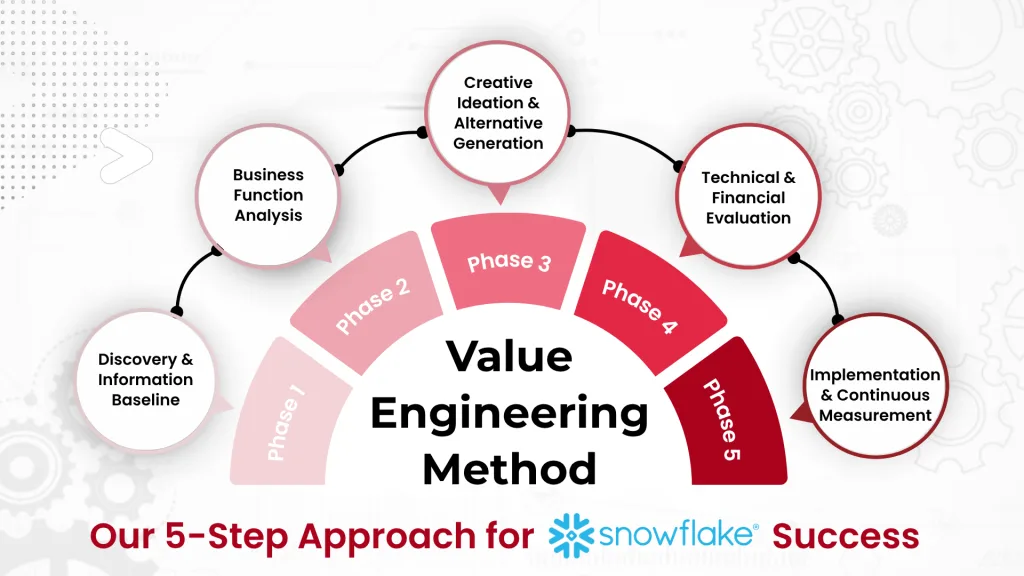
The DataCouch VE Method: Our 5-Step Blueprint for Snowflake Success
Translating the principles of VE from manufacturing to the dynamic world of the Snowflake Data Cloud requires a tailored framework. Our proprietary DataCouch VE Method is a structured, repeatable process that systematically improves the value you get from your Snowflake investment.
Phase 1: Discovery & Information Baseline
You can’t improve what you don’t measure. This phase is a deep dive into your Snowflake environment. We go beyond the surface, analysing months of historical data from QUERY_HISTORY and WAREHOUSE_METERING_HISTORY to understand credit consumption patterns, query performance, and data storage metrics. We then combine this quantitative data with qualitative insights from your stakeholders to understand your key business goals and pain points. The result is a detailed, data-driven baseline of your current state—the foundation against which all future improvements are measured.
Phase 2: Business Function Analysis
This is the heart of our methodology. We shift the focus from technical artefacts to business functions. We don’t just see a slow query; we see the business function that query serves, like “Calculate Customer Churn” or “Generate Month-End Report.” By mapping Snowflake credit consumption to these specific business functions, we conduct a cost/worth analysis. This process immediately highlights value mismatches—for example, a low-priority internal report that consumes a disproportionate amount of compute, or a mission-critical, customer-facing dashboard that is performing poorly. This step is crucial for aligning technical work with business priorities.
Phase 3: Creative Ideation & Alternative Generation
Armed with a clear understanding of where value is being lost, we bring together a multi-disciplinary team of architects, engineers, and business analysts to brainstorm a portfolio of potential improvements. These are not just simple fixes. We explore a wide range of architectural, procedural, and technological alternatives. This could include redesigning data models, re-architecting pipelines, implementing materialized views, or even leveraging third-party tools to offload specific high-concurrency workloads from Snowflake.
Phase 4: Technical & Financial Evaluation
Every idea generated in the previous phase is put through a rigorous evaluation. We assess each alternative against multiple criteria: technical feasibility, implementation effort, potential risks, and most importantly, the projected financial impact and return on investment (ROI). This transforms a long list of technical ideas into a prioritised roadmap of initiatives, each with a clear business case. This ensures your resources are focused on the changes that will deliver the greatest value.
Phase 5: Implementation & Continuous Measurement
The final phase is about execution and accountability. We implement the prioritised initiatives and then continuously monitor their impact against the baseline established in Phase 1. We use a predefined set of Key Performance Indicators (KPIs) to create a transparent feedback loop, demonstrating the tangible value delivered. Crucially, VE is not a one-time project. It’s a continuous cycle. The new, improved state becomes the new baseline, and the process can be repeated to drive ongoing value creation and prevent costs and performance from degrading over time.
From Theory to Action: Common VE Plays for Your Snowflake Environment
So, what does this look like in practice? Here are some of the high-impact VE initiatives we frequently implement for our clients as part of our Snowflake data cloud consulting services.
Taming Your Costs: Practical Ways to Stop Burning Credits
- Intelligent Warehouse Management: Based on historical workload data, we “rightsize” your virtual warehouses to match their specific needs. We implement aggressive but smart auto-suspension policies and consolidate workloads to ensure you’re never paying for idle compute.
- Surgical Query Refactoring: We systematically identify the highest-cost queries and refactor them. This goes beyond just removing SELECT *. We optimize join orders, ensure filters are applied early, and rewrite logic to maximize Snowflake’s data pruning capabilities.
- Strategic Use of Materialized Views: For dashboards or reports that run the same complex queries over and over, materialized views are a game-changer. By pre-computing the results, the cost is paid once during the refresh, and subsequent reads are nearly instantaneous and computationally free.
Boosting Performance: Making Your Queries Fly
- Architectural Surgery with Data Clustering: This is one of the most powerful performance levers. By analysing your query patterns, we identify the most effective clustering keys for your largest tables. A well-chosen key can lead to order-of-magnitude performance improvements by allowing Snowflake to scan only the tiny fraction of data it actually needs.
- Isolating Workloads with Zero-Copy Cloning: To prevent costly and unpredictable development queries from impacting production, we champion the use of Snowflake’s zero-copy cloning. This creates instant, isolated copies of production data for development and testing at no extra storage cost, giving your team a safe and realistic environment to work in.
- Offloading with a Serving Layer: For high-concurrency, low-latency use cases like a customer-facing analytics feature, we often recommend an architectural change. Using a specialised serving layer like Tinybird, data can be synced from Snowflake and served via APIs at a fraction of the cost and with millisecond latency—something Snowflake was never designed for.
This One Mindset Shift Will Save You Thousands on Snowflake
The single most impactful change you can make is to stop treating Snowflake compute as an unlimited, free-for-all utility. Instead, treat it like a valuable, finite resource. The Value Engineering mindset forces this shift. By linking every query and every warehouse back to a specific business function, you start asking the right questions: “What is the business value of this report? Does it justify the 500 credits it consumes each month?” This alignment of cost to value is the key to building a sustainable, cost-effective data culture.
How We Guarantee Measurable Impact: The KPIs That Matter
A core promise of our Value Engineering approach is “guaranteed measurable impact.” This isn’t just a marketing slogan; it’s a commitment backed by a robust measurement framework. We track a hierarchy of KPIs to provide a transparent, 360-degree view of the value we deliver—from technical metrics right up to strategic business outcomes.
Financial Impact KPIs (The Bottom Line)
These are the direct, tangible measures of financial efficiency that matter most to your CFO.
- Total Cost of Ownership (TCO) Reduction: The overall decrease in your Snowflake bill and related ecosystem costs.
- Credit Consumption per Business Function: A powerful metric showing a direct cost reduction for specific tasks, e.g., “The cost of Month-End Financial Reporting has decreased by 40%.”
- Return on Consulting Investment (ROCI): The ultimate proof of value. This KPI measures the financial savings generated by our engagement versus our fee, ensuring a clear, positive return for your business.
Operational & Performance KPIs (The Engine Room)
These metrics reflect the health, speed, and reliability of your data platform.
- Query Execution Time Reduction: We track the percentage improvement in query speed for your most critical workloads.
- Data Pipeline Latency: The end-to-end time it takes for data to get from its source to being ready for analysis. A lower number means your business is running on fresher data.
- Reduction in Data Quality Errors: According to a 2024 report by Gartner, poor data quality costs organisations an average of $12.9 million annually. We implement in-pipeline checks and track a quantifiable decrease in data errors, improving trust and reliability.
Strategic Business KPIs (The Big Picture)
This is where we connect technical improvements to tangible business outcomes.
- Time-to-Insight Acceleration: The reduction in time it takes for a business user to go from asking a question to getting a data-driven answer.
- User Adoption of Analytics: An increase in the usage of your BI tools, which indicates that data is now faster, more accessible, and more trusted by the business.
- Enablement of New Initiatives: We document how the cost savings and efficiencies gained were reallocated to fund new, innovative projects—like a new machine learning model—that were previously considered too expensive.
Table: The VE Impact Matrix
To make the connection between our actions and your results crystal clear, we use an Impact Matrix.
| VE Initiative | Financial Impact KPIs | Operational & Performance KPIsh | Strategic Business KPIs |
|---|---|---|---|
| Warehouse Rightsizing | Reduces TCO by eliminating idle compute spend. | Reduces query queuing and improves throughput. | Frees up budget for new data initiatives. |
| Query Refactoring | Lowers credit consumption per business function. | Dramatically reduces query execution time. | Accelerates time-to-insight for users. |
| Strategic Data Clustering | Lowers credit consumption by reducing data scanned. | Massively improves query speed via partition pruning. | Improves user adoption due to a faster experience. |
| Implement Serving Layer | Drastically reduces TCO for high-concurrency workloads. | Enables sub-second latency for thousands of users. | Enables launch of new real-time data applications. | Governed ELT Framework | Reduces cost of data cleaning and remediation. | Reduces data quality errors and streamlines pipelines. | Increases trust in data, leading to higher adoption. |
Why Choose DataCouch for Your Snowflake Data Cloud Consulting?
Successfully applying Value Engineering to the Snowflake ecosystem requires a rare mix of deep technical expertise, a rigorous engineering mindset, and a relentless focus on business outcomes. This is what makes DataCouch different.
We're Not Just Consultants; We're Value Engineers
We are not generic implementation partners. Our team lives and breathes the modern data stack. We bring a specialist, AI-focused perspective to every engagement. Our VE Method is a data-driven, business-centric framework designed not just to save you money but to unlock the full innovative potential of your Snowflake platform.
A Partnership Focused on Continuous Value
Our goal is to transform your relationship with your data platform. We move you from a state of reactive firefighting to one of proactive, continuous value creation. We don’t just deliver a one-time project; we install an “operating system for value management” and partner with you for the long term to ensure your success is sustained.
We're Going Global: See Us at GITEX GLOBAL 2025 in Dubai!
Our commitment to driving the future of data and AI doesn’t stop in India. This year, DataCouch is thrilled to announce that we will be setting up a booth at GITEX GLOBAL 2025, the world’s largest tech and AI show, in Dubai from October 13-17!
This is a massive opportunity to connect with global leaders and innovators, and we want to meet you there. Visit our booth to discuss how we can partner to drive your business forward. We are especially keen to connect with:
- SMEs: Looking for expert consulting and a roadmap for AI transformation.
- Tech Product Companies: Seeking partnerships for enablement and L&D extension.
- Universities: Aiming for AI-enablement to prepare the next generation of talent.
- CXOs, VPs, and GMs: In need of coaching and change management strategies for the new Agentic AI era.
- Businesses: Requiring customized AI solutions to solve unique challenges.
Come find us at GITEX GLOBAL to explore the future of technology and create new possibilities together.
Which Path Will You Choose in 2025: Value Engine or Cost Center?
The central message is this: without a systematic approach, even the world’s most powerful data platform can become an inefficient cost center. The natural state of any complex system is entropy—costs will rise, and performance will degrade over time.
Reactive optimization is a temporary fix. Proactive Value Engineering is the permanent solution. It transforms your Snowflake investment from a powerful but expensive platform into a highly efficient, predictable, and strategic value engine for your entire business.
Ready to unlock the true value of your Snowflake Data Cloud? Schedule a Value Engineering Assessment with our experts today. We’ll help you identify your top 3 value gaps and create a roadmap for guaranteed, measurable impact.