
DataCouch: Empowering GCCs To Become AI Ready And Future Ready
A Global Capability Center, or GCC, is an in-house hub that runs critical business and technology work for a global company from another country, often India, and now acts as a strategic innovation and AI engine, not just a cost center.
What Is A GCC In Simple Words
If someone asks you “what is GCC” or “what is a GCC company”, the answer is simple.
A Global Capability Center (GCC) is a captive center that a multinational sets up in another country to handle important work like IT, data, finance, operations, or product engineering. GCC meaning in business is very close to the earlier term “captive center”, but the role has become far more strategic.
All of these point to the same idea. In IT, people talk about “GCC in IT” or “GCC in IT industry” when the center runs software, cloud, AI or analytics work.
According to the India GCC Landscape Report 2024, India is now called the “GCC capital of the world” with more than 1,750 global capability centers and almost 3,000 individual units, together generating about 64.6 billion dollars in revenue and employing over 1.9 million people.
In simple terms:
- A GCC company is any global firm that runs such a captive center.
- The GCC model means the way that the center is set up, staffed and run.
So when people ask “what is global capability center” or “GCC meaning in business”, the best short answer is:
“It is your own offshore or nearshore innovation and delivery engine, owned by you, staffed by you, and built to global standards.”
Why GCCs Must Be AI Ready And Future Ready Now
GCCs are no longer only about low cost operations. They now sit at the center of AI, data and digital change.
Recent industry reports show how fast this shift is happening:
- More than 1,750 GCCs in India alone have moved from pure cost saving to value creation and transformation for their parent enterprises
- Over 70 percent of GCCs worldwide have already started their generative AI journey in the form of pilots and early use cases.
- A 2024 EY survey found that 78 percent of GCCs in India are upskilling internal teams for GenAI adoption, and 70 percent already list GenAI as a top priority for operations and customer experience.
- In the latest EY GCC Pulse insights, around 58 percent of GCCs in India are already investing in agentic AI and about 81 percent are actively upskilling teams in GenAI and niche digital skills.
Most experts agree that GCCs that ignore AI and talent development now risk becoming irrelevant within three to five years. The GCC meaning in this new phase is all about skill concentration, innovation and speed.
So an AI ready and future ready GCC:
- Has people who understand and use AI in daily work
- Has clear GCC requirements for skills, certifications and roles
- Runs continuous GCC training programs, both in person and online GCC learning tracks
- Measures experience in GCC roles using structured tools like a global employability test
- Keeps its tech stack and its people aligned with top trends identified by firms like Gartner, such as democratized generative AI and AI augmented development
If you want a one line GCC meaning in business today, it is this:
A GCC is your global lab for AI, data and digital talent, not just a back office.
Key GCC Requirements In The AI Era
For a GCC to move from support center to innovation center, the requirements are far more than office space and headcount.
You can think of GCC requirements in five simple buckets:
- Clear purpose
- Right skills
- Modern technology stack
- Learning culture
- Governance and compliance
1. Purpose And Model
A modern GCC model usually aims to:
- Own end to end products or platforms
- Run AI and analytics programs for the group
- Support global operations with high automation
- Act as a test bed for new ideas, including agentic AI and intelligent applications
Some firms even use GCC as a service style offerings from partners to spin up new centers quickly with ready talent and playbooks.
2. Skills And Experience In GCC
Experience in GCC roles looks different now compared to ten years ago.
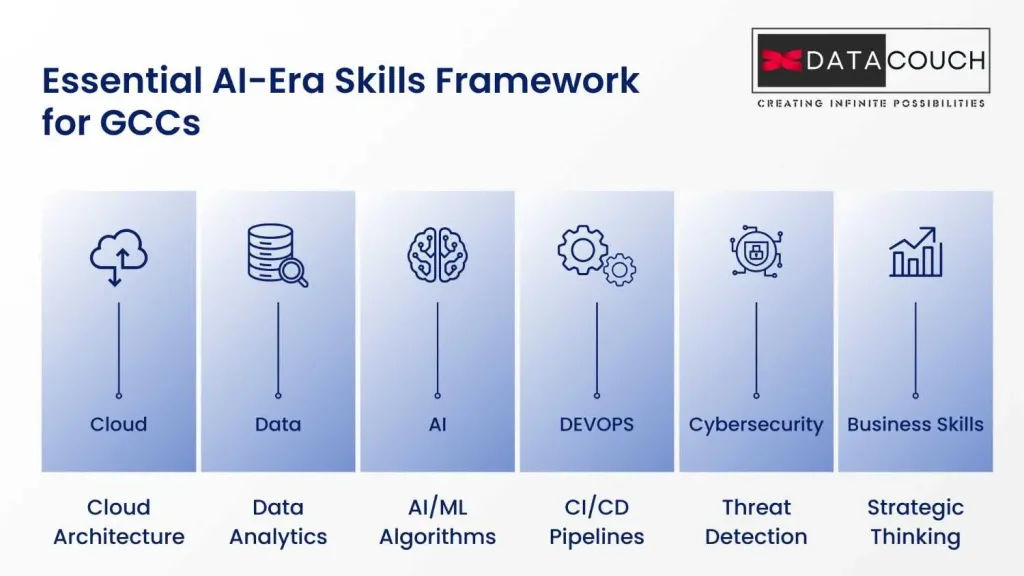
A typical AI focused GCC in IT will need:
- Cloud engineers
- Data engineers and analytics specialists
- AI and GenAI developers
- DevOps and SRE teams
- Cybersecurity and risk teams
- Product managers and domain experts who can connect tech to business
A 2025 EY analysis shows that 81 percent of GCCs are actively upskilling internal teams on GenAI, and more than 60 percent are focusing on AI, ML and data engineering skills over generic roles.
So the GCC requirements for talent are clear:
- People must be able to learn fast
- They must be ready to work with AI assistants and agents
- They must understand both the domain and the tools
From a junior marketer’s view, you can treat a GCC like a full funnel: hire, train, certify, measure, and grow.
3. Skills Table For A Future Ready GCC
Here is a simple way to explain GCC training needs to stakeholders.
| Area | What GCC Teams Need To Do | Example GCC Training Focus |
|---|---|---|
| Cloud and platforms | Run workloads on AWS, Azure or Google Cloud | Cloud fundamentals, architecture, cost optimization |
| Data and analytics | Build reliable data pipelines and dashboards | SQL, data modeling, Snowflake or Databricks |
| AI and GenAI | Use and build AI assistants, copilots and agents | Prompt design, LLM basics, responsible AI |
| DevOps and automation | Ship faster with fewer errors | CI or CD, containers, Kubernetes, Git based workflows |
| Cybersecurity and compliance automation | Protect data, follow regulations across countries | Security basics, CTEM ideas, privacy and compliance |
| Business and soft skills | Communicate with global teams and leadership | Presentation, storytelling with data, stakeholder mapping |
This table becomes the starting point for your GCC training plan and your online GCC learning catalog.
Where Most GCCs Struggle Today
Even with strong leadership, many GCCs hit the same roadblocks.
Skill Gaps And Speed Of Change
Technology moves faster than regular corporate training. New AI and platform trends appear every quarter. Gartner expects that by 2026, more than 80 percent of enterprises will use generative AI APIs or models in production, up from less than 5 percent in 2023.
If your GCC training is static, your skills go out of date. The result:
- Your best people feel stuck
- Projects fall behind global expectations
- GCC experience becomes narrow and outdated, not future ready
Fragmented Learning And No Benchmark
A lot of GCCs buy many courses and tools but do not tie them together.
Common problems:
- No common skill baseline across teams
- No clear answer to “what does good look like in our GCC”
- No measurement of who is project ready and who needs help
This is where tools like a global employability test help. DataCouch, for example, uses such tests to benchmark skills and track how GCC training actually improves readiness over time.
Over Buying Technology And Under Investing In People
A very common pattern looks like this:
- The GCC buys a new AI platform or cloud tool.
- Only a small expert group knows how to use it.
- Everyone else keeps working in old ways.
The GCC meaning in business then stays stuck at “delivery unit” instead of “innovation hub”.
Contrarian View: Technology Without Training Fails Most GCCs
It is tempting to believe that technology alone will make a GCC future ready.
A more honest view says:
- A tool without trained people creates more confusion than value.
- You still pay license fees, but no one uses advanced features.
- Business leaders then lose trust in AI and digital initiatives.
So the bold but simple statement for your slide deck is:
A GCC that doubles its training budget and aligns it with AI strategy will often get more ROI than a GCC that only doubles its tech budget.
Training and change management may not sound flashy, but they decide whether your AI projects move from pilot to scale.
How DataCouch Supports GCCs On This Journey
DataCouch is not an outsourcer. It is a specialist partner that builds capabilities inside your GCC so that your own teams can deliver world class work.
From a junior marketer’s angle, you can think of DataCouch as:
A training first, AI first talent engine for GCCs.
1. Training First Approach To GCC Requirements
DataCouch starts with capability, not just content.
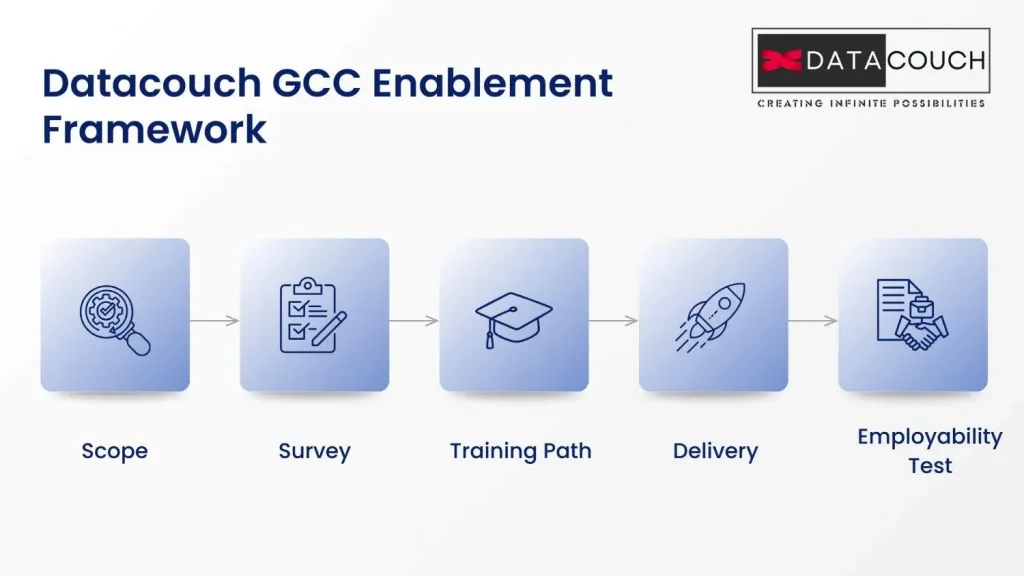
For a GCC, this usually looks like:
- Scoping
- Understand your GCC model, functions and locations
- Map roles across cloud, data, AI, DevOps, security and business
- Pre delivery survey
- Check current skills and experience in GCC teams
- Identify gaps against global standards and certifications
- Design of GCC training paths
- Create role based paths for engineers, analysts, leads and architects
- Combine classroom, virtual and online GCC modules
- Delivery and labs
- Run instructor led bootcamps
- Provide sandbox access and projects on real tools
- Post training assessment
- Use a global employability test to see how much skills improved
- Share reports with GCC leadership for planning and promotions
This process makes GCC training a structured program, not a random list of webinars.
2. Online GCC Learning At Scale
Most GCCs have large distributed teams. You cannot train everyone only in classrooms.
DataCouch runs online GCC learning programs that:
- Give learners self paced access to content in AI, data, cloud and more
- Mix video lessons with quizzes and hands on labs
- Allow managers to track progress in dashboards
This makes it easy to onboard new hires, refresh existing teams, and support new projects without waiting for quarterly workshops.
For marketing content, you can describe it like this:
“Your GCC teams can learn the latest AI, cloud and data skills from anywhere, with projects that match your real work.”
3. Vendor Aligned, Certification Ready
DataCouch is an official education partner for several leading tech vendors. That matters a lot to GCCs.
The benefit for a GCC:
- Courses follow vendor best practices
- Trainers are certified and have delivery experience
- Teams can prepare for exams like Snowflake, Confluent, Google Cloud, Azure or AWS using approved content
This ties directly to GCC requirements around compliance and global quality. When an internal stakeholder asks “can our India GCC really handle this new AI stack”, you can point to hard numbers:
- X percent of your engineers certified on key platforms
- Y number of projects delivered after DataCouch training
- Global employability test scores trending up over time
4. Real World GCC Experience Through Labs And Projects
DataCouch does not stop at theory.
In a typical program for a global capability centre, your teams will:
- Build data pipelines that look like your production flows
- Design AI workflows that match your actual customer journeys
- Practice secure deployments with governance in mind
This builds confidence and gives real experience in GCC teams before they touch high risk systems.
You can tell a simple story:
“Our GCC engineers did not just watch videos about AI. They built working prototypes on the same kind of stack our company uses.”
5. This One GCC Habit Can Save Leaders Hours Every Week
Here is a more provocative point you can use in the blog.
If a GCC trains every manager and team to use AI assistants properly, that single habit can easily save several hours per week per person.
Examples:
- Drafting status reports in minutes instead of hours
- Summarizing large documents or logs quickly
- Creating first draft test cases or data checks
DataCouch programs often include “AI for leaders” or “AI for business users” tracks that show non technical people how to use tools safely and effectively, not only engineers.
The effect:
- Faster decisions
- Better communication
- Less time lost in manual documentation
In short, leadership level AI literacy turns the GCC into a smarter, faster unit.
Final Words: Turn Your GCC Into A Future Ready Talent Engine
GCC meaning in business has changed forever. The full form of GCC, Global Capability Center, now implies a center of gravity for AI, data and digital skills, not just a remote support office.
To be AI ready and future ready, a GCC must:
- Set clear GCC requirements for skills across cloud, data, AI, DevOps and security
- Run structured GCC training and online GCC learning programs
- Use tools like a global employability test to benchmark experience in GCC roles
- Treat talent as the primary asset, and technology as the amplifier
DataCouch sits exactly at this intersection. It brings:
- Training first methodology
- Vendor aligned content and labs
- Benchmarks and assessments for global employability
- Real world GCC experience through projects and case studies
If your GCC is still measured mainly on cost savings, you are behind. The future belongs to GCCs that invest in capability and become AI ready, and DataCouch is here to help you get there.