
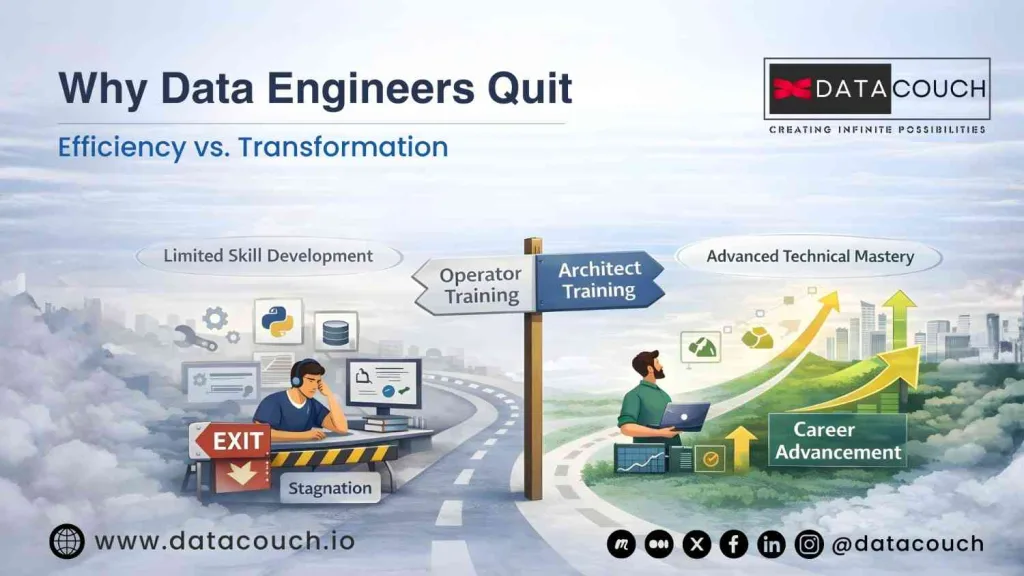
Why Data Engineers Leave: Training & Career Paths as Retention
Let us talk about something your CTO is thinking but might not say out loud. They see the numbers. They know the immense cost every time a skilled data engineer walks out the door. It is not just the salary. It is the lost knowledge, the delayed projects, the quiet panic in the team picking up the pieces.
You hire a brilliant data engineer. They do great work for a year or two. Then, they slowly become disengaged. Finally, they leave for a “better opportunity.” You replace them, and the costly, disruptive cycle begins again.
Most articles will tell you they leave for more money or less burnout. That is surface level. What if the real reason is that your company, despite its best intentions, is accidentally stifling their growth? What if your well funded corporate training and standard promotion path are the very things pushing them out the door?
The surprising truth is this: traditional upskilling and career frameworks are failing data engineers. Too often, companies focus on teaching new tools but neglect the skills that create architects. They default to promoting engineers into management, when their passion is mastering systems. This mismatch isn’t a paycheck problem, it’s a fundamental growth problem that stunts careers and teams.
The Training Trap. Why Your Upskilling Program is Failing
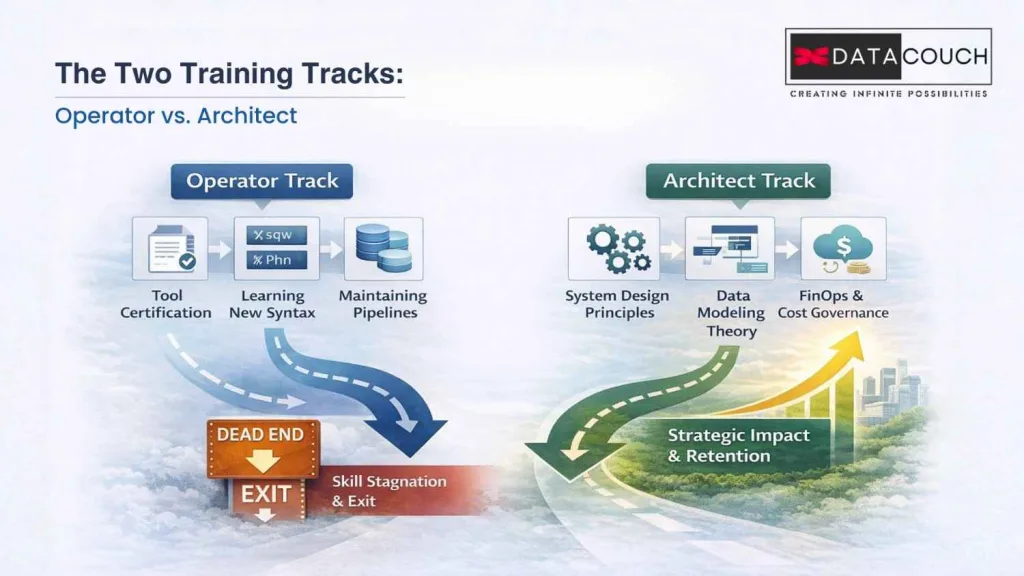
You invest in learning platforms. You pay for certifications. So why is it not working? Because there is a fundamental mismatch between the training you provide and the growth your data engineers crave.
Tool Training vs. True Mastery: You Are Creating Operators, Not Architects
Think about your last training budget approval. It likely funded courses for the latest data platform: Snowflake, Databricks, and Azure Synapse. This is tactical tool training. It keeps the lights on. But it does not build a visionary.
A data engineer proficient in a tool can build a pipeline. A data engineer with mastery in architecture can design a system that reduces pipeline cost by 40%, improves reliability by 90%, and scales effortlessly. Which one is more valuable? Which one feels more rewarding to be?
The gap here is critical. Tool training teaches how. Architectural mastery teaches why. When you only fund the how, you create experts in a specific technology that might be obsolete in five years. You leave their foundational, transferable skills like data modeling, systems design, and cost optimization to rust. They feel this stagnation deeply. They see their long-term value shrinking, and they leave to find a place that will invest in their foundational brain, not just their current toolset.
Ready to move beyond basic tool training? See how comprehensive programs build architecture skills
The Missing Pieces in Your Curriculum
What do most internal corporate training programs miss? They skip the subjects that transform a technician into a strategic partner.
- Data Mesh and Distributed Ownership: Engineers are tired of being the “central data janitor” for the entire company. Training them on Data Mesh principles empowers them to design systems where domains own their data. This changes their role from reactive supporter to proactive enabler.
- FinOps for Data: Show me a data engineer who understands the cloud bill, and I will show you an engineer aligned with business goals. When you train them to see the direct cost impact of their inefficient queries, you give them ownership. You turn a cost center into a value center.
- Production Engineering Skills: Universities and bootcamps do not teach this. How do you build monitoring that alerts before the pipeline breaks? How do you design a rollback strategy? Training here reduces midnight emergency pages and builds pride in craft.
This table shows the stark difference between common training and the growth-focused approach that retains talent.
| Training Focus | Common Corporate Program | Retention-Focused Program, What Engineers Crave |
|---|---|---|
| Primary Goal | Keep up with vendor updates. | Build resilient, cost-effective systems. |
| Content | New tool features, syntax. | System design patterns, cost governance, and data modeling theory. |
| Outcome | A team that can use Tool X. | A team that can design the optimal system for any problem. |
| Engineer Sentiment | "I am a cog in the machine." | "I am the architect of the machine." |
Want a concrete next step?
Audit your last six months of training spend. What percentage went to tactical tool updates versus strategic architectural mastery?
The Broken Career Ladder. Management is Not the Only Destination
Here is the single most common career path failure we see. A stellar senior data engineer is promoted. Their reward? They are now a manager, spending their days in meetings, reviewing budgets, and managing performance. Their genius for optimizing data flows is now used to optimize team calendars. They are miserable.
The "People Manager or Nothing" Dead End
For decades, the only visible path to more prestige, influence, and salary was management. This is a relic of industrial-era corporate structures. It fails the modern technical expert. A 2023 study by the Dice tech job board found that over 60% of technologists wanted a path to advance without going into people management, but fewer than 30% of companies had a clear path for this.
Forcing a world-class engineer onto a management track misunderstands their core talent. It wastes their gift. And predictably, they drive that talent right to your competitor, who likely offers a real technical track.
Building a Real Dual Track Ladder: A Blueprint
The solution is a true dual track career ladder with equal prestige, compensation, and influence for both paths.
- The Management Track: Designed for leaders who excel at driving execution, aligning stakeholders, and building high-performing teams. Their core strengths lie in people leadership, operational excellence, decision-making, and translating strategy into predictable delivery.
- The Technical IC Track, The Often Missing Piece: For masters who excel at solving deep, complex system wide problems. Their core strength is technical depth and innovation. They choose to remain Individual Contributors rather than people managers, while still informally coaching and mentoring team members through expertise and example.
Let us define what progression on the technical IC track actually looks like.
- Senior Data Engineer: Owns the design and build of critical pipelines. Mentors juniors.
- Staff or Principal Data Engineer: Solves scaling and reliability problems for multiple teams. Sets technical standards for the department. Evaluates new technologies.
- Distinguished Engineer or Solution Architect: Defines the data strategy for the entire organization. Their decisions shape the company’s tech stack for years. They are the ultimate internal authority on everything data.
Promotion on this track is based on technical scope, impact, and mentorship, not headcount. When you formalize this, you give your best engineers a future they can see themselves in. You give them a reason to stay.
The Hidden Frustrations That No One Talks About
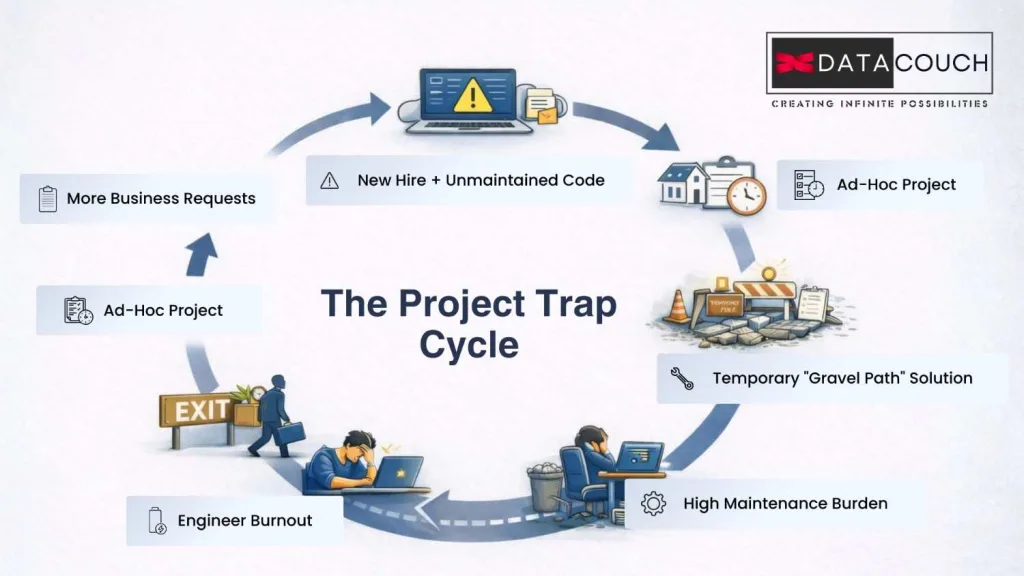
Beyond training and titles, silent killers erode an engineer’s will to stay. These are the systemic issues that make even good days frustrating.
The Platform vs. Project Trap
Top-tier data engineers have a builder’s mentality. They want to create elegant, reusable systems. They want to build the internal platform that makes everyone else’s job easier. However, most businesses staff them on endless, short-term projects. For example, “Build the sales report” or “Fix the marketing dashboard.”
This is a fundamental misalignment. Project work is transactional. Platform work is foundational. Without a dedicated platform team, your engineers never get to build the “paved road.” They are forever laying down temporary gravel paths, over and over. This lack of legacy, of building something that lasts, is deeply unfulfilling.
Knowledge Hoarding vs. Knowledge Sharing
Here is an uncomfortable question. Is your most senior engineer also your biggest bottleneck? Do teams wait for them to solve mysteries? This is “tribal knowledge,” and it is a career trap.
For the senior engineer, this is a dead end. They spend a significant part of their time answering “how to” questions. This prevents them from doing the high-leverage work that would justify a promotion. The fix is cultural. You must make knowledge sharing a measurable, rewarded duty.
Frame documentation and mentorship not as a nice-to-have, but as a core engineering responsibility. Make “authored key design docs that enabled team X” a mandatory bullet point for promotion to the Staff level. This turns a frustration into a recognized leadership skill.
The DataCouch Retention Framework: A Strategic Shift
Solving this requires moving from tactical fixes to a strategic talent framework. It is about building an environment where a data engineer’s mind can grow for years, not just survive for a few months.
- Audit for Growth, Not Just Skill Gaps. Do not just ask, “What tools do we need?” Ask, “What architectural challenges will we face in 18 months? Do our engineers have the principles to solve them?” Align upskilling with future business complexity, not just current tech.
- Formalize the Technical Track. Work with HR now. Draft the ladder. Define the expectations for Principal Engineer that are as clear as those for Director. Announce it. Celebrate promotions on this track as loudly as you do management promotions.
- Create a Platform Mandate. Even a small, dedicated platform squad focused on internal tools and standards can be a career destination for your best builders. It shows you value systems thinking.
- Measure What Matters. Track retention alongside project delivery. Measure knowledge sharing through contribution to internal wikis. Survey your team on growth sentiment, not just job satisfaction.
Final Words
Data engineers do not primarily leave for a few thousand dollars more. They leave when they can no longer see their future selves growing in your organization. They leave when they feel their hard skills becoming obsolete. They leave when the only future you offer them is a future away from the work they love.
Retention is not about holding on. It is about building forward. It is about replacing a limiting, generic corporate training plan with a journey of true mastery. It is about offering a celebrated career as a master craftsman, not just a manager.
Is your career ladder a single path to management? When was the last time your top engineer felt the thrill of solving a fundamentally new kind of problem?
If these questions are hard to answer, it is time for a new approach. At DataCouch, we help companies build these very frameworks. We help architect data teams that are resilient, innovative, and built to last.