

Why Platform Engineers Are Replacing DevOps
Platform engineering reshapes how software teams work together by building self-service tools that let developers manage infrastructure without constant back-and-forth with operations. Unlike traditional DevOps, which often spreads responsibilities across every team in slightly different ways, platform engineering creates a dedicated team that builds and maintains shared systems everyone else uses, similar to how one team runs your company’s email instead of every employee managing their own setup.
Gartner defines platform engineering as the practice of building Internal Developer Platforms (IDPs) that enable secure, self-service infrastructure and application delivery at scale.
And this is the key shift in 2026: DevOps did not fail, it just became too complex to manage by hand. What used to be “you build it, you run it” has quietly turned into “you build it, you burn out.” Platform engineering is the evolution that reduces that pressure by turning infrastructure into a self-service product, so developers can ship features faster without carrying the full operational burden every day.
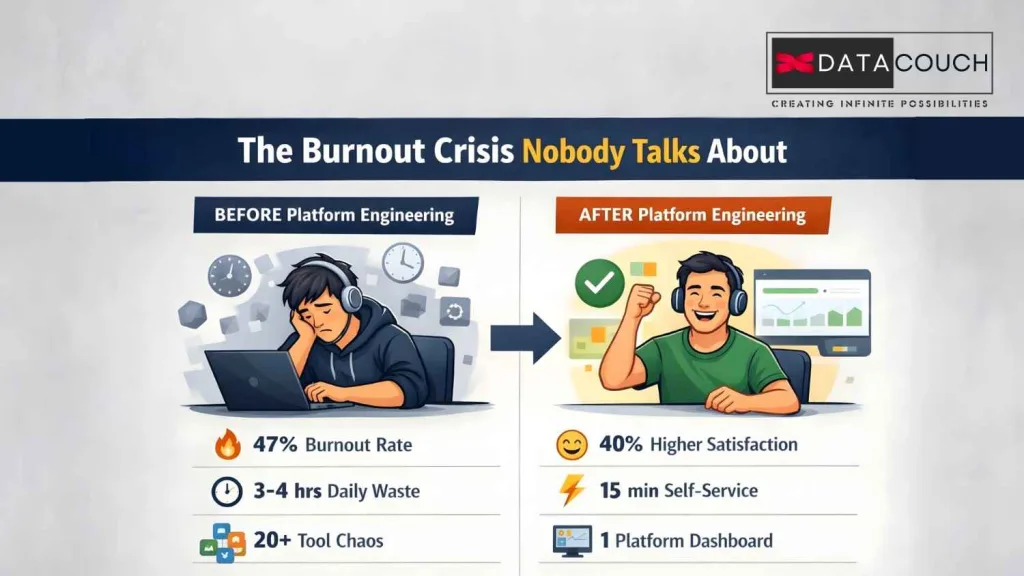
The Burnout Crisis Nobody Talks About
The real problem isn’t DevOps. It’s scale.
Most DevOps operating models were designed for small, fast-moving teams. They work well when a company has a handful of services and a limited number of engineers. But as organizations grow, those same patterns start to strain.
What once felt like collaboration turns into shared ownership without shared standards. Tooling decisions multiply. Pipelines diverge. Infrastructure knowledge becomes tribal. The DevOps team becomes the default escalation point for everything from deployments to permissions.
DevOps doesn’t look “broken” in small teams. At scale, it starts to feel chaotic, not because of a lack of skill or effort, but because the operating model itself no longer fits.
Burnout is the signal leaders can’t ignore
The cost of this mismatch shows up most clearly in developer burnout.
47% of engineers now say DevOps work causes their burnout. Your best developers spend Instead of building products, developers spend 3–4 hours every day managing Kubernetes clusters, fixing deployment pipelines, and fighting 20+ tools that don’t talk to each other.
As teams grow from a few squads to dozens, DevOps experts become bottlenecks. Every request feels urgent. Every interruption pulls engineers out of deep work. On-call becomes constant. Focus disappears.
Every tool switch costs engineers 15-23 minutes of lost productivity.
Multiply that across an entire organization, and whole workdays vanish into context switching and operational overhead.
How platform engineering changes the equation
Platform engineering doesn’t replace DevOps; it evolves it.
Instead of relying on shared heroics and tribal knowledge, platform teams create paved paths: shared platforms, opinionated standards, and self-service capabilities that remove unnecessary operational work from developers’ daily lives. The result is fewer interruptions, clearer ownership, and engineers who can focus on building reliable products instead of managing infrastructure complexity.
Curious how training reduces DevOps burnout?
See our Platform Engineering course overview.
Why Platform Engineering Completes DevOps
Understand this first: Platform engineering doesn’t replace DevOps. It makes DevOps work at scale.
DevOps gave you the philosophy. Platform engineering gives you the infrastructure to make that philosophy real when you grow from 10 engineers to 100+.
Here’s the difference your leadership team needs to grasp:
Traditional DevOps: Every team builds their own deployment process. Every team picks their own tools. Every team needs their own infrastructure expert.
Result: 10 different ways of doing the same thing. Security gaps. Constant configuration fights. Skyrocketing costs with a platform team, security and compliance are built into the Golden Path using policy-as-code, so every deployment follows approved guardrails by default and breach risk drops without slowing developers down.
Platform Engineering: One specialized team builds an “internal app store” for infrastructure. Developers click buttons to get environments, databases, deployments. No waiting. No expertise needed.
Result: Consistency. Predictability. Scale without hiring proportionally.
Your developers build features. The platform team makes that possible.
The Hidden Financial Disaster Nobody Calculates
Let me show you numbers that keep CTOs up at night but rarely get discussed.
Your organization likely loses $14-25 million annually from DevOps inefficiencies, and most don’t realize it.
Tool Sprawl Costs More Than You Think
53% of large organizations use 20+ DevOps tools but only coordinate half of them. Here’s the breakdown:
- Licensing: 20 tools x $100K average = $2 million annually
- Integration: 2-3 engineers full-time writing “glue code” between tools
- Configuration drift: Terraform state doesn’t match Helm charts doesn’t match actual infrastructure
- Security gaps: Tool A data never connects with Tool B logs
You’re paying 2-3x for overlapping functionality without realizing it.
Developer Time Gets Stolen Daily
70% of developers spend 3-4 hours daily on infrastructure instead of features. For a 100-person team:
100 developers x 3 hours x 250 workdays = 75,000 hours wasted yearly
At $150/hour fully loaded cost = $11.25 million in lost productivity
Burnout Drives Expensive Turnover
47% burnout rates mean 40-50% annual churn risk. Replacing one senior DevOps engineer costs:
- Recruiting: $50K-$100K
- Lost productivity: 3-6 months ramp-up
- Knowledge loss: Undocumented tribal knowledge leaves
- Total: $200K-$400K per departure
5 engineers leaving = $1-2 million unplanned expense.
Total hidden annual cost: $14+ million. Invest $500K-$1M in platform engineering, save $6-8 million. 600-800% ROI within 18 months.
| Cost Bucket | What’s Happening | Typical Impact (100 Dev Team) | Annual Cost Range |
|---|---|---|---|
| Tool sprawl | 20+ tools, overlapping spend, weak coordination | Licenses + upkeep + vendor creep | $1M–$3M |
| Integration “glue work” | 2–3 engineers maintaining pipelines and tool bridges | Engineering time diverted from product | $600K–$1.5M |
| Configuration drift | IaC, Helm, runtime don’t match, causing incidents/rework | Delays, rollbacks, downtime risk | $500K–$2M |
| Security gaps | Logs, access, policies spread across tools and teams | Higher breach and audit risk | $500K–$3M |
| Developer toil | 3–4 hrs/day on infra instead of features | 75,000 hrs/year at fully loaded cost | $8M–$15M |
| Burnout + churn | Attrition, ramp-up time, knowledge loss | 3–6 months productivity loss per hire | $1M–$5M |
| Total hidden cost | Tooling + toil + churn compounding together | $14M–$25 |
Before vs. After: Real-World Example
Your developer needs a new database. Here’s what happens now:
Before Platform Engineering (7-10 days):
- Opens DevOps ticket
- Waits 3-5 days (team overloaded)
- DevOps configures, documents, troubleshoots
- Misconfiguration requires back-and-forth
- Finally gets access after a week
The next developer repeats the entire process.
After Platform Engineering (15 minutes):
- Logs into self-service platform
- Clicks “Create Database”
- Fills simple form (type, size, environment)
- Gets secure credentials instantly
- Starts working immediately
The platform team built it once. Works the same way every time. Security stays consistent.
From Manual Toil To Architectural Leverage
| The DevOps Crisis (Today) | The Platform Solution (Tomorrow) |
|---|---|
| Cognitive Load: Devs must master K8s, Terraform, IAM. | Abstracted: Devs use a simple UI/CLI; complexity is hidden. |
| Ticket Ops: "Hey DevOps, I need a database." (Wait 3 days). | Self-Service: "Click: Provision Database." (Ready in 3 mins). |
| Snowflakes: Every team deploys differently. | Golden Paths: Standardized, secure templates for everyone. |
| Bottleneck: Senior DevOps folks are the single point of failure. | Scalability: One Platform team supports 100+ developers. |
| Onboarding: "Read this 50-page Wiki and ask Joe for access." | Day 1 Ready: "Log in to the portal; your dev environment is live." |
| Security: "Shadow IT" and manual checks before every release. | Guardrails: Security & compliance are baked into the templates. |
| Shadow Ops: Devs spend 30% of their sprint fixing pipelines. | Feature Focus: Devs spend 90% of their sprint writing business logic. |
| Knowledge Silos: If your lead DevOps engineer leaves, everything breaks. | Institutionalized: The "expertise" is coded into the platform itself. |
| Cloud Costs: Orphaned clusters and over-provisioned instances everywhere. | FinOps: Automated cleanup and cost-transparency for every team. |
| Innovation: Teams are too busy "keeping the lights on" to experiment. | Velocity: Lower barrier to entry means more MVPs and faster pivots. |
What Most Platform Engineering Articles Miss
Surprising truth: Most articles focus on tools (Backstage, Humanitec, Port.io). Tools matter 20%. The other 80% is whether developers actually use your platform.
The missing piece: Product mindset.
Wrong approach: “We built this. Use it.”
Right approach: “We’re building a product developers want to use.”
This means:
- Ask developers what slows them down (don’t assume)
- Feedback channels where they request features
- Roadmap transparency (they know what’s coming)
Usage metrics (are they actually clicking your buttons?)
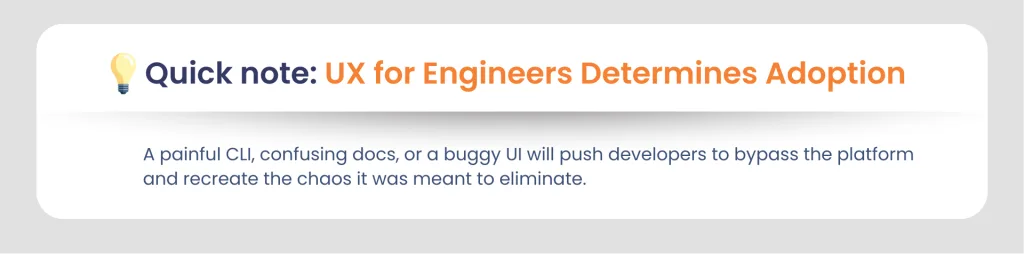
When platform engineering is framed as an IT project, adoption fails. Developers work around it, and teams drift back to old habits.
When it’s built and run like a real product, adoption follows, because it removes friction from developers’ daily work.
Honest Implementation Timeline
Most articles claim 6-month transformations.
Reality check: 12-18 months for maturity.
Months 1-2: Foundation
Pick one problem. Build MVP. Get 10% adoption. Learn ruthlessly.
Months 3-6: Early Wins
Expand to 30-40%. Iterate based on feedback. Measure deployment speed gains.
Months 6-12: Scale
80%+ adoption. Add security/compliance. Consolidate tools. See cost drops.
Month 12+: Optimize
Automate platform operations. Add AI capabilities. Focus on innovation.
Companies understanding this timeline succeed. Companies expecting miracles quit halfway.
Why 20-30% of Projects Actually Fail
Most articles don’t mention this: Platform engineering has 20-30% failure rate
Failure #1: Over-engineering
Build a “perfect” platform for 6 months. Problem changes. Nobody wants it.
Fix: Solve one problem excellently first.
Failure #2: No product thinking
Build what platform team thinks developers need. Get zero adoption.
Fix: Treat developers as customers. Ask them directly.
Failure #3: Tool obsession
Argue Backstage vs. Port.io forever. Never solve real problems.
Fix: Tool choice = 20% of success. People/process = 80%.
Failure #4: No executive buy-in
The CTO sees it as a “tech project.” The budget gets cut. Team demotivated.
Fix: Make strategic priority with clear ROI targets.
How Your Team Structure Changes
Current reality:
- Product teams build features
- DevOps team supports everyone, burns out
- No platform team exists
Platform engineering reality:
- Product teams use self-service platform
- Platform team (5-7 engineers) builds infrastructure product
- DevOps/SRE focuses reliability, not daily requests
Biggest benefit nobody mentions: Psychological safety.
Developers experiment freely without production risk. They try bold ideas. They ship faster. They stay longer.
2025 Numbers That Prove It Works
Deployment speed: 68% of organizations deploy monthly or less. Platform teams deploy 10-20x daily.
Developer happiness: 40% higher satisfaction scores. Onboarding drops from 4 weeks to 1 week.
Financial wins:
- 20-30% cloud cost reduction (no idle resources)
- Real case: SaaS company cut monthly cloud bill $25K to $12K (52% savings)
- 77% report faster time-to-market
- 85% see revenue impact
Market momentum:
- Gartner: 80% of engineering orgs get platform teams by 2026
- 55% already adopted (up from 25% in 2023)
$10.13B market growing to $28B by 2033
The Question That Determines Success
Here’s what separates winners from losers:
“Are we building compliance tools, or products developers choose?”
Forced platforms feel like bureaucracy. Developers resist.
Products they helped build? Developers evangelize them.
Your Immediate Action Plan
CTOs/Engineering Managers:
- Calculate your hidden costs using framework above
- Get CEO alignment (show $14M+ waste numbers)
- Pilot with one team, one problem (30 days)
- Track adoption metrics weekly
DevOps Team Leads:
- Acknowledge team burnout (structural problem, not personal)
- Document top 3 developer pain points
- Propose MVP solving #1 pain point
- Measure before/after deployment times
Developers:
- List your daily infrastructure frustrations
- Share with leadership (be specific)
- Volunteer for platform pilot
Give honest feedback during testing
The Bottom Line
Platform engineering doesn’t replace DevOps. It completes DevOps at scale.
DevOps promised collaboration and automation. Platform engineering delivers the infrastructure making those promises real when you grow beyond 20 engineers.
Your developers burn out managing 20+ tools. You lose $14-25M annually to inefficiencies. Competitors adopting platform engineering ships 10-20x faster.
The barrier isn’t technology. It’s organizational willingness to change structure.
DataCouch helped 200+ enterprises make this exact transition – from DevOps chaos to platform maturity. We train platform engineering teams, design internal developer platforms, and guide the organizational shifts required.
If you ignore this for two years, what does your engineering team look like? More burnout? Higher costs? Falling behind?
Or you start now. Build one platform team. Transform how you scale.
What’s the one change you make this week to reduce engineering burnout?
Ready to train your team on platform engineering?
Explore DataCouch's practical courses designed for real transformation.