
AI Factory Certification Roadmap: Which Courses Should Your Team Complete First?
An AI factory certification roadmap is a structured sequence of courses and credentials that maps each role in your enterprise AI team to the exact skills they need, in the right order, so the whole system can run together.
Most enterprises have a training budget. Most also have an AI skills gap. Yet only 35% of organizations report having a mature, organization-wide AI upskilling program, according to the DataCamp 2026 State of Data and AI Literacy Report. The other 65% are investing in training that is fragmented, generic, and disconnected from what their teams actually need to do in production.
The result? Only 21% of enterprise leaders report seeing significant positive ROI from their AI investments. Not because the technology is broken. Because the workforce was not built to operate it.
This guide fixes that. Whether you are a student planning your first AI certification, a working professional trying to move into an AI-adjacent role, a team lead building a new AI practice, or a CTO asking where to invest the training budget, this roadmap tells you exactly which courses to complete first and why.
Why Most Teams Train in the Wrong Order
The Mistake That Wastes Training Budgets
Here is what usually happens. An L&D team gets a budget approved for AI training. They run a company-wide generative AI workshop. Some people sign up for a cloud certification on their own. A data engineer takes a Python refresher. A few managers watch YouTube playlists about ChatGPT.
Nobody learns in a connected sequence. Nobody’s skills stack on anyone else’s. The team has more certifications than before and the same deployment rate as before.
What most people do not realize is that an AI factory is a system, not a collection of individuals. Each role feeds the next. A data pipeline engineer’s work directly determines what the MLOps engineer can deploy. The MLOps engineer’s practices directly determine what the agentic AI developer can build reliably. If any one layer in the chain trains out of sequence with the others, the factory floor breaks at exactly that point.
Key stat: Organizations with mature, workforce-wide AI upskilling programs are nearly twice as likely to report significant positive AI ROI — DataCamp, 2026 State of Data and AI Literacy Report.
The fix is not more training. It is sequenced training that maps to the actual workflow of your AI factory. Here is how to build that sequence.
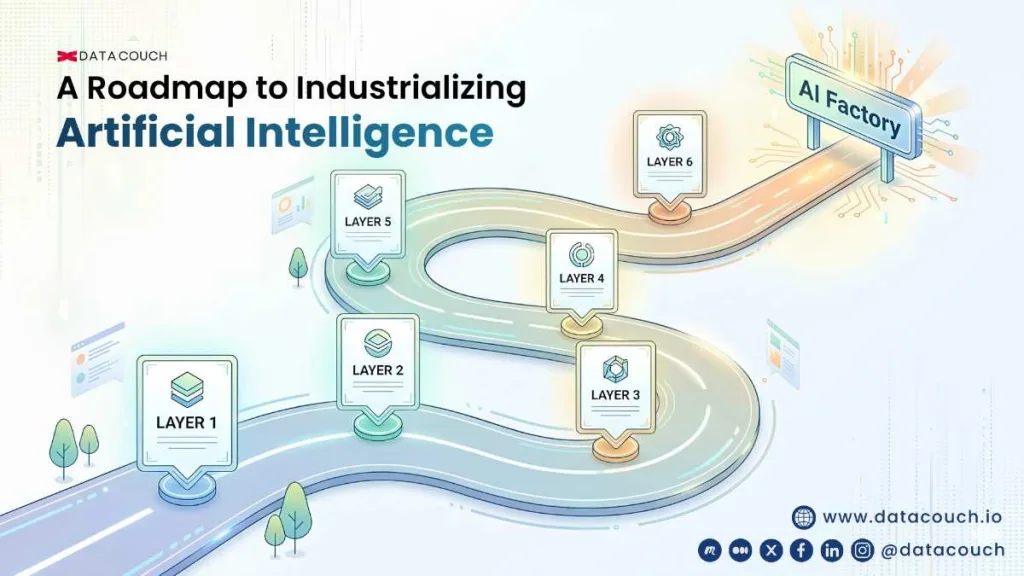
The 6-Layer AI Factory Certification Roadmap
Think of your AI factory team as a six-floor building. Each floor must be structurally sound before the next one can be built on top of it. Skipping a floor does not save time. It creates a structural failure that you discover after you have already paid for the floors above it.
| 1 | All roles | AI Foundations and Prompt Engineering | Start here |
| 2 | Data Engineers, Platform Teams | Data Engineering and Pipeline Architecture | Second |
| 3 | ML Engineers, DevOps Teams | MLOps and Model Lifecycle | Third |
| 4 | AI Developers, Architects | Generative AI and Agentic Systems | Fourth |
| 5 | Compliance, Legal, AI Leads | AI Governance and Responsible AI | Fifth |
| 6 | CTOs, PMs, Team Leads | AI Strategy and Cross-Functional Leadership | Sixth |
Layer 1: AI Foundations and Prompt Engineering (All Roles)
Start Here Before Anything Else -- No Exceptions
This is the layer that most companies skip for technical roles because they assume their engineers already know enough. That assumption costs them later.
AI foundations training is not about learning what a large language model is. It is about building a shared vocabulary across your entire team so that a data engineer, a product manager, a compliance officer, and a CTO can talk about the same system without talking past each other. Without this layer, every cross-functional conversation about your AI factory generates more confusion than alignment.
Prompt engineering specifically has evolved well beyond writing better ChatGPT queries. In 2026, prompt engineering and generative AI literacy are the single most universally demanded AI skills across all job functions, according to recruiter data and LinkedIn’s 2026 hiring reports. Organizations that invest in this foundation first deploy AI tools at 3 to 4 times higher adoption rates than those that skip straight to advanced courses.
- What everyone needs: Understanding AI model behavior, prompt design, use-case scoping, limitations awareness, and how to evaluate AI outputs critically.
- What technical roles are needed additionally: Automated prompt optimization, prompt versioning, evaluation pipelines, and integration with production LLM APIs.
Build your team's AI foundation the right way.
Explore DataCouch's Generative AI and Prompt Engineering courses designed for every role, from business leaders to engineers.
Layer 2: Data Engineering and Pipeline Architecture (Data Teams)
The Layer That Determines Everything Downstream
An AI factory without a solid data infrastructure is like a manufacturing plant without a supply chain. The machines exist. Nothing comes out.
Data engineering training at this layer is not just about knowing SQL or writing Spark jobs. It is about understanding how to build production-grade pipelines that feed AI models with clean, consistent, version-controlled feature data. The most critical concept at this layer is training-serving symmetry: the data transformations applied during model training must be replicated identically at inference time. Teams that train on data engineering without this concept end up with models that quietly drift in production.
According to Deloitte’s 2025 Enterprise AI survey, 48% of organizations cite data searchability and 47% cite data reusability as their top AI automation blockers. That is a pipeline training problem, not a tool problem.
- Core skills at this layer: ELT pipeline design, feature store architecture, data mesh principles, dbt, Apache Iceberg, Delta Lake, data quality monitoring, and FinOps for data engineering.
- Cloud platform track: AWS SageMaker pipelines, Databricks, Snowflake Cortex, or Microsoft Fabric, depending on your enterprise stack.
- Who needs this: Data engineers, data platform leads, analytics engineers, and any ML engineer who also touches data infrastructure.
Train your data team on modern AI-ready pipeline architecture.
Browse DataCouch's Data Engineering courses covering dbt, Databricks, Kafka, Iceberg, Snowpark, and Lakehouse design.
Layer 3: MLOps and Model Lifecycle Management (ML Engineering Teams)
The Layer Most Companies Under-Train -- and Pay for in Production
Here is a scenario that plays out repeatedly in enterprise AI teams. A model performs beautifully in testing. Stakeholders approve it. It ships to production. Six months later, predictions are off. Nobody can explain when the degradation started. The business quietly stops trusting it.
That is model drift, and it is the most common reason enterprise AI pilots do not survive their first year in production. The fix is not a better model architecture. The fix is MLOps training: teaching your team to treat model deployment as a continuous manufacturing process, not a launch event.
AI-related job postings grew over 100% between 2024 and 2026, with MLOps skills showing one of the steepest demand-supply gaps in the market. Every major cloud ecosystem has updated its MLOps certification track in response to this demand. Microsoft launched the MLOps Engineer Associate (Exam AI-300) in early 2026, replacing the older DP-100 and expanding the scope to include GenAIOps, drift detection, inference cost control, and agentic model governance. AWS updated the Machine Learning Associate (MLA-C01) exam to provide stronger coverage of SageMaker MLOps pipelines and model monitoring. Google refreshed the Professional ML Engineer certification to include Vertex AI model registry, pipeline automation, and responsible AI evaluation. All three ecosystems are telling the same story: the market has moved from building models to operating them reliably in production.
- Core skills at this layer: CI/CD for ML, drift monitoring, model registry and versioning, containerization with Docker and Kubernetes, inference cost optimization, and canary deployment strategies.
- Certifications worth pursuing: Microsoft AI-300 (MLOps Engineer Associate), AWS MLA-C01 (Machine Learning Associate), or GCP Professional ML Engineer, depending on your cloud stack.
- Who needs this: ML engineers, DevOps engineers supporting AI teams, cloud architects, and any data scientist who will be responsible for production deployments.
Close the MLOps gap before it becomes a production incident.
Explore DataCouch's AI and ML Engineering programs on AWS and Azure, including SageMaker MLOps, model lifecycle management, and enterprise AI design.
Layer 4: Generative AI and Agentic Systems (AI Developers and Architects)
The Highest-Value Layer -- and the Most Undertrained One
If you had to pick one layer that separates an AI factory that generates business value from one that runs a series of disconnected demos, this is it.
Generative AI training at this level is not about learning to use ChatGPT. It is about building production-grade GenAI applications: RAG pipelines with real retrieval quality, LLM fine-tuning workflows, prompt version control, evaluation pipelines, and the multi-agent orchestration architecture that makes autonomous AI systems reliable rather than unpredictable.
Agentic AI in particular is the most under-trained skill in enterprise teams right now. As of March 2026, 80% of organizations are deploying AI agents to automate routine decisions, yet the majority of those teams have no formal training in multi-agent design, guardrail engineering, or human-in-the-loop workflow architecture. Professionals certified in agentic orchestration command a 43% salary premium over standard AI engineers.
- Core skills at this layer: RAG architecture, LLM fine-tuning and evaluation, multi-agent design patterns, orchestration frameworks like LangChain and LangGraph, guardrail engineering, and LLMOps including prompt versioning, cost tracking, and quality measurement.
- Platform tracks available: Amazon Bedrock, Azure OpenAI and AI Foundry, Google Cloud Vertex AI and Gemini, and open-source LLM stacks.
- Who needs this: AI developers, solution architects, senior data scientists, and any engineer who will build or maintain GenAI-powered applications or agentic workflows.
Ready to build and orchestrate production-grade AI agents?
Explore DataCouch's Agentic AI and Generative AI Engineering courses, including multi-agent systems, Amazon Bedrock, Azure AI Foundry, and Vertex AI programs.
Layer 5: AI Governance and Responsible AI (Compliance, Legal, and AI Platform Leads)
The Counter-Intuitive Layer: Governance Speeds You Up
Most companies treat governance training as a legal requirement, something you schedule for the compliance team after the engineers have already shipped. Here is what that approach actually produces: every new AI deployment triggers a separate ad hoc review with no shared documentation, no reusable audit framework, and no consistent standard. Each deployment is slower than the last.
Companies that train their teams in AI governance before deployment take a different approach. They build bias auditing pipelines, audit trail architecture, and explainability standards once. Every subsequent deployment reuses them. According to Wishtree’s 2026 AI Workforce Report, companies with mature AI governance frameworks deploy AI systems 2x faster than those without one. Governance is a speed asset, not a speed penalty.
The WEF Future of Jobs Report 2025 identified AI governance as the skill with the sharpest global shortage in the enterprise AI workforce. And with the EU AI Act now in force, plus India’s DPDPA 2025 Rules approaching their compliance deadline, governance training has moved from a nice-to-have to a legal imperative for any team deploying AI across multiple jurisdictions.
- Core skills at this layer: Bias auditing and fairness testing, explainability techniques including SHAP and LIME, audit trail architecture, responsible AI by design, data residency and sovereignty compliance, and EU AI Act risk classification.
- Who needs this: AI governance leads, compliance and legal teams, CISOs, platform architects, and any engineer who builds systems that make decisions affecting people.
Train your team to build AI systems that are fast, fair, and audit-ready.
Explore DataCouch's Responsible AI and Governance courses covering ethical AI design, bias testing, XAI, and compliance architecture.
Layer 6: AI Strategy and Cross-Functional Leadership (CTOs, PMs, and Team Leads)
The Layer That Makes All the Others Convert to Revenue
Explore DataCouch’s AI strategy and leadership coaching programs for CTOs, senior managers, and cross-functional AI leaders.
AI strategy training for leaders is not about learning to code. It is about learning to frame AI investments in terms that boards, legal teams, and product managers understand. It is about understanding how AI systems accumulate technical debt, how to define success metrics that matter to the business rather than to the model, and how to run an organizational change program that shifts a company from project-centric AI to platform-centric AI.
Boston Consulting Group’s 2026 analysis found that organizations with formal AI training programs achieve 2.3x faster AI adoption and 67% higher AI ROI compared to those struggling with talent gaps. The differentiator is not just technical depth. It is leadership teams that understand how to design for AI at scale, measure its output in business terms, and make decisions about deployment risk with clarity rather than anxiety.
- Core skills at this layer: AI product management and ROI framing, failure mode thinking for ML systems, change management for AI adoption programs, communicating model uncertainty to non-technical stakeholders, and sovereign AI strategy for GCCs operating across multiple regulatory jurisdictions.
- Who needs this: CTOs, CIOs, AI product managers, technical program managers, GCC heads, and senior L&D leaders who design enterprise upskilling programs.
Build leaders who can turn AI investment into measurable business outcomes.
Explore DataCouch's AI strategy and leadership coaching programs for CTOs, senior managers, and cross-functional AI leaders.
How to Sequence Training for Different Team Sizes
Small Teams (5 to 15 people)
In smaller teams, most people will cover two or three layers. Start every member at Layer 1 regardless of background. Then assign Layer 2 and Layer 3 to your data and ML engineers simultaneously. Introduce Layer 4 after Layer 3 is complete. Assign Layer 5 to at least one person on day one, not as an afterthought. Keep Layer 6 for whoever is leading the team externally.
Mid-size Teams (15 to 50 people)
You can run Layers 1 through 3 as cohorts across the full team, with different depth tracks for technical and non-technical members. Layer 4 should be a dedicated cohort for your AI developers. Layers 5 and 6 should run in parallel with Layer 4, not after it, because governance and leadership requirements shape how Layer 4 is implemented.
Enterprise and GCC Teams (50 and above)
Run structured, role-based certification programs with measurable outcomes. The IDC 2026 report found that 40% of IT leaders struggle with inconsistent skills development across their organizations. The fix is not more courses. It is a governed certification pathway with skills verification at each layer, so you always know exactly which layer each team member has completed and where the gaps are.
The 5 Most Common AI Training Mistakes (And How the Roadmap Fixes Them)
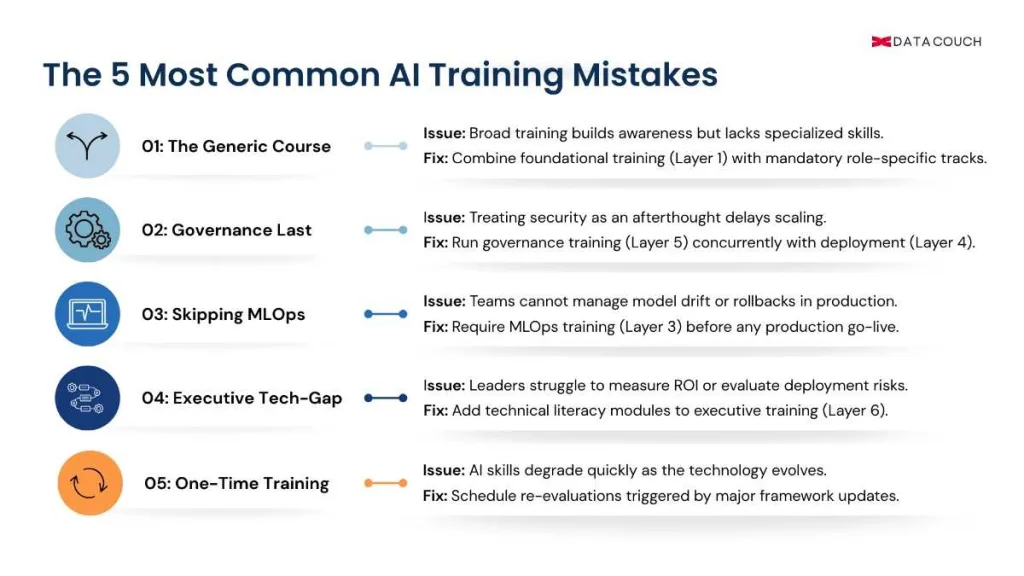
Mistake 1: Everyone does the same generic AI course.
Technical and non-technical roles need different depth. Generic training builds awareness without capability. The fix: Layer 1 for everyone, then role-specific tracks from Layer 2 onward.
Mistake 2: Governance training is scheduled last.
Every deployment creates a separate review from scratch, and deployments get slower as the portfolio grows. The fix: Layer 5 starts in parallel with Layer 4, not after it.
Mistake 3: MLOps is skipped for data scientists.
Models perform in testing and drift in production. The team has no monitoring or rollback capability. The fix: Layer 3 is mandatory before any production deployment.
Mistake 4: Leadership skips all technical layers.
Executives cannot evaluate deployment risk, communicate uncertainty, or measure AI ROI in business terms. The fix: Layer 6 includes technical literacy modules, not just strategy.
Mistake 5: Training is one-time, not continuous.
AI skills have a 6-month effective half-life. One-time certifications expire faster than the technology evolves. The fix: each layer is revisited on a rolling schedule tied to model and framework updates.
Key Takeaways
The AI factory certification roadmap works because it is sequenced to match how an AI factory actually operates, not how a course catalog happens to be organized. Here is the short version:
- Layer 1 (AI Foundations) builds the shared vocabulary that makes every other layer possible. No team should skip it for any role.
- Layer 2 (Data Engineering) determines the quality of everything downstream. Train this layer before your team touches model training at scale.
- Layer 3 (MLOps) is the difference between AI that ships once and AI that runs reliably in production. This is the #1 hiring bottleneck in enterprise AI in 2026.
- Layer 4 (Generative AI and Agentic Systems) is where competitive differentiation lives. The 43% salary premium for agentic orchestration skills reflects genuine market scarcity.
- Layer 5 (Governance) speeds up deployment when built in from the start. The companies deploying fastest are the ones that trained governance first, not last.
- Layer 6 (Leadership) is where technical capability converts to business ROI. Without it, all five layers below it produce value that nobody in the organization can measure or communicate.
According to PwC’s 2025 AI Jobs Barometer, AI-skilled professionals earn a 56% wage premium over comparable roles without AI skills. And roughly 1 in 50 enterprise AI investments produce meaningful ROI when organizations invest in technology without upskilling the people who use it. The roadmap above is not an optional improvement to your AI strategy. It is the structural difference between those two outcomes.
So here is the question worth bringing to your next team planning session: Which layer in this roadmap is your team missing right now, and what would it mean for your AI factory if you closed that gap in the next 90 days rather than the next two years?
Not sure where your team currently sits across these six layers?
Browse DataCouch's full enterprise AI training catalog and find the right starting point for every role on your team.