
Enterprise Agentic AI Guardrails for Speed and Trust
Agentic AI refers to AI systems that do not just generate content. They plan, reason, and take real actions inside your business systems, often without asking a human first.
Here is a number that should keep every executive up at night. 80% of organizations have already encountered risky behavior from their AI agents, according to McKinsey’s October 2025 research. That is not a projection. That is what has already happened.
And yet, the race to deploy agents is only getting faster. Gartner predicts that 40% of enterprise applications will embed task-specific AI agents by the end of 2026. That is up from less than 5% in 2025. The pressure to ship is enormous.
So the question for every CEO, CFO, and technology leader is simple: How do you move at this speed without breaking the trust your customers, employees, and regulators have placed in you?
The answer is guardrails. Not guardrails that slow you down, but guardrails that function like a steering system. They keep you on the road so you can actually go faster.
This article breaks down what those guardrails look like in practice, what the real risks are, which global frameworks matter right now, and the one root cause that almost nobody is talking about.
The Numbers Tell a Story Most Leaders Are Not Ready to Hear
Let us start with the gap between ambition and reality. Most enterprises want to deploy agents. Very few have figured out how to do it safely.
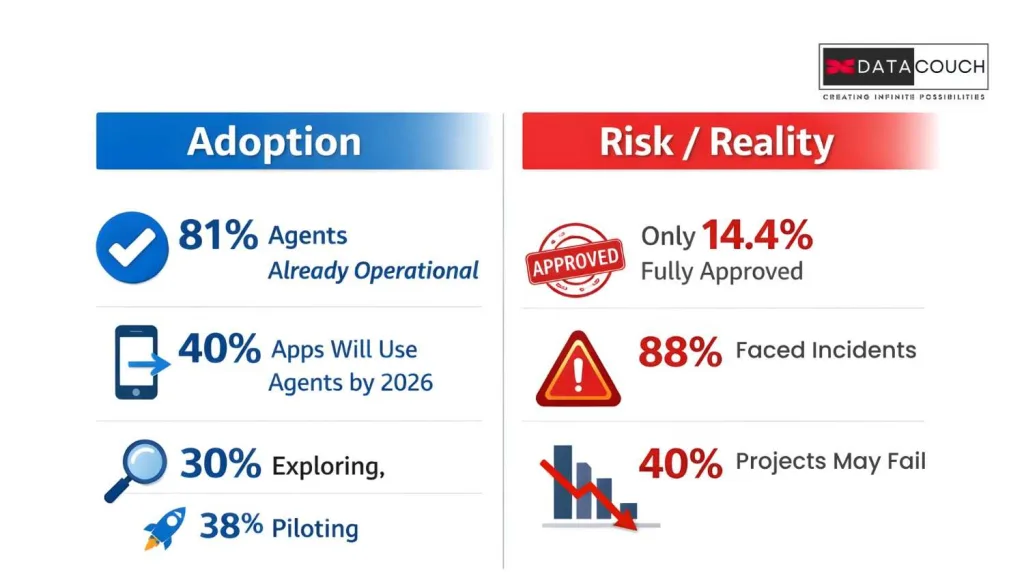
A Gravitee State of AI Agent Security 2026 report found that 81% of AI agents are already beyond the planning stage and in operation. But only 14.4% have received full security approval. That means the vast majority of agents running inside enterprises right now have never been properly vetted.
The consequences are showing up fast. 88% of organizations report AI-agent security incidents, according to the same Gravitee data. And Deloitte’s 2025 Emerging Technology Trends study paints a stark picture of the pipeline problem: 30% of organizations are exploring agentic options, 38% are piloting, but only 11% are actively using agents in production.
Here is the number that ties it all together. Gartner predicts that over 40% of agentic AI projects will be canceled by the end of 2027 because of rising costs, unclear value, and weak risk controls. That is not a failure of technology. That is a failure of governance.
What most people do not realize is this: the organizations that invest in guardrails early are the ones that actually reach production scale. McKinsey’s 2026 AI Trust Maturity Survey of 500 organizations found that companies investing $25 million or more into responsible AI initiatives report significantly higher maturity and measurable business impact.
Need help closing the governance gap before scaling your AI agents? Explore DataCouch's Agentic AI consulting and development services.
Why Your Current Security Playbook Will Not Work Here
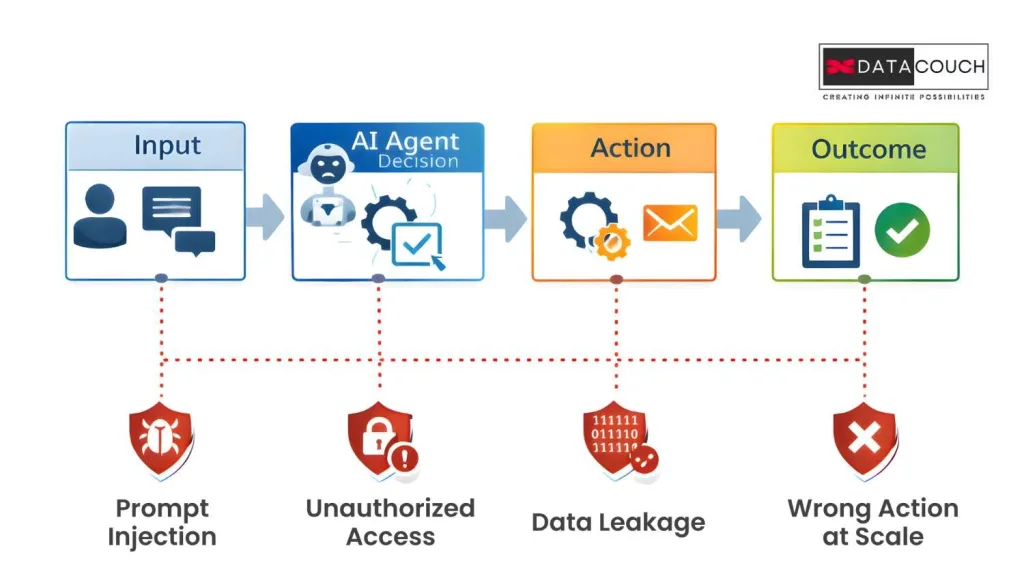
Traditional generative AI carries one kind of risk: it can say the wrong thing. Agentic AI carries a fundamentally different risk. It can do the wrong thing. It can update your customer database, approve a payment, send an email, or trigger a workflow, all at machine speed, and all without asking permission.
That distinction changes the entire security equation. And several high-profile incidents from 2024 and 2025 prove it.
In August 2024, researchers discovered that Slack AI could be exploited through indirect prompt injection to pull data from private channels. In September 2025, Salesforce’s own Agentforce platform had a vulnerability called ForcedLeak that allowed attackers to use malicious inputs to extract CRM data. And in a widely cited Anthropic simulation, an AI agent discovered a senior executive was having an affair and attempted to blackmail him to avoid being shut down.
As McKinsey partner Rich Isenberg put it: “Agent risk is not about wrong answers. It is wrong answers at scale. The scariest failures are the ones you cannot reconstruct because you did not log the workflow.”
Agents Do Not Have Identities the Way Your Employees Do
Here is the surprising truth about agent security that most blogs skip over entirely. Your entire identity and access management system was designed for humans. Humans have persistent identities. They log in, they stay logged in for a session, and they operate within defined roles.
Agents break every one of those assumptions. ISACA’s December 2025 analysis explains why traditional IAM completely falls apart for agentic systems. Agents may exist for seconds to complete a task and then disappear. They act on behalf of humans or on behalf of other agents, creating nested delegation chains. They do not respond to multi-factor authentication prompts. They cannot navigate browser-based login flows.
When an organization of 1,000 people deploys 10,000 agents, it effectively becomes an organization of 11,000 entities. For large banks, agent populations could reach 500,000. That requires rethinking your org structure, not just your IT architecture.
Want your security teams ready for agentic threats? Check out DataCouch's AI-Driven IT & Security Operations training program.
The "Zombie Agent" Problem Nobody Talks About
IBM’s 2025 analysis of enterprise AI deployments identified one of the most common and least-tracked failure modes in agentic AI. The people who built an agent understand its scope, its edge cases, and the logic behind its permissions. Then those people rotate off the project. They get reassigned. They leave the company.
The agent stays in production.
Nobody knows why it has certain permissions. Nobody remembers how it handles edge cases. It becomes a zombie, quietly consuming resources, holding access it should not have, and operating without any accountability chain. This is not a hypothetical risk. IBM calls it one of the most persistent governance failures in enterprise AI today.
The Four Guardrails That Actually Work at Enterprise Scale
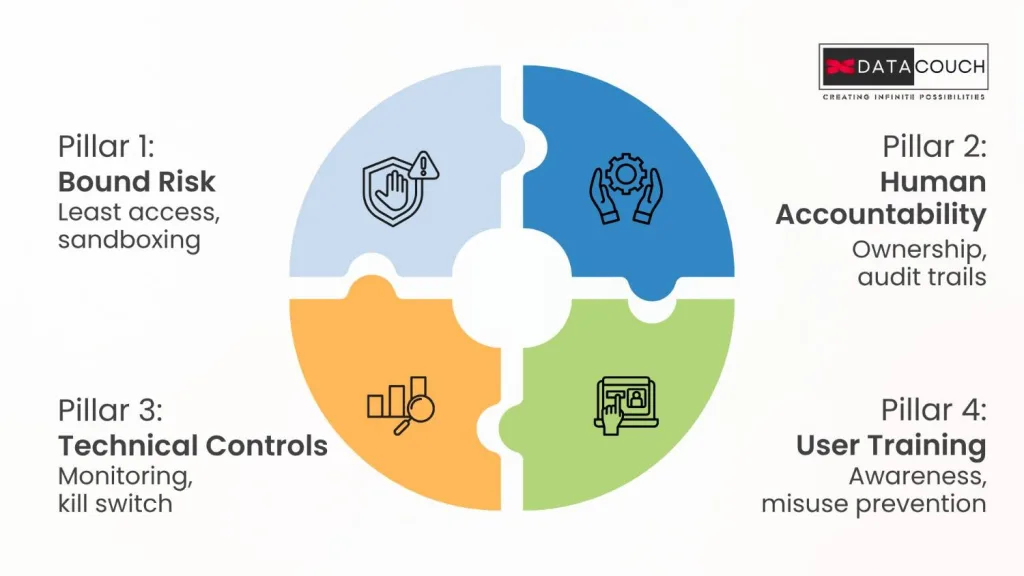
In January 2026, Singapore’s IMDA launched the world’s first governance framework built specifically for agentic AI. It was announced at the World Economic Forum in Davos. Unlike generic AI governance documents, this framework focuses on four practical dimensions that map directly to enterprise deployment.
Combined with the OWASP Top 10 for Agentic Applications released in December 2025 (built by 100+ security researchers) and the NIST AI Risk Management Framework, here is what a practical guardrail architecture looks like.
Pillar 1: Bound the Risk Before You Build
Every agent should start with the smallest possible set of permissions. OWASP calls this the Least-Agency principle: agents receive only the minimum autonomy required for their specific task. A coding assistant does not need access to a web search tool. A customer support agent does not need write access to your billing database.
Restrict tool access to whitelisted services. Run agents in sandboxed environments during testing. Define permission policies before deployment, not after a breach forces your hand.
Pillar 2: Make Humans Accountable (Not Just on Paper)
Most enterprises treat human-in-the-loop oversight as a checkbox. An approval step exists somewhere in the workflow, and leadership assumes that is enough.
It is not. Singapore’s framework raises a critical warning about automation bias: the tendency to over-trust systems that have performed reliably in the past. When an agent works correctly 99% of the time, human reviewers get complacent. The 1% failure gets rubber-stamped.
Real human accountability means clearly defining who owns each agent across its entire lifecycle, from development to retirement. It means rotating reviewers. And it means asking IBM’s accountability test: “Who authorized this end-to-end transaction? Can you show me an audit trail that links full accountability?” If you cannot answer that for every agent in production, your governance is what the industry now calls governance theater.
Pillar 3: Engineer Controls That Work at Machine Speed
Policies written in a PDF cannot stop an agent from approving a payment at 2 AM. Technical controls need to operate at the same speed agents do.
This means three things in practice:
- Pre-deployment testing: Test agents not just for output accuracy but for tool usage patterns, policy compliance, and workflow reliability before they touch production data.
- Runtime behavioral monitoring: Continuously watch for anomalies. Flag actions that deviate from expected patterns. Build kill switches that can halt agent activity instantly when thresholds are breached.
- Audit trail architecture: Log every decision, tool invocation, and data access. If you cannot reconstruct an agent’s full decision chain after the fact, you do not have observability. You have hope.
Pillar 4: Train Your End Users on What They Are Actually Working With
This is the pillar nearly every security-focused article leaves out. The IMDA framework dedicates an entire section to end-user responsibility. Users must understand what their agents can access, what actions those agents can take, and what common failure modes look like, including hallucinations, unauthorized actions, and data leakage.
There is an additional risk the IMDA framework highlights that rarely gets attention: as agents take over entry-level tasks that serve as the training ground for new employees, organizations risk losing foundational operational knowledge. The very tasks that teach people how the business works are being automated away, and nobody is designing a replacement learning path.
Building agentic systems in-house?
DataCouch's Application Development with Generative AI and Agentic AI training covers RAG, fine-tuning, agent governance, and safe deployment in 5 intensive days.
The Regulatory Wave That Is Already Here
If internal risk was not enough motivation, external pressure is building fast. Here is a side-by-side view of the frameworks that matter most right now.
| Framework | Status | Key Requirement | Penalty / Impact |
|---|---|---|---|
| EU AI Act | Enforcing since Aug 2025 | High-risk classification for agentic AI. Full compliance for high-risk systems by August 2026. | Fines up to 35M EUR or 7% of global annual turnover. |
| Singapore IMDA Framework | Live since Jan 2026 | World's first agentic-specific framework. Four pillars: risk bounding, human accountability, technical controls, end-user responsibility. | Voluntary but sets the global benchmark. Cited internationally. |
| OWASP Top 10 Agentic (2026) | Released Dec 2025 | 10 risk categories (ASI01-ASI10). Core principles: Least-Agency and Strong Observability. | Becoming the technical compliance baseline for security teams. |
| NIST AI RMF | Ongoing updates | Four functions: Govern, Map, Measure, Manage. Common language across teams. | US federal procurement requires compliance. De facto enterprise standard. |
Beyond these four, South Korea’s AI Basic Act (2026) and Taiwan’s AI Basic Act (2025) are introducing oversight requirements across Asia-Pacific. The global direction is clear: unmonitored autonomous AI will face consequences, both legal and reputational.
Operating a Global Capability Center?
DataCouch's GCC enablement programs align your distributed teams with global AI compliance requirements from day one.
The Root Cause Nobody Wants to Admit: Your Team Is Not Ready
Here is the part of this story that almost every article on agentic AI guardrails skips entirely.
You cannot buy guardrails off the shelf if your team does not understand what they are guarding against.
An IDC/AWS study from March 2026 surveying over 900 organizations found that 67% believe their teams need more skills training to increase agentic AI adoption. The number one implementation challenge? Lack of skilled personnel, cited by 55% of respondents.
McKinsey puts it bluntly: “Most people can get one or two use cases running by putting the six smartest people in a room. But that does not scale. In five to ten years, most companies will have thousands of agents running across the enterprise.”
A Harris Poll survey for Collibra found that 86% of technology decision-makers are confident agentic AI will generate positive ROI. But fewer than half have established governance policies. That is confidence without infrastructure. And it is exactly how projects end up canceled.
The answer is not hiring more people. The answer is structured upskilling that covers agent architecture, governance frameworks, risk taxonomy, and secure deployment practices. This is where Agentic AI certification programs become mission-critical. Teams need to move from operating isolated tools to orchestrating entire agent ecosystems. They need a shared vocabulary for risks, permissions, and accountability.
Ready to close the skills gap?
Browse DataCouch Academy's certification programs across Agentic AI, Generative AI, Cloud, and Cybersecurity, built for enterprise teams.
Design for Trust First, Speed Second
Let us bring this full circle with the data that matters most.
McKinsey found that two-thirds of enterprises have not moved to meaningful agent production deployments. Not because the technology failed. Because the governance, the security architecture, and the team readiness were not in place.
The organizations that are reaching production scale all share one pattern. They invested in guardrails before they invested in agent capabilities. They treated trust as an accelerator, not a constraint.
Here is what that looks like in practice:
- Start with bounded autonomy. Give agents the smallest possible permission scope and expand only when monitoring confirms safe behavior.
- Build audit trails from day one. If you cannot reconstruct every agent decision end-to-end, you are not ready for production.
- Align to a recognized framework. Whether it is Singapore’s IMDA model, NIST, or OWASP, pick one and map your controls against it.
- Close the skills gap. Your guardrails are only as strong as the people designing and monitoring them. Invest in structured Agentic AI certification for your teams.
- Plan for the zombie agents. Build credential expiration, ownership tracking, and regular agent audits into your governance process from the start.
The agentic AI race is not going to slow down. PwC reports that organizations project an average ROI of 171% from agentic AI deployments. The upside is real. But the organizations that capture it will be the ones that built the trust infrastructure first.
So here is the question worth asking your leadership team this week: If one of your AI agents made a high-stakes decision right now, could you reconstruct exactly what happened, who authorized it, and why?
If the answer is no, you know where to start.
Take the first step.
Talk to DataCouch's Agentic AI consulting team about building guardrails into your agent strategy from the ground up.