
Kotlin Multiplatform in 2026: The End of Siloed Mobile Development?
For CTOs, Tech Leads, Developers & Engineering Managers
The Story That Changed How We Think About Mobile Development
In 2018, Airbnb made headlines by walking away from React Native. They had bet big on write once, run everywhere for their mobile apps. The result was a product that felt slow, a team that was frustrated, and an architecture that held them back. They ditched it and went back to separate native teams for iOS and Android.
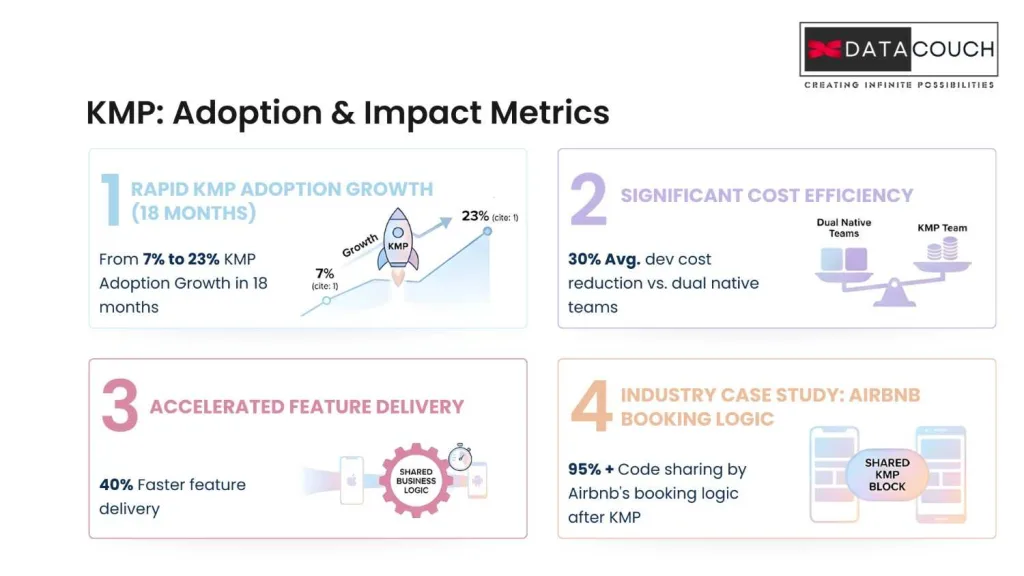
Fast forward to 2025. Airbnb came back to the cross-platform conversation, but this time with Kotlin Multiplatform. Within six months, they hit 95% code sharing for their booking logic. Their release cycle went from monthly to weekly. Their iOS and Android teams were finally shipping together, not in parallel.
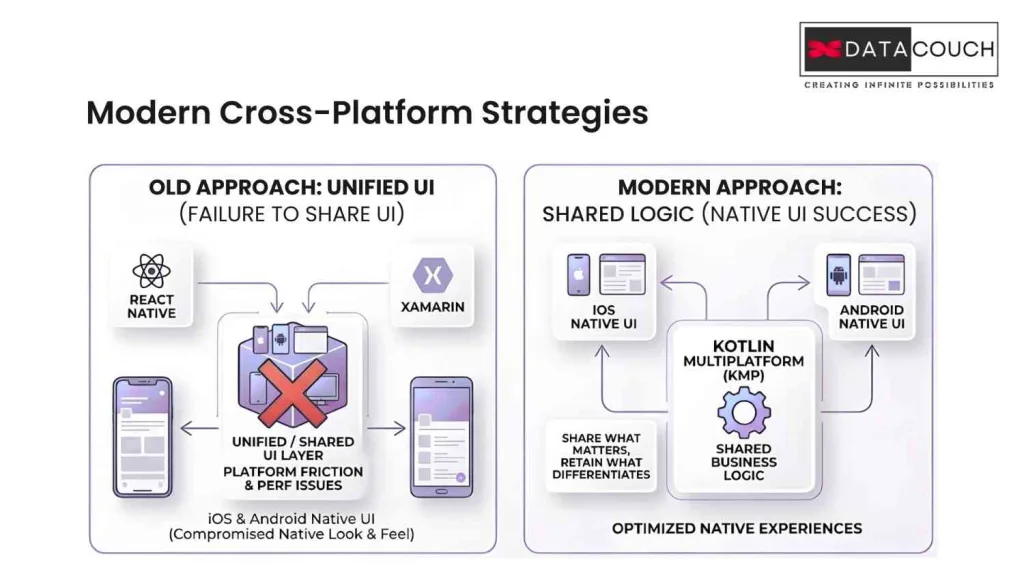
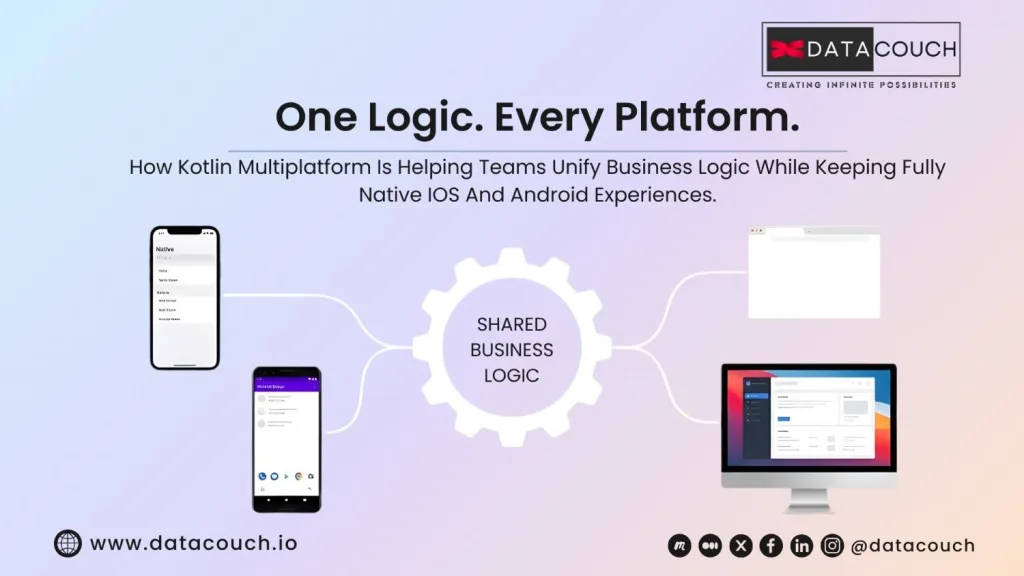
What changed? The technology did not magically improve overnight. The thinking changed. The industry finally learned to share the right thing, which is business logic, not the UI. That single insight is why Kotlin Multiplatform is now the most talked-about shift in mobile development.
If you are a CTO trying to cut costs, a tech lead deciding on your next stack, a developer who wants to stay ahead, or a manager trying to justify a platform change to leadership, this article is written for you. We are going to go well beyond the surface-level takes and dig into the stuff that most articles completely skip.
What Actually Changed Between 2024 and 2026
The ‘KMP is production-ready’ headline started circulating in 2023. But real adoption only accelerated after a cluster of changes hit in 2024 and 2025. Here is what actually moved the needle.
Compose Multiplatform for iOS Went Stable and What That Really Means
In May 2025, JetBrains announced Compose Multiplatform for iOS reached stable status. 96% of teams in early pilots reported no major performance issues. Before this, sharing UI across iOS and Android via KMP was risky. After this milestone, it became a realistic option for many product types.
That said, stable does not mean identical to SwiftUI. There are still differences in animation fidelity and how the app feels on iOS. The smart approach is to use Compose Multiplatform for internal tools, dashboards, and utility screens while keeping native SwiftUI for your main consumer-facing experiences.
The K2 Compiler Made Teams Measurably Faster
JetBrains’ K2 compiler delivered over 40% faster compilation in real-world tests. For a team running 50 or more CI builds per day, this is not a minor improvement. It compounds. Faster builds mean faster feedback loops, which means faster shipping. This was a quiet but hugely practical win for engineering teams at scale.
Google Started Moving Its Own Libraries to KMP
Room (database), Navigation 3, and Paging 3 all moved to Kotlin Multiplatform in 2025. When Google starts using KMP in its own first-party libraries, it signals a long-term platform commitment that goes beyond a blog post endorsement. It tells CTOs and tech leads that this is a safe long-term bet, not an experiment.
Meta Joined the Kotlin Foundation
Meta’s membership in the Kotlin Foundation in 2025 added another major player to the ecosystem. Combined with Google’s existing involvement, the message to the market is clear: Kotlin is not going away, and its multiplatform capabilities are being taken seriously at the industry’s highest levels.
HERE’S THE SURPRISING TRUTH ABOUT KMP ADOPTION
It is not driven by startups chasing new technology. According to JetBrains’ 2024 developer survey, the majority of new KMP adopters are existing Android teams who are expanding their Kotlin knowledge sideways into iOS, rather than completely rebuilding their stack.
Real Companies, Real Numbers: The Case Studies That Actually Matter
Every blog about KMP mentions Netflix and Cash App. Here are the deeper data points that most articles gloss over.
| Company | Code Sharing | Key Win |
|---|---|---|
| Duolingo | 80% | Simultaneous iOS and Android releases for 40M+ weekly users |
| Airbnb | 95% | Release cycle went from monthly to weekly after 6 months of KMP adoption |
| Stone | 61% | 40% faster feature delivery, including a React Native app in the mix |
| Google Workspace | N/A | Google Docs for iOS running KMP in production |
| McDonald's | 70%+ | Unified loyalty logic across 50+ country apps |
The Stone case study is particularly worth noting. They were not running a pure KMP setup. They had Android native, iOS native, and a React Native app all running side by side. They still achieved 61% code sharing across all of them. That is the hybrid framework reality that many teams will recognize, and it shows KMP is not an all-or-nothing commitment.
KMP vs Flutter vs React Native in 2026: An Honest Comparison
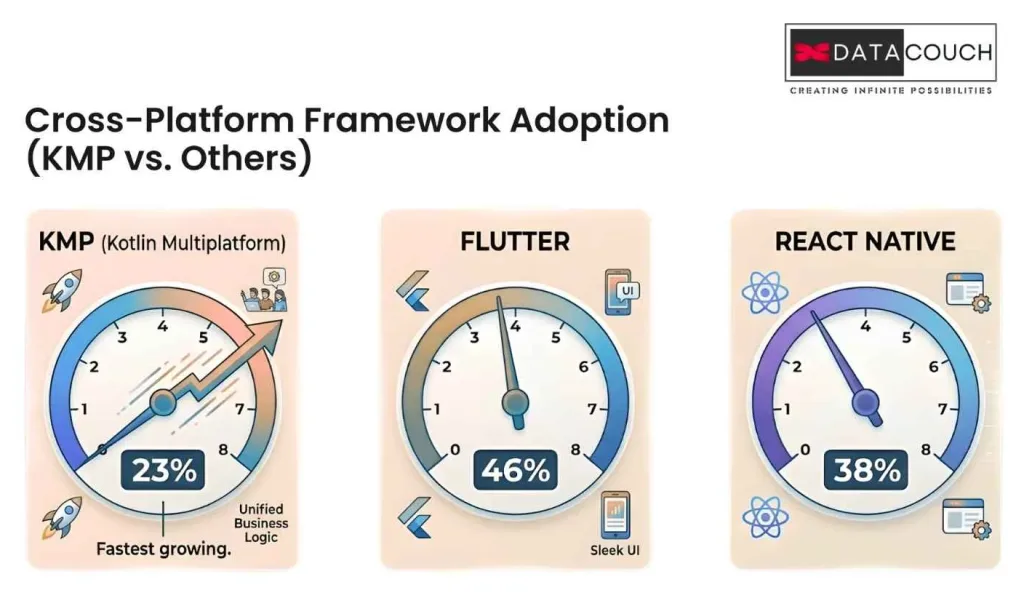
What most people don’t realize is that the framework wars framing is outdated. In 2026, large engineering teams are not choosing one framework. They are choosing where each framework belongs in their architecture. But if you do need a clear comparison for a decision you are making right now, here it is.
| Framework | Market Share | Avg. Senior Dev Salary | Best For | Watch Out For |
|---|---|---|---|---|
| Kotlin Multiplatform | 23% (growing fast) | ~$135K | Android teams, logic sharing, performance-critical apps | iOS team buy-in, macOS CI dependency |
| Flutter | 46% (dominant) | $135K to $180K | Pixel-perfect UI, rapid consumer apps, Dart-native teams | Dart talent is scarce, larger app binary size |
| React Native | 35 to 42% (maturing) | ~$145K | Large JS talent pools, MVP prototypes, web-plus-mobile teams | High 3-year maintenance cost, frequent breaking updates |
| Native Only (iOS + Android) | Baseline | $140K to $200K | Maximum platform control, full hardware access | Double the codebase and double the ongoing cost |
The metric most teams use to compare frameworks is initial development speed. That is the wrong metric. The metric that actually determines whether a framework was a good choice is 3-year total cost of ownership. When you factor in maintenance, hiring, onboarding, and keeping up with platform updates, KMP consistently shows lower costs after the first 12 months.
The Stuff Most Blogs Don't Talk About
Apple Is Quietly Fighting Back and Nobody Is Covering It
Here is something that almost every KMP article ignores: Apple is responding to KMP’s growth with its own moves. In late 2024 and 2025, Apple made Swift Build fully open-source, launched an official Swift plugin for VS Code, and enabled external build workflows that make Swift more portable beyond Xcode.
A developer preview of Swift for Android also emerged from the Swift community, allowing Swift code to run on Android through JNI bindings. It is still experimental and far from production-ready, but the direction is clear. Apple does not want Kotlin to become the default language for both platforms.
This matters to your planning because it changes the risk picture for betting entirely on KMP. In 12 to 18 months, iOS developers may have their own cross-platform path. The teams that design their architecture around a clean separation of UI and business logic will be positioned to shift tools without rebuilding from scratch.
The Org Chart Problem: Your Biggest Risk Is Not Technical
THE HIDDEN ADOPTION KILLER
When Android developers start moving business logic into shared Kotlin modules, iOS developers feel sidelined. They did not vote for this change. They are now expected to write Kotlin. Who owns the bug in shared code? This organizational tension is the real reason KMP migrations stall, and almost no blog covers it.
Monzo’s engineering team reported that iOS developer resistance was a bigger friction point than any technical challenge. Airbnb solved this by including iOS engineers in the API design of shared modules from day one. The iOS team owned the interface contracts, even when Android engineers were doing the implementation. That change in ownership model made all the difference.
Before you start a KMP migration, the first conversation should not be about Gradle configuration. It should be about team structure. Who owns commonMain? What happens when a shared module breaks an iOS build? What does an iOS engineer’s job look like after KMP is fully adopted?
The CI/CD Tax That Nobody Budgets For
Compiling KMP code for iOS still requires macOS. This sounds like a minor detail until you scale it up. A team running 100 or more daily CI builds needs dedicated macOS runners, and those are significantly more expensive than Linux runners. One team with 150 mobile developers described their CI costs doubling after a full KMP rollout.
JetBrains is working on klib cross-compilation, which would remove the macOS requirement for most builds. It is in active development but not production-stable as of mid-2026. Budget for higher CI costs in your first 12 months and plan for a cost reduction once cross-compilation ships.
The 2026 Upskilling Window Is Open Right Now
Here is the career math that most developers are not doing. KMP adoption is at 23% and growing. Flutter has been at high adoption long enough that Flutter developers are now commoditized in the job market. The KMP skill premium exists right now. In 18 to 24 months, it will start to narrow as KMP becomes mainstream.
Android developers who already know Kotlin have the shortest path to KMP expertise. The transition is lateral, not a full rebuild. For corporate training leaders thinking about where to invest learning and development budgets, a structured upskilling program in Kotlin and KMP is one of the clearest return-on-investment calls in mobile development right now.
KMP in 2026: Where It Shines and Where It Still Falls Short
| What KMP Does Well | Where KMP Still Has Gaps |
|---|---|
| Shares business logic without compromising UI quality | macOS still required for iOS builds, causing CI cost spikes |
| Native performance with no runtime overhead | Gradle complexity remains steep for beginners |
| Kotlin/Native GC now 60% faster than 2023 benchmarks | Swift interop still goes through Objective-C headers |
| Strong JetBrains tooling and IDE support | Niche library gaps: AR, complex PDF, payments |
| Google and Meta both backing the ecosystem | Large project migrations take 12 to 18 months |
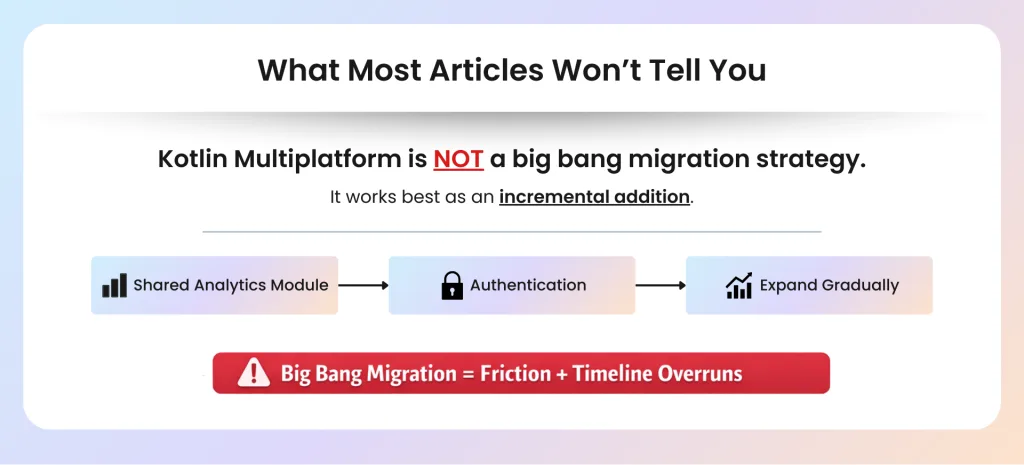
| Works alongside existing native codebases incrementally | No established testing playbook for shared modules yet |
| Swift Export moving toward stable for cleaner iOS interop | NA |
A Practical Migration Guide for Tech Leads and CTOs
If you are considering KMP for your team, here is a grounded starting framework based on what is actually working in 2026.
- Start with one shared module only. Analytics event tracking or auth token management are good candidates. Both are logic-heavy, UI-free, and easy to validate across platforms.
- Never start with UI sharing. Even with Compose Multiplatform stable, start with logic. Prove the shared module pattern works for your team before adding UI complexity.
- Create a dedicated platform team or at least a clear ownership model. Someone needs to own commonMain. If it is everyone’s responsibility, it becomes no one’s responsibility.
- Include iOS engineers in module API design from day one. They need to feel they have input and ownership, not that KMP is something being done to them by the Android team.
- Do a CI/CD cost audit before committing. Count your current macOS runner hours and estimate what you will need post-adoption. Build the budget before you build the modules.
- Invest in upskilling your existing Kotlin developers first. Hiring KMP specialists is slow and expensive. Your Android team already speaks Kotlin. The gap to KMP is much smaller than most managers think.
Key Takeaways: Is This Really the End of Siloed Mobile Development?
The honest answer is: yes and no. Platform silos are not disappearing. iOS and Android will always have UI differences worth respecting. What is ending is the era of completely separate business logic, separate networking layers, separate data models, and separate validation rules for each platform. That duplication has cost the industry billions of dollars and years of wasted engineering effort.
Kotlin Multiplatform is not the winner of a framework war. It is the right answer to the question the industry has been asking since 2010: where should the shared layer actually live? The answer is below the UI, in the business logic, and KMP is the most mature tool for putting it there in 2026.
The companies moving fastest in mobile right now are not the ones who picked the best framework. They are the ones who built clean separations between logic and UI, invested in developer upskilling early, and treated cross-platform adoption as a team and organizational challenge first, and a technical challenge second.
If you are a developer, the KMP skill window is open right now. If you are a tech lead or CTO, the cost savings are real and the case studies are no longer theoretical. For teams looking to close that skill gap fast, DataCouch’s Intermediate Kotlin course offers a structured path from Kotlin fundamentals to KMP-ready production skills.
Ready to Build KMP Skills on Your Team?
DataCouch's Intermediate Kotlin course is built for developers who know the basics and want to be production-ready for KMP adoption. Structured, hands-on, and designed for corporate training programs that need real results.