
Why Manual Infrastructure Costs $500K+ Per Year
It’s 11 PM on a Friday night. Sarah, a DevOps engineer at a mid-sized tech company, sits in her home office. She’s supposed to be at her daughter’s basketball game. Instead, she’s coordinating a production deployment with four other team members. They follow a 47-page runbook. One wrong command could take down the entire system.
This scene repeats every two weeks. And the cost is far more than overtime pay.
What’s really happening is a slow, invisible cash leak.
Manual infrastructure creates “shadow costs” that don’t show up as a single line item, so they rarely get challenged. The money gets buried across different buckets: incident response time, after-hours work, rework from failed changes, delayed releases, slower onboarding, and constant firefighting that blocks real improvement.
Here’s why that matters: the cloud bill is usually the most visible number, so leadership tries to optimize it first. But even a big cloud cut often saves less than the waste created by manual work. When infrastructure depends on runbooks, tribal knowledge, and human execution, every change becomes expensive, risky, and slow. That’s how companies quietly bleed $500,000+ a year without anyone calling it what it is: an operating tax.
Sarah’s story isn’t unique. Thousands of companies right now are bleeding money through manual infrastructure operations. The real kicker? Most executives don’t even know it’s happening. They see the AWS bill. They see the salaries. But they miss the invisible costs that add up to $500,000 or more each year.
What is manual infrastructure? It’s when your team manages servers, deployments, and system configurations by hand instead of using automated tools and processes. Think of it like using a typewriter when everyone else has moved to computers.
Here’s what nobody tells you about manual infrastructure. It’s not just inefficient. It’s a financial trap that gets worse every month you ignore it.
The Hidden Money Pit: Where Your Budget Actually Goes
Most companies focus on the wrong numbers. Your CFO looks at the cloud bill and wants to cut 20%. That saves maybe $120,000 per year. Meanwhile, you’re losing $880,000 somewhere else. Let me show you where.
The 80/20 Rule Nobody Mentions
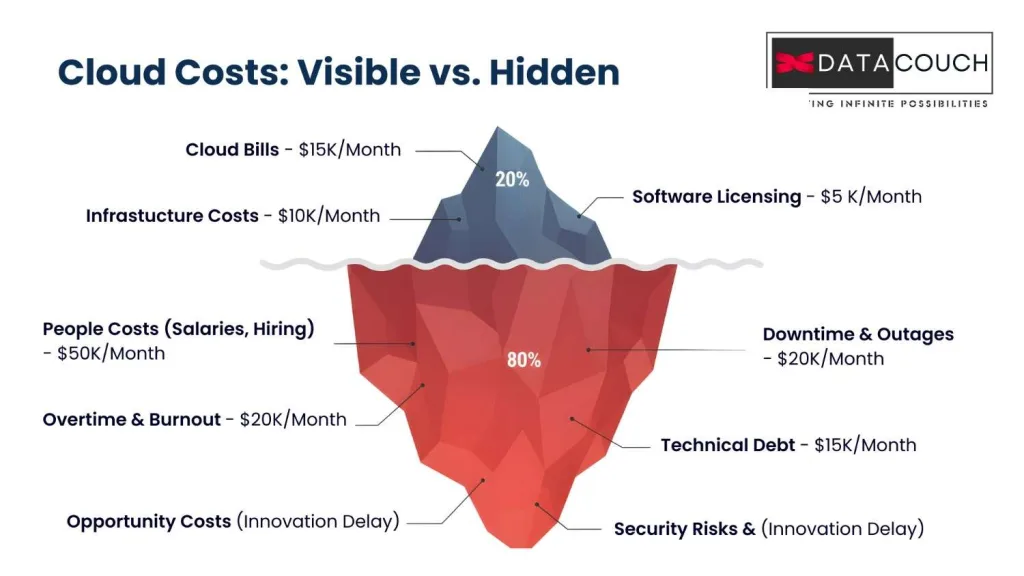
Research from multiple DevOps studies in 2025 shows something shocking. Only 20% of your infrastructure costs come from actual infrastructure. The other 80%? That’s people, processes, and the mess created by doing things manually.
Here’s what I mean. You pay $50,000 per month for cloud services. That’s $600,000 per year. But you also pay two DevOps engineers at $153,000 each. That’s $306,000. Add the hidden costs, and you’re looking at over $1 million in total infrastructure spending. Yet everyone obsesses over that $600,000 cloud bill.
This happens because cloud bills show up on reports. The other costs hide in plain sight.
Cost Category 1: The Weekend Warrior Tax
Let me tell you about De Lijn, a European transit company. Every weekend, five engineers had to deploy updates. Every single weekend. They couldn’t deploy during business hours because the risk was too high. One mistake meant angry customers and lost revenue.
This “weekend warrior” pattern costs companies in three ways:
Overtime premiums add up fast. Engineers working weekends get paid 1.5 to 2 times their normal rate. If your deployment takes 6 hours and involves three people, that’s 18 hours at premium rates. Do this twice a month, and you’re paying an extra $61,000 per year just in overtime.
Burnout costs even more. When engineers work every other weekend, they start looking for new jobs. Replacing a DevOps engineer costs six to nine months of their salary. That’s $76,000 to $115,000 in recruitment, training, and lost productivity. One turnover per year makes this a real expense, not a hypothetical one.
The coordination tax might be the worst part. Getting five people together at 11 PM on a Friday isn’t just about the hours. It’s about the planning meetings beforehand, the contingency plans, the backup personnel on standby. Companies spend $500 to $800 per deployment just coordinating all the moving parts.
Add it up: $61,000 in overtime, $76,000 in turnover costs, and $24,000 in coordination expenses. That’s $161,000 per year, and we haven’t even counted the actual work yet.
Cost Category 2: When Things Break
According to the 2024 Siemens report on downtime costs, Fortune 500 companies lose $1.4 trillion annually to unplanned outages. That’s 11% of their total revenue. Let that sink in. One in every nine dollars disappears because systems go down.
Splunk’s 2025 research found the Global 2000 companies specifically lose $400 billion per year to downtime. For smaller companies, the numbers scale down but the percentage stays brutal.
Here’s the math for a mid-sized company with $20 million in annual revenue:
Your systems go down for 4 hours during a major incident. At $7,500 per hour (the average from Gartner’s 2025 research), that’s $30,000 lost. One incident per quarter means $120,000 per year. But major incidents rarely travel alone. You’ll also have smaller problems. Systems slow down for an hour here, a service fails for 30 minutes there. Add another 24 minor incidents throughout the year at $7,500 each. That’s $180,000.
Don’t forget the penalties. If you have SLA agreements with customers, you’re paying credits or refunds when you miss uptime targets. Budget another $50,000 for that.
Total downtime cost: $350,000 per year.
The brutal truth? According to CompTIA’s 2025 security research, 23% to 40% of these incidents happen because someone made a manual error. A misconfigured server. A forgotten firewall rule. A deployment step done in the wrong order. When humans do repetitive tasks, mistakes happen. Those mistakes cost money.
Cost Category 3: The Technical Debt Trap
McKinsey published a study in 2024 showing that technical debt represents 20% to 40% of the value of entire technology estates. The Stripe Developer Coefficient found that developers spend 42% of their working week dealing with technical debt instead of building new features.
Let’s make this concrete. You have 10 developers earning $120,000 per year. That’s $1.2 million in payroll. If they spend 42% of their time maintaining legacy systems and fixing problems created by manual processes, you’re wasting $504,000 worth of their time.
But here’s the part that really hurts. Technical debt doesn’t just waste time. It slows down everything else. Features that should take two weeks take four. Bugs that should be simple to fix require three days of investigation. Your competitor ships five new features while you’re still debugging the last release.
VFunction’s research from 2025 shows the global opportunity cost of technical debt reaches $85 billion annually. That’s money companies could have made but didn’t because they were too busy maintaining broken systems.
Cost Category 4: The Security Time Bomb
IBM’s Cost of a Data Breach Report from 2025 found that the average breach costs $4.44 million. In the United States, that number jumps to $10.22 million. For healthcare companies, it’s $7.42 million. Financial services see $5.56 million on average.
You might think, “We’ve never had a breach, so this doesn’t apply to us.” That’s like saying you don’t need car insurance because you’ve never had an accident. The risk exists whether or not it has materialized yet.
Manual infrastructure makes breaches more likely. When you configure servers by hand, settings drift. One server gets patched, another doesn’t. A firewall rule gets updated on production but forgotten on staging. These inconsistencies create gaps that attackers exploit.
According to CompTIA’s 2025 data, 52% of security breaches happen because of human error. Manual processes are full of human touchpoints. More touchpoints mean more opportunities for mistakes.
Even if you never experience a breach, you’re paying for the risk. Cyber insurance premiums reflect your security posture. Companies with manual infrastructure pay higher premiums. Security audits take longer because auditors have to verify each system individually. Compliance certifications cost more because you can’t prove consistent configurations across your infrastructure.
Risk-adjusted cost for manual infrastructure security: $100,000 to $500,000 per year.
Cost Category 5: What You're Not Building
This one hurts the most because you can’t see it. It’s the features you didn’t ship. The improvements you didn’t make. The innovations you didn’t try.
When your team spends 31% of their time on manual processes (per DORA research), that’s 31% they’re not spending on strategic work. You wanted to build that new customer dashboard. You wanted to implement that AI feature. You wanted to optimize that slow checkout process. But you couldn’t because the team was busy keeping the lights on.
Here’s a real example. A product company has the potential to ship 50 new features per year with proper automation. With manual processes, they ship 25. If each feature generates $100,000 in additional revenue on average, they’re leaving $2.5 million on the table. Even a conservative 10% conversion rate means $250,000 in lost opportunity.
Your competitors aren’t sitting still. While you manually deploy updates every two weeks, they deploy 50 times per week. They experiment faster. They learn faster. They capture market share faster.
Ready to stop the bleeding?
DataCouch's DevOps certification programs help teams eliminate these hidden costs in 90 days or less. Explore our hands-on training courses designed specifically for infrastructure teams looking to automate their way to $500K+ in annual savings.
The Total Damage: Adding It All Up
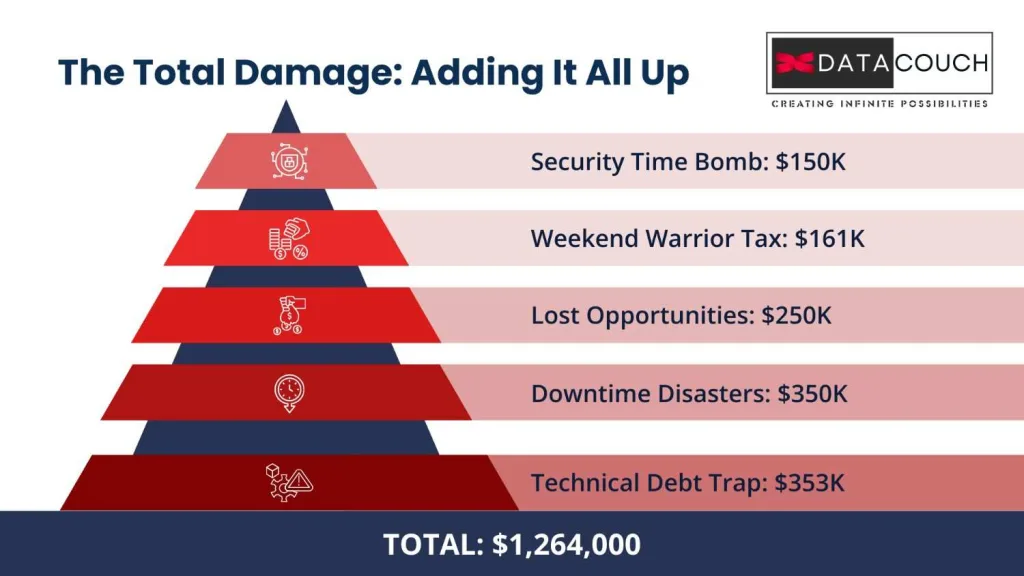
Let’s look at the complete picture for a typical mid-sized company:
- People costs and overtime: $161,000
- Downtime and incidents: $350,000
- Technical debt waste: $353,000
- Security risk exposure: $150,000
- Lost opportunities: $250,000
Total: $1,264,000 per year
This is why the $500,000 figure in the title is actually conservative. Most companies lose more than that, not less.
The DevOps Training Solution: Why It Works
Here’s where it gets interesting. You can fix this problem without hiring more people or buying expensive enterprise software. The solution is DevOps training for your existing team.
I know what you’re thinking. “We don’t have time for training. We’re too busy fighting fires.” That’s exactly why you need it. You’re too busy chopping wood to sharpen the axe.
The ROI Math That Changes Everything
Let’s compare two approaches to fixing manual infrastructure problems.
Traditional Approach: Hire More Engineers
You hire two more DevOps engineers to handle the workload. Cost:
- Two engineers at $153,000 each: $306,000
- Recruitment fees and time: $30,000
- Three months of reduced productivity while they ramp up: $38,000
- Total first year: $374,000
Result? You have four people doing manual work instead of two. The process hasn’t improved. You’ve just added capacity to a broken system.
DevOps Training Approach
You invest in comprehensive corporate training for your existing team. Cost:
- Training for two engineers: $20,000
- CI/CD platform licenses: $30,000
- Implementation time (20% of team capacity for three months): $30,000
- Total first year: $80,000
Result? Your team automates the manual processes. They implement infrastructure as code. They set up continuous integration and deployment pipelines. They eliminate the root causes of the problems.
The savings start showing up within six weeks:
Month 2: Automated development environment setup saves 15 hours per week. That’s $114,000 per year in recovered productivity.
Month 4: Automated deployments eliminate weekend work. Save $61,000 in overtime plus improve team morale and retention.
Month 6: Automated monitoring catches problems early. Downtime drops 70%. Save $245,000 per year.
Month 9: Technical debt reduction improves developer productivity 30%. Recover $106,000 in wasted time.
Month 12: Automated security scanning and configuration management reduce risk. Save $150,000 in risk exposure.
Total first-year savings: $676,000
Return on investment: 845%
Break-even time: 6 weeks
By year three, you’ve saved $2.4 million while the “hire more people” approach has cost you $992,000.
Our DevOps training programs deliver this exact transformation for companies like yours with measurable results in under 6 weeks. Learn how DataCouch's instructor-led courses equip your team with automation skills that pay for themselves before training even ends.
What Makes Training Different From Just Buying Tools
Here’s what most companies get wrong. They buy DevOps tools without understanding DevOps principles. They install Jenkins or GitLab CI and expect magic to happen. It doesn’t work that way.
Tools are useless without knowledge. It’s like buying a piano and expecting to play Beethoven. You need to learn the fundamentals first.
Quality team training provides three things tools alone can’t:
Understanding of principles. DevOps isn’t about tools. It’s about culture, collaboration, and continuous improvement. Training teaches the “why” behind the practices, not just the “how.”
Systematic approach. Trained engineers know which problems to solve first. They start with quick wins that build momentum. They create a roadmap instead of randomly implementing tools.
Long-term capability. Once your team understands DevOps principles, they can adapt to new tools and technologies. They become self-sufficient instead of dependent on vendors or consultants.
The 12-Month Transformation Roadmap
Let me show you how this actually works in practice. This isn’t theory. It’s the proven path dozens of companies have followed.
Months 1-3: Foundation and Quick Wins
Your team completes DevOps training fundamentals. They learn Git workflows, basic CI/CD concepts, and infrastructure as code principles.
First implementation: Automate development environment setup. New developers go from three days of setup to three hours. Immediate time savings and better onboarding experience.
Second implementation: Create a basic CI/CD pipeline for the development environment. Automated builds and tests catch bugs before code review. Developers save 10 hours per week.
Third implementation: Schedule non-production environments to shut down nights and weekends. This single change reduces your cloud bill by 15% to 25%. That’s $30,000 saved in the first quarter.
Months 4-6: Production Automation
Your team implements automated deployment pipelines for production. Manual deployments that took 6 hours now take 30 minutes. Weekend deployments move to business hours because the risk drops by 90%.
Infrastructure as code replaces manual server configuration. Terraform or Ansible ensures every server has identical, correct settings. Configuration drift becomes impossible. Security improves dramatically.
Automated monitoring and alerting get deployed. Problems that used to hide for 17 hours now trigger alerts within 15 minutes. Mean time to detection drops 95%.
Months 7-12: Optimization and Advanced Practices
The team implements cloud cost optimization. Auto-scaling, right-sizing, and reserved instance strategies cut cloud bills 30% to 40%. That’s $200,000 saved annually.
Security automation gets added to the pipeline. Every deployment includes automated security scans. Patches apply automatically. The attack surface shrinks while compliance becomes easier.
By month 12, you’ve built a self-service platform. Developers provision resources themselves using approved templates. The DevOps team shifts from handling tickets to improving the platform. Innovation accelerates.
Real Results From Real Companies
De Lijn, the transit authority I mentioned earlier, freed three team members from weekend deployments. Their monthly infrastructure costs dropped from €1,500 to €750. Two and a half years later, they handle significantly more traffic at the same cost.
According to DORA research, companies that implement DevOps practices deploy 30 times more frequently than competitors. They have 60 times fewer failures. They recover from incidents 440 times faster.
One medium-sized tech company documented by DORA invested $2.8 million in DevOps transformation including training, tools, and agile coaching. Over three years, they generated $35 million in returns. That’s a 1,252% ROI.
Why Waiting Costs More Than Acting
Every day you delay, you lose $2,500 to $6,000 in hidden infrastructure costs. Your technical debt compounds. Your best engineers update their resumes because they want to work with modern tools.
Think about where you want to be in 12 months. If you start today:
- Month 6: First major savings appear, team morale improves
- Month 9: Deployment frequency increases 5x, downtime drops 70%
- Month 12: $660,000 saved, competitive advantage established
If you wait another year:
- You’ve burned $1.2 million more on manual processes
- Your technical debt is 40% worse
- Some of your best engineers have left
- You’re further behind competitors who already made the change
The choice seems obvious when you look at it this way.
Getting Started: What To Do Monday Morning
Don’t try to boil the ocean. Start small, prove value, then expand.
This week:
- Count how many hours your team spends on manual deployments
- List your last five production incidents and calculate downtime costs
- Identify which manual process causes the most pain
Next week:
4. Research corporate training options (DataCouch offers comprehensive DevOps certification programs specifically designed for teams)
5. Calculate your specific hidden costs using the categories in this article
6. Schedule a meeting with your CFO or CTO to present the business case
This month: 7. Get budget approval for training 8. Pick one small automation project as a proof of concept 9. Start building momentum toward full DevOps transformation
The companies winning in 2025 aren’t the ones with the biggest teams or the largest budgets. They’re the ones that stopped doing things manually and invested in training their people to work smarter.
The Bottom Line
Manual infrastructure costs you $500,000 to $2 million per year in hidden expenses. These costs appear in overtime, downtime, wasted developer time, security risks, and missed opportunities.
DevOps training fixes the root cause instead of treating symptoms. An $80,000 investment delivers $660,000 in first-year savings and $2.4 million over three years. The ROI is 800% or higher. Break-even happens in six weeks.
Your competitors already know this. They’re already making the change. The question isn’t whether you should invest in DevOps training. The question is: can you afford another year of manual infrastructure?
What’s the one manual process you could automate this quarter that would make the biggest impact on your team?
Don't wait another quarter losing $125K+ to manual processes. Contact DataCouch for a free consultation and custom DevOps training roadmap. Let our experts show you exactly how to transform your team and recover $500K+ annually starting this quarter.