Why TCS and Infosys Are Prioritizing AI-102
Two of India’s largest IT companies are spending millions to certify their employees in AI-102. This certification validates skills in building AI solutions on Microsoft Azure, covering everything from machine learning to responsible AI deployment.
Here’s what most people miss: this isn’t just about employee development. It’s a calculated business move that’s reshaping how the entire tech industry hires, trains, and values talent. And if you’re an educator, this shift matters more than you think.
Let me explain why.
The Number That Should Get Every Educator's Attention
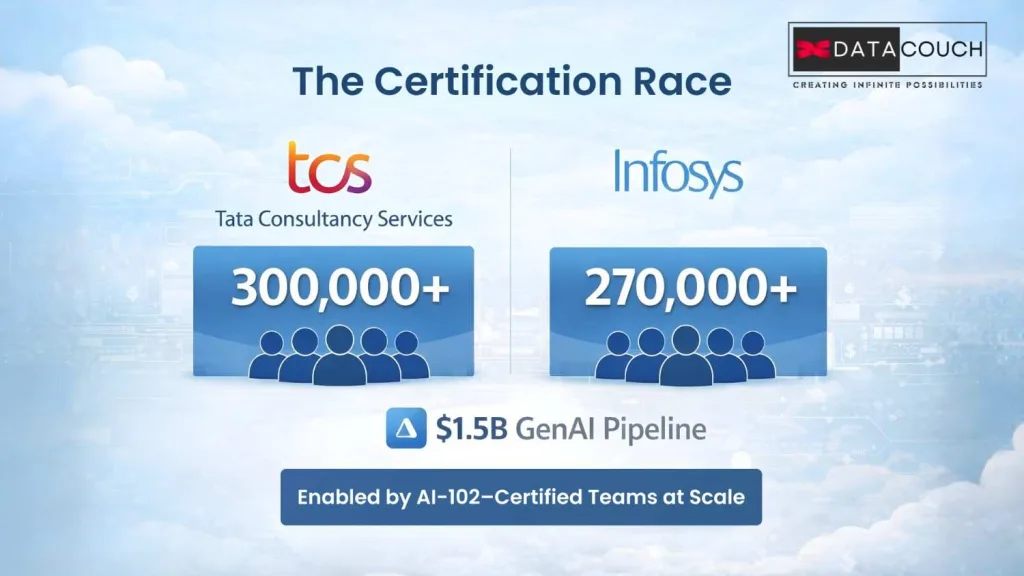
TCS trained over 300,000 employees in AI and generative AI fundamentals last year. Infosys certified 270,000 people as “AI Aware.” These aren’t small pilot programs. These companies are running training operations that rival the size of entire university systems.
But here’s the part that caught my attention: they’re not just teaching AI basics. They’re specifically pushing for AI-102 certification from Microsoft.
Why this particular certification? The answer reveals something important about where the job market is heading.
What Makes AI-102 Different (And Why It Matters)
Most AI courses teach theory. You learn about neural networks, algorithms, and maybe write some Python code. That’s useful, but it’s not what companies need right now.
AI-102 teaches something different. It shows you how to build AI solutions that actually work in real businesses. You learn to deploy Azure OpenAI models, create document intelligence systems, and build computer vision applications that handle millions of requests.
Here’s what this means in practice:
A student who completes a typical AI course can explain how ChatGPT works. A student with AI-102 certification can deploy GPT-4 in a banking app that handles customer queries while meeting security regulations.
See the difference?
Companies like TCS and Infosys aren’t paying for people who understand AI. They’re paying for people who can ship AI products to clients.
The Azure Factor Nobody Talks About
Microsoft Azure now holds 24% of the global cloud market. More importantly, 95% of Fortune 500 companies use Azure for something. When you combine that with Microsoft’s $13 billion investment in OpenAI, you get something powerful.
Azure is becoming the standard platform for enterprise AI. Not AWS. Not Google Cloud. Azure.
This creates what I call the “certification lock-in effect.” If your clients use Azure, you need Azure-certified engineers. If you want to bid on enterprise AI projects, having AI-102 certified teams isn’t optional anymore.
TCS reported a $1.5 billion pipeline in generative AI projects in their last quarter. Want to guess which platform most of those projects use? You got it: Azure.
The Skills Gap That's Costing Trillions
Let me share some numbers that should worry anyone involved in education.
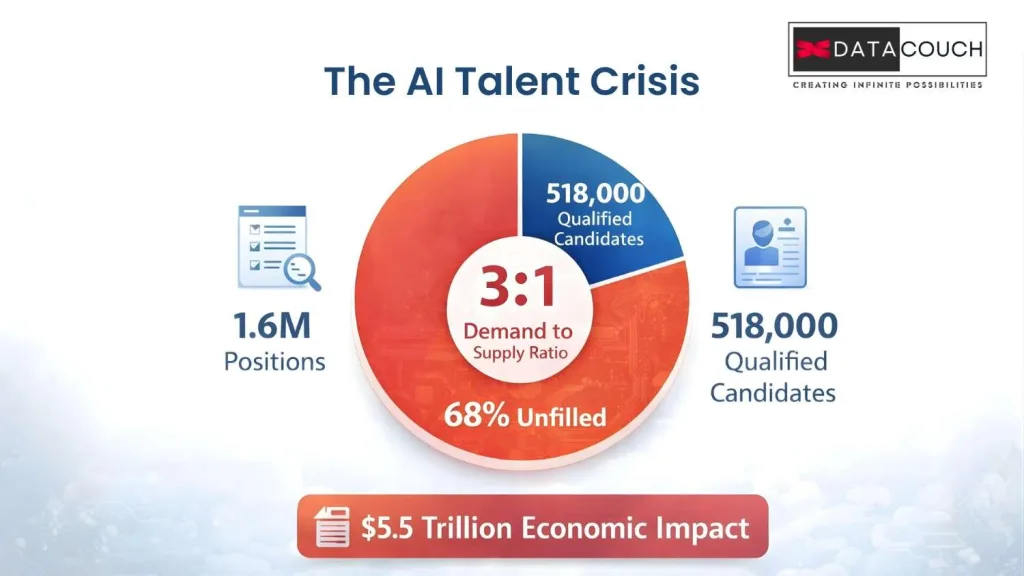
Right now, there are 1.6 million open positions in AI. Only 518,000 qualified people can fill them. That’s a 3-to-1 gap between what companies need and what they can find.
The Korn Ferry Institute projects this skills shortage will cost the global economy $5.5 trillion by 2026. That’s not a typo. Trillion with a T.
Here’s the painful truth: universities are producing graduates, but many lack the specific skills companies need right away. There’s a disconnect between what gets taught and what gets used.
What Universities Often Miss
I’ve talked to dozens of computer science departments. Most teach AI using TensorFlow or PyTorch. They focus on building models from scratch. That’s academically rigorous and absolutely has value.
But here’s what the industry needs today: people who can use pre-built AI services, integrate them into business applications, and deploy them securely. They need graduates who understand Azure AI Studio, know how to handle PII in AI systems, and can implement responsible AI frameworks.
Only 9,000 people globally hold AI-102 certification right now. Compare that to the millions taking CS degrees. That’s your opportunity gap. DataCouch has successfully transformed 400+ students at one the top ranking universities in India UPES in one go.
Ready to bridge this gap?
DataCouch's AI-102 certification program equips your students with hands-on Azure AI skills that employers actually pay premium salaries for.
Inside TCS's Strategy: Building the World's Largest AI Workforce
TCS didn’t accidentally become one of the world’s largest IT services companies. They’re strategic about everything they do. Their push for AI-102 certifications is no different.
They created something called the AI Experience Zone. It’s not a classroom. It’s a hands-on lab where employees work on real AI projects using Azure tools. They’re not just learning. They’re building.
But here’s what makes this interesting for educators: TCS discovered that certified employees close deals 40% faster than non-certified ones. Their project success rate is 2.5 times higher. Client satisfaction scores jump by 25%.
Certification isn’t just a resume line. It’s directly tied to business outcomes.
The Revenue Model Shift
Traditional IT services worked on a time-and-materials model. You billed clients for hours worked. A junior developer costs $50 per hour. A senior developer costs $100 per hour.
AI-102 certified engineers? They’re billing at $150 to $200 per hour.
That’s not price gouging. That’s the market value for specialized skills that reduce project risk and speed up delivery.
Think about what this means for your students. The difference between a $70,000 starting salary and a $130,000 starting salary often comes down to having the right certifications plus practical project experience.
Infosys's Three-Tier Approach: A Model for Academic Programs
Infosys took a different approach that universities should study. They built a three-tier learning framework:
Tier 1: AI Aware (270,000 people) – Everyone understands AI basics, ethics, and responsible AI principles.
Tier 2: AI Skilled (growing pool) – Platform-specific certifications like AI-102, plus hands-on project experience.
Tier 3: AI Master (elite specialists) – Advanced architects who design AI systems for specific industries.
Notice something? This looks a lot like how universities could structure their programs: foundational courses, specialized tracks, and advanced research opportunities.
The Platform Play
Infosys built something called Topaz, which is their own AI platform. But Topaz runs on Azure. It uses Azure OpenAI services, Azure AI Search, and other Microsoft tools.
To work on Topaz projects, Infosys engineers need Azure certifications. They literally can’t deploy their own company’s platform without this knowledge.
This is the future of industry-academia collaboration. Companies are building proprietary solutions on top of cloud platforms. Your students need to understand both.
What This Means for Your Students (The Part Most Articles Skip)
I work with universities through DataCouch, and I see this pattern repeatedly: students graduate with strong theoretical knowledge but struggle in their first industry role. It’s not because they’re not smart. It’s because there’s a gap between academic AI and production AI.
Let me break down what employers actually look for when hiring AI talent:
What resumes say: “Completed ML course, 3.8 GPA, built a recommendation system project.”
What hiring managers want to see: “AI-102 certified, deployed Azure OpenAI chatbot handling 10K daily requests, implemented content filtering and PII detection”
The second candidate gets hired faster and at a higher salary. Not because they’re smarter, but because they speak the language of production systems.
The Hidden Cost of Missing Certifications
Here’s something painful that nobody likes to discuss: 78% of generative AI projects fail to move beyond the proof-of-concept stage.
Why? Not because the AI doesn’t work. Teams don’t know how to handle real-world challenges like security, compliance, cost optimization, and scale.
AI-102 specifically teaches these production concerns. It’s not about building the most accurate model. It’s about building a system that works reliably when a million people use it.
When students graduate without this knowledge, companies have to train them anyway. That creates a 3-6 month onboarding gap. Companies like TCS and Infosys are just doing that training themselves now.
The Client Mandate Nobody Talks About
Here’s an inside detail most education blogs won’t mention: enterprise clients now explicitly require certified teams in their RFPs (Request for Proposals).
I’ve seen contracts from major banks and insurance companies. They don’t just ask, “Do you know AI?” They ask, “How many AI-102 certified engineers will be on our project team?”
Certification has become a qualification gate. If you don’t have certified people, you don’t even get to bid on certain projects.
This creates pressure on service providers like TCS and Infosys. They need certified talent immediately. And right now, universities aren’t producing it at the scale needed.
That’s your opportunity.
The Billing Rate Reality
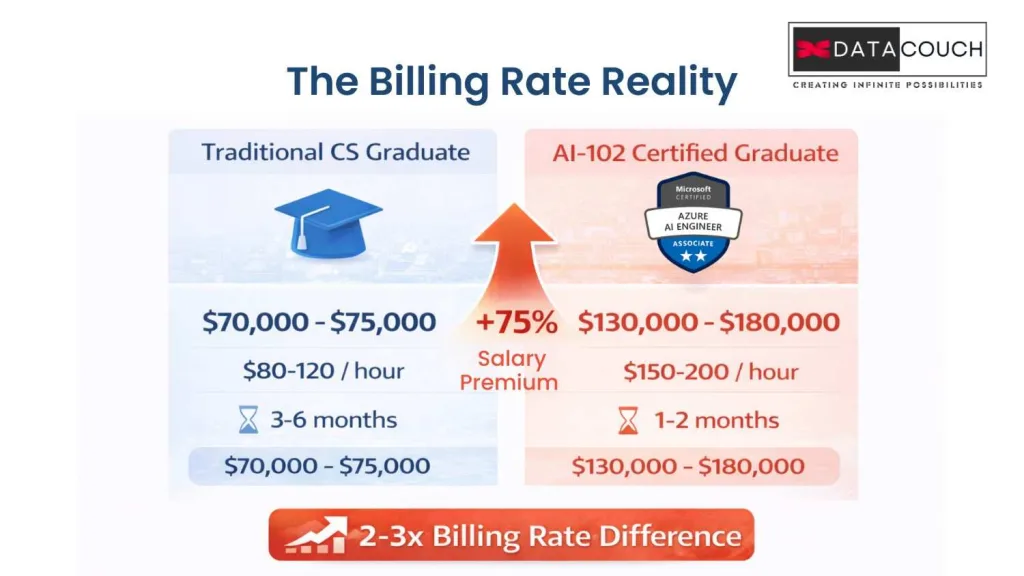
Let me put this in concrete terms. A non-certified software engineer might bill at $80-120 per hour for enterprise projects. An AI-102 certified engineer handling Azure AI deployments? $150-200 per hour.
For TCS or Infosys, that’s a 50-100% increase in billable rate for the same person with a few months of focused training.
For your students, that’s the difference between starting at $75,000 versus $130,000 in their first job.
These aren’t projections. These are actual market rates I see in consulting contracts.
How Universities Can Respond (Practical Steps)
You might be thinking, “This is interesting, but what do we actually do with this information?”
Here’s what forward-thinking universities are already doing:
- Integrate certification tracks into degree programs. Don’t make certifications extra. Make them part of the curriculum. Students graduate with both a degree and industry-recognized credentials.
- Build hands-on labs with cloud platforms. Azure offers education credits. Your students should be deploying real AI services, not just simulating them on localhost.
- Partner with training organizations. Full disclosure: this is where DataCouch can help. We work with universities to set up certification programs, provide lab environments, and train faculty on current industry practices.
- Track employment outcomes differently. Don’t just measure graduation rates. Measure time-to-employment, starting salaries, and job satisfaction six months out. Those metrics tell you if you’re teaching what matters.
The Faculty Development Gap
Here’s an uncomfortable truth: many CS professors have never deployed a production AI system. They’re brilliant researchers, but they haven’t worked with Azure AI Studio, haven’t dealt with API rate limits, and haven’t debugged a failing computer vision pipeline at 2 AM.
That’s not a criticism. It’s reality. Academics and industry operate on different timelines.
But it creates a teaching gap. You can’t effectively prepare students for Azure AI certification if you’ve never used Azure AI yourself.
Progressive universities are sending faculty through certification programs. Not to replace their research focus, but to complement it with current industry practices.
The Competitive Landscape: Who's Winning the Talent War
While TCS and Infosys lead the Indian IT sector, the global competition is fierce.
Accenture is training 700,000 employees in agentic AI. They’re partnering with OpenAI, Anthropic, and multiple cloud providers. They’re not putting all their eggs in the Azure basket like TCS and Infosys are.
But here’s what the data shows: companies with focused certification strategies (TCS, Infosys) are showing better project success rates than those with broader, less structured training approaches.
Specialization beats generalization when clients need proven expertise fast.
What This Means for Student Career Paths
Your students face a choice. They can graduate with general AI knowledge and compete with thousands of others in the same position. Or they can graduate with specific, certified skills that companies actively seek.
The job market rewards specificity. “I know AI” gets you interviews. “I’m AI-102 certified and deployed three Azure OpenAI projects” gets you offers.
The 2026 Outlook: What's Coming
The AI-102 exam was refreshed in 2025 to emphasize agentic AI systems. These are AI tools that can take actions autonomously rather than just answering questions.
This reflects where enterprise AI is heading. Companies don’t just want chatbots anymore. They want AI agents that can complete complex workflows, integrate with multiple systems, and make decisions within defined parameters.
Students graduating in 2026 and beyond need to understand these concepts. Not theoretically, but practically.
Here’s my prediction: By 2027, having some form of cloud AI certification will be as standard for software engineering jobs as knowing Git is today. It won’t make you special. It’ll just be expected.
The students who get ahead of this curve now will have significant advantages.
Why Azure Specifically? (The Strategic Calculation)
I’ve talked about Azure throughout this article, but let me address the obvious question: why not AWS or Google Cloud?
Three reasons:
- Microsoft’s enterprise relationships. Most large companies already use Microsoft products. Adding Azure AI is an easier sell than switching entire cloud platforms.
- The OpenAI partnership. Azure is the only cloud with native GPT-4 and GPT-4o integration. That’s a huge advantage for enterprise AI projects.
- Integrated tools. Azure AI Studio, Azure AI Search, and Azure OpenAI work together seamlessly. That integration reduces complexity, which enterprises value highly.
TCS and Infosys are betting on Azure because their clients are standardizing on Azure. It’s not a technology choice. It’s a business decision based on where the money is.
The Real Cost of Waiting
If you’re an educator reading this, you might be thinking, “We’ll add this to our curriculum in the next revision cycle.”
Here’s the problem: curriculum revisions take 2-3 years. The market is moving faster than that.
Students graduating in 2025 and 2026 are entering a job market that already expects these skills. If they don’t get them from you, they’ll get them from boot camps, online platforms, or corporate training programs after graduation.
When companies like TCS and Infosys are training hundreds of thousands of people in AI-102, they’re not just upskilling their workforce. They’re setting the baseline for what “job-ready” means.
Universities that don’t respond will find their graduates at a disadvantage.
Key Takeaways
Let me summarize what matters most:
TCS and Infosys are certifying massive numbers of employees in AI-102 because their clients demand it, and it directly impacts revenue. The global skills gap in AI is creating a $5.5 trillion economic problem, and certifications are one way to close that gap quickly. Students with AI-102 certification plus project experience command significantly higher starting salaries than those with theoretical knowledge alone. Universities need to integrate certification tracks and hands-on cloud experience into degree programs to keep graduates competitive. The shift from theoretical AI to production AI represents the biggest change in tech education requirements in the past decade.
This isn’t just about one certification or one platform. It’s about preparing students for a job market that values proven, practical skills alongside academic knowledge.
So here’s my question for you: What’s stopping your institution from adding certification tracks to your AI and computer science programs? Is it budget, expertise, or just not knowing where to start?
Your Next Step
If you’re ready to explore how your university can integrate AI-102 certification into your curriculum, DataCouch offers comprehensive training programs designed specifically for academic institutions. We provide faculty training, student certification tracks, and hands-on lab environments that mirror real industry projects.
But more importantly, we help you think through the curriculum design challenges so these certifications enhance your degree programs rather than feeling tacked on.
The companies are already moving. The job market is already changing. Your students’ futures depend on how quickly you can adapt.
What will you do differently this semester?
Explore DataCouch's AI-102 certification program and discover how we help universities integrate industry-recognized Azure AI training into their curriculum with hands-on labs, faculty enablement, and comprehensive certification support.