
Scaling Your Tech Team with Agentic AI Training
Let’s paint a familiar picture. The board just gave your tech initiative the green light. The mission is to integrate Agentic AI, those autonomous systems that can think, decide, and act. The budget is approved. The vision is bold. But as you look at your talented tech team, you notice something unsettling. The engineers who can build flawless applications now seem hesitant. The mention of “agentic workflows” or “LLM orchestration” is met with quiet uncertainty. Your strategy is facing its biggest risk: not the technology, but the collective skill gap of the very team that must bring it to life. This is the unspoken truth for many tech leaders today. This article is not about the promise of AI. It is about solving the very human problem of preparing your people for it.
Agentic AI refers to artificial intelligence systems that can autonomously pursue complex goals, making decisions and taking actions without constant human direction.
The Real Problems You Face (That No One Talks About)
Before we talk about solutions, we need to name the real problems. These are not just technical hiccups. They are fundamental people and process breakdowns that stop AI projects cold.
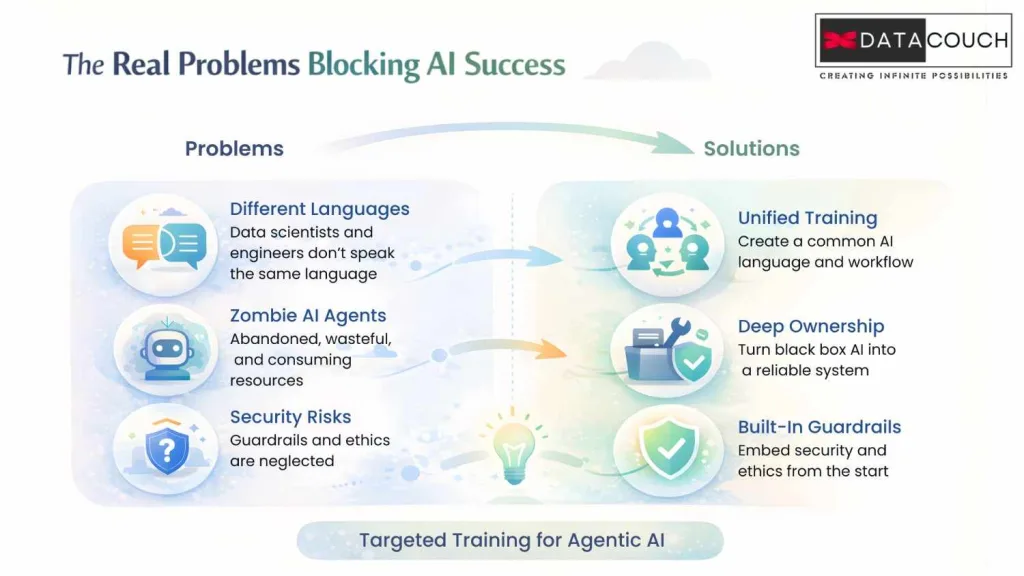
Problem 1: Your Team Is Speaking Different Languages
Your data scientist builds a brilliant model. Your software engineer designs a robust application. But Agentic AI lives in the space between them. Without a shared framework, they clash. The data scientist worries about model precision. The engineer worries about system stability. They use different tools and have different success metrics. The result? Friction, delays, and a system that works perfectly in a demo but fails in the real business environment. This language barrier is the number one cause why projects stall.
Problem 2: You Are Wasting Money on “Zombie Agents”
What is a zombie agent? It is an AI tool you built and deployed that no one fully understands or trusts. Your team might have followed a generic tutorial to create it. It works, but it is a black box. When it acts strangely, no one knows how to fix it. When a new requirement comes, no one knows how to adapt it. So, it sits there, consuming cloud computing resources and generating bills, but delivering little real business value. As the time passes, this agent goes into oblivion, and turns into a zombie, all because of abandonment. This waste is silent but massive. A report by McKinsey notes that up to 30% of AI project costs can be lost to inefficiency and rework, often due to skill gaps.
Problem 3: Security and Ethics Become an Afterthought
In the rush to launch, critical questions get pushed aside. Who is accountable for the agent’s decision? How does it handle biased data? Where are its limits? Without proper training, your team is forced to build first and figure out the guardrails later. This is a dangerous and costly approach. It can lead to reputation damage, compliance failures, and public trust issues. Security and ethics cannot be patched in later. They must be designed from the start, and that requires a new kind of skill set.
The Answer: Training That Builds a Unified System, Not Just Isolated Skills
The solution to these problems is not another software license or a hiring spree. The answer is targeted training that rewires how your team works together. It is about moving from a group of skilled individuals to a single, cohesive AI-ready unit.
The Answer is Orchestration-First Learning.
The core of the answer is shifting the focus from operating single tools to orchestrating entire systems. Effective training must ensure your data experts, developers, and business analysts to collaborate on one shared goal: designing a functional agentic workflow. This is where real learning happens. They stop being specialists in isolated fields and start becoming architects of intelligence. They learn a common language of goals, tasks, and handoffs. This eliminates the friction of Problem 1.
The Answer is Creating Ownership, Not Just Code.
To eliminate zombie agents (Problem 2), training must create deep ownership. Your team should not just learn how to build an agent. They must learn how to diagnose, debug, and evolve it. They need to understand its cost drivers and performance metrics. When they know how to care for the system over its entire life, it stops being a mysterious black box. It becomes a tool they control and optimize. This turns a cost center into a valuable asset.
The Answer is Building with Guardrails from Day One.
The right training integrates ethics and security into every single lesson. It does not have a separate “AI Ethics” module at the end. Instead, every exercise includes constraints. “Build an agent to personalize marketing, but ensure it cannot access private customer data.” “Design a workflow that must flag decisions above a $10,000 value for human review.” This practice makes safe, responsible design a habit, not an afterthought. This directly solves Problem 3.
Why Your Current Upskilling Plan Is Failing for Agentic AI
You know training is needed. You have probably already signed the team up for a few online courses. But Agentic AI is a different beast. It does not just add a new tool. It changes the blueprint of the entire house.
Traditional training focuses on the individual. It teaches a data scientist a new model or a developer a new library. Agentic AI, however, demands a team based, systems thinking approach. The failure happens in the gap. It is the gap between knowing how a single AI works and knowing how to make a team of them work together reliably for your business.
The Three Pillars Most Training Ignores
What most generic courses completely miss are the pillars that make Agentic AI work at scale in a real company.
- Orchestration, Not Just Operation
Everyone learns how to use a large language model. But can your team design the conversation between multiple specialized agents? One agent might analyze data. Another draft content. A third checks for compliance. Getting them to collaborate, hand off tasks, and recover from errors is called orchestration. This is the core skill for Agentic AI. It is rarely taught in standard “AI Prompt Engineering” courses. It is like teaching someone to play a single violin note beautifully but never showing them how to conduct an entire orchestra. - Designing Guardrails, Not Just Goals
An AI agent instructed to “increase website traffic” could, in theory, resort to counterproductive or unethical methods such as buying fake traffic, spamming links, keyword stuffing, creating low-quality SEO content, using misleading clickbait titles or thumbnails, manipulating analytics, deploying intrusive pop-ups, or engaging in other aggressive tactics that ultimately harm user trust. It is an extreme example, but it makes the point. Autonomous systems need built in ethical and operational boundaries. Training must cover guardrail design. This means how to programmatically define what an agent cannot do. It means how to instill company values into its decision making. It means knowing where to place human oversight checkpoints. This is the unsung hero of successful Agentic AI implementation. - The New Metrics of Success
When you shift from traditional software to agentic systems, your old metrics become obsolete. You cannot just measure lines of code or server uptime. Now, you need to track agent efficiency. That is how well it uses resources to complete a task, or a series of tasks. You need to track task success rate. This is how often it achieves the goal without human help. You need to track human in the loop (HITL) handoff quality. Training that does not teach your team how to measure and optimize for these new metrics sets you up for confusion, and ultimately failure. You will not know if your AI investment is actually working.
The Competitor Landscape: Where Generic Training Falls Short
Let’s look at the common training options and where they create gaps for your Agentic AI ambitions.
| Training Type | What It Is Good For | The Gap for Agentic AI Scaling |
|---|---|---|
| General Online Courses (MOOCs) | Building strong foundational knowledge of AI/ML theory. | They often focus on single models in isolation. They do not teach the integrated, multi agent, business process thinking required for enterprise scaling. |
| Vendor Specific Certifications | Learning how to implement solutions on a specific platform (for example, AWS or Google Cloud). | The knowledge can be locked into that vendor's ecosystem. It may not teach the principled, flexible architecture needed to manage a complex web of interacting agents across different tools. |
| Short Bootcamps and "Prompt Engineering" Courses | Getting individual contributors started with basic AI interaction skills. | These are often tactical, not strategic. They miss the architectural view. They miss the cross team collaboration protocols necessary for organization wide deployment and management. |
| The Implied DataCouch Approach | Linking customized training directly to measurable business outcomes and existing enterprise tech stacks. | Fills the gap by focusing on integration, orchestration, and the specific 'last mile' of connecting agents to live business systems like CRM and data clouds. |
The table shows a clear pattern. Most available training solves for the “what”. What is Agentic AI? Or the “how”. How to use one tool? Scaling your tech team requires mastering the “how together”. How to make all the pieces work as one cohesive, reliable system within your company’s unique environment.
Building Your Team's New AI Brain: A Practical Framework
So, what does effective, gap closing training actually look like? It moves beyond theory into a framework for action.
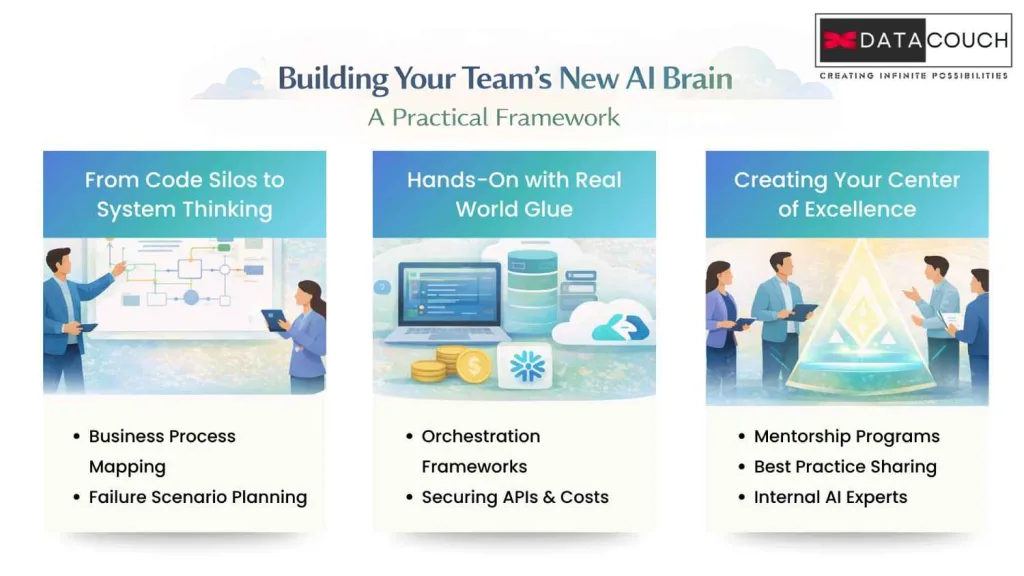
Phase 1: From Code Silos to System Thinking
The first shift is mental. Your developers and engineers need to start thinking in workflows and outcomes, not just code modules. Training should force this shift through exercises like:
- Business Process Mapping: Translate a company procedure, like “process a customer support ticket”, into an agentic workflow diagram. Which agent does what? Where does a human step in?
- Failure Scenario Planning: What happens if the data agent returns an error? What is the backup chain of command? Practicing this builds resilient system design thinking.
Phase 2: Hands On with Real World Glue
Real learning happens when your team gets hands on with the actual “glue” that holds agents together. This means less time in theoretical sandboxes. It means more time in environments that simulate your company’s setup. They need to practice with:
- Orchestration frameworks like LangChain or custom solutions.
- Securing API keys and managing costs at scale. A runaway agent can create a huge cloud bill in minutes.
- Connecting agents to your live data sources in Snowflake or your cloud infrastructure.
This is the gritty, practical work that turns a cool demo into a robust business tool. Most training shy away from this complexity. The right training embraces it as the core curriculum.
Phase 3: Creating Your Center of Excellence
The final, most overlooked goal of training is creating a self sustaining AI culture. The program should not end when the last module is complete. The goal is to create your first cohort of internal experts who can:
- Mentor the next wave of learners.
- Develop company specific best practices.
- Become the nucleus of your internal AI Center of Excellence (CoE).
This transforms the training from a one time cost into a strategic investment. An investment that multiplies in value across your organization. You are not just upskilling employees. You are building institutional knowledge and capability.
The Key Was Never Just the AI. It Was the 'I' in Your Team.
Let’s return to that boardroom from the beginning of our story. The anxiety was not about the technology’s potential. It was about the team’s preparedness. The path to scaling Agentic AI is not found in a vendor’s sales brochure. It is not found in a lone developer’s certification. It is forged in a training philosophy. A philosophy that understands the real world chaos of enterprise integration.
It is about choosing a learning journey. A journey that respects the complexity of orchestrating intelligence. A journey that does not shy away from the tough questions of ethics and cost. A journey that aims to leave your team not just informed, but fundamentally transformed in their approach to problem solving.
The companies that will win the AI race are not just the ones with the biggest data lakes. They are not just the ones with the most powerful chips. They are the ones who most effectively upgrade the collective intelligence of their tech teams. They are the ones who bridge the dangerous gap. The gap between strategic ambition and practical execution.
Is your current training plan building bridges? Or is it just handing out maps of a shoreline you cannot reach?
At DataCouch, we design our corporate training programs to solve this exact scaling challenge. We focus on turning your tech team’s potential into your company’s most powerful agent for transformation.