
Snowflake vs Databricks Enterprise Comparison 2026
Organizations building modern data platforms often face a critical strategic decision: Snowflake or Databricks?
Both platforms dominate the modern data stack, but they are designed with different philosophies.
- Snowflake evolved from the cloud data warehouse world, prioritizing analytics, governed data sharing, and scalable BI workloads.
- Databricks emerged from the data engineering and machine learning ecosystem, emphasizing a unified lakehouse architecture for AI-driven data platforms.
Choosing the right platform is not simply a technical choice—it shapes how your organization stores, processes, governs, and monetizes data.
This guide provides a deep Snowflake vs Databricks comparison across architecture, governance, AI capabilities, performance, and cost to help you determine the best platform for your enterprise.
Snowflake vs Databricks: Core Philosophy
Snowflake: Cloud-Native Data Platform
Snowflake was built as a fully managed cloud data warehouse with a unique architecture that separates compute and storage.
Key characteristics:
- Elastic compute clusters called Virtual Warehouses
- Fully managed infrastructure
- Strong SQL-based analytics ecosystem
- Secure data sharing across organizations
- Increasing AI capabilities via Snowflake Cortex
Snowflake excels in enterprise analytics, data sharing, and governed business intelligence workloads.
Databricks: Lakehouse Architecture
Databricks pioneered the Lakehouse architecture, combining data lakes and data warehouses into a unified platform.
Key characteristics:
- Built on Apache Spark
- Open data storage using Delta Lake
- Strong support for data engineering, ML, and AI pipelines
- Notebook-driven development environment
- Governance via Unity Catalog
Databricks shines when organizations want to build large-scale data pipelines, machine learning systems, and AI platforms.
Architecture Comparison: Warehouse vs Lakehouse
Snowflake Architecture
Snowflake’s architecture is built on three layers:
- Cloud Storage Layer – stores structured and semi-structured data
- Compute Layer – independent virtual warehouses
- Cloud Services Layer – query optimization, metadata, and security
Advantages:
- Near-infinite scaling
- Workload isolation
- Simpler operational model
- High concurrency for BI users
This architecture is particularly strong for enterprise analytics and reporting platforms.
Databricks Architecture
Databricks uses a Lakehouse architecture, combining data lake flexibility with warehouse performance.
Key components:
- Delta Lake storage layer
- Apache Spark processing engine
- Photon execution engine
- Unity Catalog governance
- Notebook-based development
Advantages:
- Supports structured, semi-structured, and unstructured data
- Handles batch and streaming workloads
- Strong ML and AI workflow integration
This makes Databricks ideal for AI-driven data platforms and advanced data engineering workflows.
Executive Meetup: Snowflake vs Databricks
Evaluating Snowflake vs Databricks for your enterprise data platform? Join this 1-hour executive session exploring the real architectural trade-offs across governance, cost, scalability, and AI readiness to help you make an informed platform decision.
Who Should Attend
CDOs, Data & AI Leaders, Enterprise Architects, Data Platform Owners, and technology decision-makers planning data platform modernization or AI initiatives.

Data Engineering Capabilities
Data engineering pipelines are where the Snowflake vs Databricks debate becomes most visible.
Snowflake for Data Engineering
Snowflake supports ELT pipelines through:
- Snowpipe for ingestion
- Snowpark for developer workflows
- SQL-based transformations
- Integration with tools like dbt and Fivetran
Best suited for:
- Structured data pipelines
- Analytics engineering
- ELT-based architectures
Databricks for Data Engineering
Databricks is widely used for complex data pipelines.
Capabilities include:
- Spark-based distributed processing
- Streaming pipelines
- Large-scale ETL transformations
- Data pipeline orchestration
- Notebook-based collaboration
Best suited for:
- Large-scale data pipelines
- streaming data platforms
- AI-ready data engineering
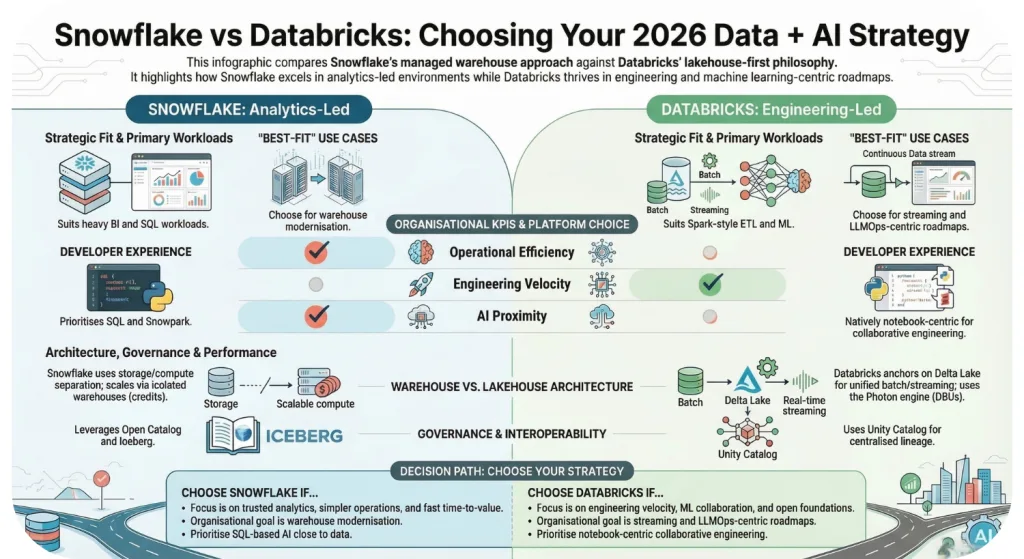
AI and Machine Learning Capabilities
AI workloads are rapidly becoming the deciding factor in platform selection.
Snowflake AI Capabilities
Snowflake has introduced Cortex AI, which brings AI directly inside the data platform.
Capabilities include:
- Built-in LLM functions
- Vector search
- Retrieval-Augmented Generation (RAG)
- AI-powered SQL functions
This approach is ideal for teams that want AI directly integrated into analytics workflows.
Databricks AI Capabilities
Databricks has long been a leader in AI platforms.
Capabilities include:
- Feature engineering pipelines
- ML lifecycle management
- scalable training environments
- AI governance
- Integrated notebook development
Databricks is typically preferred by organizations building production-grade ML platforms and AI products.
Governance, Security, and Data Management
Data governance is critical in enterprise environments.
Snowflake Governance
Snowflake offers:
- Role-based access control
- Dynamic data masking
- Row and column-level security
- Data sharing and marketplace
- Data lineage tools
Snowflake governance is strong for enterprise BI and compliance-driven data environments.
Databricks Governance
Databricks uses Unity Catalog to manage governance across data and AI assets.
Capabilities include:
- Centralized metadata
- Cross-workspace governance
- Lineage tracking
- Access controls
- Model governance
Unity Catalog provides strong governance across data pipelines, ML models, and AI assets.
Performance and Scalability
Snowflake Performance Model
Snowflake performance is managed via:
- warehouse sizing
- automatic scaling
- workload isolation
Benefits include:
- Predictable query performance
- High concurrency
- Optimized BI workloads
Databricks Performance Model
Databricks performance relies on:
- Spark distributed computing
- Photon query engine
- Pipeline optimization
Benefits include:
- Faster large-scale transformations
- Strong ML pipeline performance
- High throughput workloads
Pricing Model Comparison
Snowflake Pricing
Snowflake pricing is based on compute credits and storage.
Advantages:
- Simple consumption model
- Easy warehouse scaling
- Cost visibility
Potential challenge:
- High costs if warehouses run continuously.
Databricks Pricing
Databricks pricing uses DBUs (Databricks Units) plus cloud infrastructure costs.
Advantages:
- Flexible compute optimization
- Cost control for large workloads
Potential challenge:
- More complex pricing model.
Snowflake vs Databricks: Best Use Cases
Choose Snowflake If You Need
- Enterprise data warehouse modernization
- Governed BI analytics
- Secure cross-company data sharing
- High concurrency dashboards
- Simplified operations
Snowflake is widely used by organizations prioritizing analytics and data governance.
Choose Databricks If You Need
- Large-scale data engineering pipelines
- Machine learning platforms
- AI product development
- Streaming data platforms
- Open lakehouse architectures
Databricks is often preferred by companies building AI-first data ecosystems.
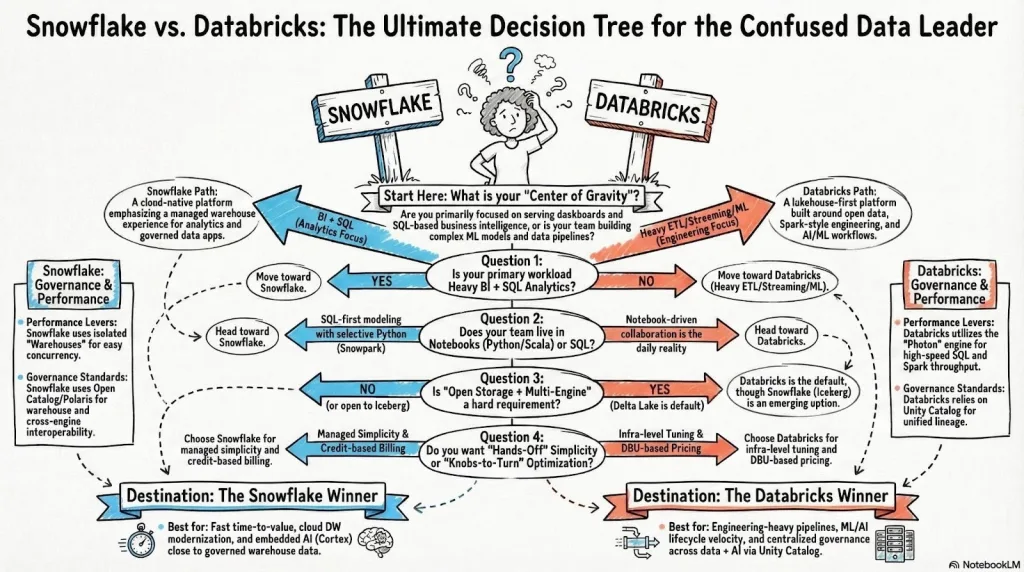
Decision Checklist: Which Platform Should You Choose?
Use this quick checklist before making a platform decision.
Choose Snowflake if:
- Your primary workload is analytics and BI dashboards
- Your teams work primarily in SQL
- You want a fully managed data warehouse
- Governance and data sharing are top priorities
- Your workloads involve high user concurrency
Choose Databricks if:
- You run large-scale data engineering pipelines
- You are building machine learning or AI platforms
- Your teams rely on Python, Spark, and notebooks
- You want an open lakehouse architecture
- Your platform includes streaming data pipelines
The Future: Convergence of Data and AI Platforms
The gap between Snowflake and Databricks is narrowing.
Snowflake is expanding into:
- AI workloads
- Developer frameworks
- Open table formats
Databricks is expanding into:
- SQL analytics
- BI workloads
- Enterprise governance
The result is a converging modern data platform landscape, where both platforms increasingly support analytics, engineering, and AI workloads.
The real decision now depends on which workload dominates your organization’s data strategy.
Final Thoughts
The Snowflake vs Databricks comparison is not about which platform is objectively better.
Instead, it is about which platform aligns with your enterprise data strategy.
- Snowflake leads in enterprise analytics and governed data platforms.
- Databricks leads in data engineering, machine learning, and AI-driven data ecosystems.
Organizations that understand their workload priorities, data maturity, and AI roadmap can make the right choice.
Build Your Enterprise Data Platform with Expert Guidance
Choosing between Snowflake and Databricks requires architecture expertise, governance planning, and cost optimization strategies.
DataCouch helps enterprises design and deploy modern AI-ready data platforms.
Our services include:
✓ Snowflake architecture and optimization
✓ Databricks lakehouse implementation
✓ AI-ready data platform consulting
✓ Enterprise data governance frameworks