
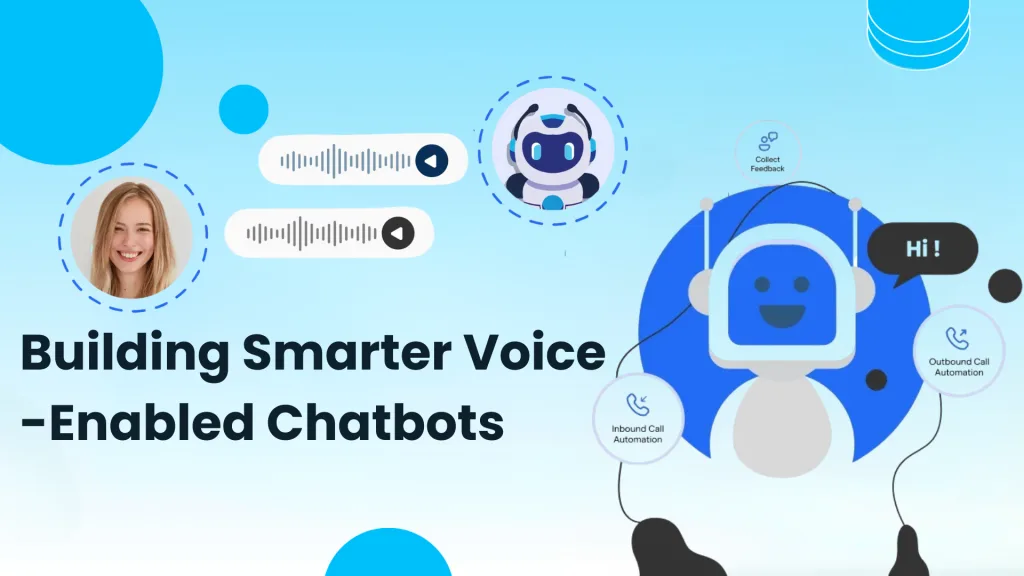
Building Voice-Enabled Chatbots (Voicebots) for Hands-Free Interaction: The 2025 Guide
A voicebot is an AI-powered software that understands and responds to spoken commands. It allows users to interact with technology hands-free, using natural conversation, much like talking to a person, to get tasks done or find information quickly.
Ever found yourself driving and wishing you could just ask your phone to schedule a meeting? Or maybe you’ve seen videos of AI taking drive-thru orders and wondered, “Could my business do that?” If so, you’re in the right place. The world is moving towards voice-first interaction, and businesses that acclimate are the ones that will win.
This isn’t just about fancy tech; it’s about meeting your customers where they are, on the move, multitasking, and looking for the quickest way to get help. In this guide, we’ll break down everything you need to know about building voicebots. We’ll keep it simple, factual, and focused on what matters for your business. Let’s get started.
What Exactly is a Voicebot? (And How is it Different from a Chatbot?)
You’ve probably used a chatbot before, that little window that pops up on a website asking if you need help. A voicebot is its talkative cousin. While a chatbot communicates through text, a voicebot uses spoken language. Think of Siri or Alexa, but built specifically for your business needs.
This difference is more than just text vs. talk. Because voicebots need to handle spoken language, they rely on a more complex set of technologies working together in milliseconds.
The Three Pillars of Voice Technology: A Simple Breakdown
To understand a voicebot, you just need to know about the three key technologies that power it. Think of them as the bot’s ears, brain, and mouth.
- Automatic Speech Recognition (ASR) – The “Ears”: This is the first and most crucial step. ASR technology listens to what the user says and alters the spoken words into written text that a computer can understand. The biggest challenge here is accurately understanding different accents, dialects, and filtering out background noise.
- Natural Language Processing (NLP) – The “Brain”: Once the words are in text form, NLP gets to work. This is the AI part that figures out the meaning and intent behind the words. For example, it knows that “Track my package” and “Where the heck is my order?” mean the same thing. It’s the core intelligence of the system.
- Text-to-Speech (TTS) – The “Mouth”: After the bot has figured out the right response, the TTS engine converts that text back into natural-sounding human speech. Modern TTS is so advanced that it can mimic human intonation and rhythm, making the conversation feel much less robotic.
Chatbot vs. Voicebot: It's More Than Just Talk
While both tools aim to automate conversations, they are suited for different situations. Here’s a quick comparison:
| Feature | Text Chatbot | Voicebot |
|---|---|---|
| Interaction | Text-based (typing) | Voice-based (speaking) |
| Best For | Websites, messaging apps (WhatsApp, Facebook) | Phone support, smart speakers, in-car systems |
| User Experience | Good for sharing links, images, and detailed text | Ideal for hands-free situations (driving, cooking) and accessibility |
| Technology | Primarily uses NLP | Uses ASR, NLP, and TTS | Complexity | Simpler and more cost-effective to build | More complex and resource-intensive to develop |
Why Your Business Needs a Voicebot in 2025: The Real-World Benefits
Adopting voice technology isn’t just about seeming modern. It delivers real, measurable benefits that can impact your bottom line and make your customers happier.
- Be Available 24/7, Without the Hefty Salary Costs: Voicebots don’t sleep, take breaks, or go on vacation. They can answer customer calls around the clock, even outside of business hours. According to Salesforce, 83% of customers expect to interact with someone immediately when they contact a brand. A voicebot makes that possible without the cost of a 24/7 human team.
- Drastically Reduce Customer Wait Times: Nobody likes being put on hold. The average call duration in a contact centre is nearly 6 minutes, often spent on repetitive questions. A voicebot can handle hundreds of calls at once, answering common queries like “What’s my order status?” or “What are your hours?” instantly, which means no more long queues for your customers.
- Free Up Your Team for High-Value Work: By automating the simple, repetitive tasks, you allow your skilled human agents to focus on complex, sensitive, or high-value customer issues that truly require a human touch. This not only improves efficiency but also leads to higher job satisfaction for your team.
- Improve Accessibility: Voicebots provide a crucial service for individuals with visual impairments or limited mobility, offering them a convenient, hands-free way to interact with your business.
Voicebot Use Cases: How Different Industries are Winning with Voice
Voicebots are incredibly versatile. Here’s how different sectors are using them to transform their operations and customer experience.
E-commerce & Retail
- 24/7 Order Tracking: The most common customer question, “Where Is My Order?” (WISMO), can be fully automated. A voicebot can integrate with your shipping systems to provide real-time updates anytime.
- Automated Returns: Voicebots can guide customers through the entire returns process, from initiating a return to providing instructions, making a common pain point hassle-free.
- Hands-Free Shopping: Customers can check product availability, get recommendations, and even place orders using simple voice commands.
Healthcare
- Appointment Management: Voicebots can schedule, confirm, and reschedule patient appointments over the phone, drastically reducing no-shows and the administrative burden on front-desk staff.
- Medication & Refill Reminders: Proactive outbound calls from a voicebot can remind patients to take their medication or refill their prescriptions, improving patient adherence and health outcomes.
- Answering FAQs: HIPAA-compliant voicebots can answer common patient questions about clinic hours, locations, and preparation for procedures, freeing up clinical staff.
Customer Support Call Centres
- Intelligent Call Routing: Instead of confusing “press 1 for sales” menus, a voicebot can understand a caller’s needs in natural language and route them to the correct department or agent immediately.
- Automating Simple Queries: Voicebots can handle a huge volume of inbound calls for tasks like password resets, account balance checks, and status updates, letting human agents handle the tough cases.
- Collecting Feedback: A voicebot can make automated follow-up calls after a service interaction to conduct surveys and gather valuable customer feedback at scale.
Your Step-by-Step Guide to Building a Voicebot
Ready to build your own voicebot? The process can be broken down into a few logical steps. While you might want to hire a chatbot developer for complex projects, understanding the process is key.
- Define a Clear Use Case: Don’t try to automate everything at once. The most successful projects start small. Analyze your call logs and identify the top 2-3 most frequent and repetitive questions your customers ask. This is your sweet spot for automation.
- Design the Conversation: This is where you map out the flow of the conversation. What will the bot say first? How will it handle different user responses? The goal is to make the interaction feel natural and helpful, not robotic and frustrating.
- Choose Your Technology Stack: You need to select the right platforms for ASR, NLP, and TTS. Many businesses opt for established cloud platforms that bundle these services together.
- Train and Test Your Bot: An AI is only as smart as the data it’s trained on. You’ll need to feed your voicebot with sample dialogues and real-world examples to help it learn. Then, test it rigorously to find and fix errors before it talks to a real customer.
- Integrate with Your Business Systems: For a voicebot to be truly useful, it needs to connect to your other systems, like your CRM or order management database, to fetch real-time information.
- Deploy and Continuously Improve: Launching the bot is just the beginning. You must monitor its performance, analyze conversations, and use that data to continuously refine and improve its accuracy and helpfulness over time.
Why Most Voicebots Fail (And How to Make Sure Yours Doesn't)
Building a voicebot is one thing; building one that customers don’t hate is another. Many projects fail because they overlook a few critical, human-centric details.
The Contrarian Take: A Technically Perfect Bot Can Still Be a Customer Service Nightmare
You can have the most advanced AI and the most natural-sounding voice, but if the conversational design is poor, users will get frustrated. A common pitfall is choosing the wrong use case, trying to automate a task that is too complex or emotionally charged for a bot to handle. If a customer is already upset, forcing them through a robotic menu will only make things worse.
Solution: Start with simple, informational tasks. Focus on designing a conversation that is brief, clear, and always guides the user toward a solution instead of trapping them in a loop.
Forgetting the Most Important Feature: The Human Handoff
No voicebot can handle 100% of queries. The biggest mistake a business can make is not providing a seamless, easy way for a user to escape the bot and speak to a human agent. When a customer says “speak to an agent” or “operator,” the bot must understand this immediately and facilitate a smooth transfer.
Solution: Design the human handoff as a core feature, not an afterthought. The best systems even pass the context of the bot conversation to the human agent, so the customer doesn’t have to repeat themselves.
The Future is Calling: What's Next for Voicebots?
The technology behind voicebots is evolving at an incredible pace. With the rise of Generative AI and Large Language Models (LLMs), the same tech behind ChatGPT, voicebots are becoming even more human-like. They can now handle more fluid, open-ended conversations and understand context with amazing accuracy.
Most experts agree that we will see voicebots become proactive assistants, not just reactive responders. Imagine a voicebot from your airline calling you to say your flight is delayed and offering to rebook you on the next one automatically. That’s the future of hands-free, intelligent customer service.
We're Going Global: See Us at GITEX GLOBAL 2025 in Dubai!
Our commitment to driving the future of data and AI doesn’t stop in India. This year, DataCouch is thrilled to announce that we will be setting up a booth at GITEX GLOBAL 2025, the world’s largest tech and AI show, in Dubai from October 13-17!
This is a massive opportunity to connect with global leaders and innovators, and we want to meet you there. Visit our booth to discuss how we can partner to drive your business forward. We are especially keen to connect with:
- SMEs: Looking for expert consulting and a roadmap for AI transformation.
- Tech Product Companies: Seeking partnerships for enablement and L&D extension.
- Universities: Aiming for AI-enablement to prepare the next generation of talent.
- CXOs, VPs, and GMs: In need of coaching and change management strategies for the new Agentic AI era.
- Businesses: Requiring customized AI solutions to solve unique challenges.
Come find us at GITEX GLOBAL to explore the future of technology and create new possibilities together.
Is a Voicebot Right for Your Business in 2025?
If your business receives a high volume of phone calls with repetitive queries, the answer is a resounding yes. A well-designed voicebot can transform your customer service, reduce costs, and free up your team to concentrate on growth.
The key is to start with a clear strategy, choose the right use cases, and prioritize the user experience above all else. Don’t think of it as replacing your human team, but as giving them a powerful new tool to help them succeed.
Ready to explore how a voicebot could work for your business? At DataCouch, we provide Advanced AI Chatbot Development Services to help companies like yours build intelligent, effective, and user-friendly conversational AI solutions.