
Complete Guide to Generative AI Certifications
Priya walked into the office on a Monday morning in early 2025. Her team had been using ChatGPT quietly for months. They used it to draft customer emails, summarize meeting notes, and write code snippets. Everything seemed fine.
Then her compliance officer called. A junior analyst had pasted confidential client data into a public AI tool. The data was now outside their control. The legal team was worried. The CEO wanted answers.
Priya saw the real problem very clearly. Her team knew how to use AI tools. They did not know how to use them safely, responsibly, or in a way that matched company rules. They had no common language. No shared standards. No proof of competency.
This kind of story now plays out in companies of every size. As we move through November 2025, generative AI spreads even faster. The gap between usage and training widens. Many leaders discover too late that usage without skills creates real business risk.
Generative AI certification programs for corporate teams are structured learning paths with clear outcomes and official credentials. They prove that employees understand both the power and the responsibility of AI tools in business.
Why Corporate Teams Need GenAI Certification Right Now
The Hidden Risk No One Talks About
Many leaders worry that employees will resist AI tools. In reality, a bigger risk sits under the surface. Employees already use AI informally, without training, process, or guardrails.
Research shows that over 60 percent of employers now expect some AI familiarity from workers. But familiarity is not competence. And competence without responsibility is dangerous.
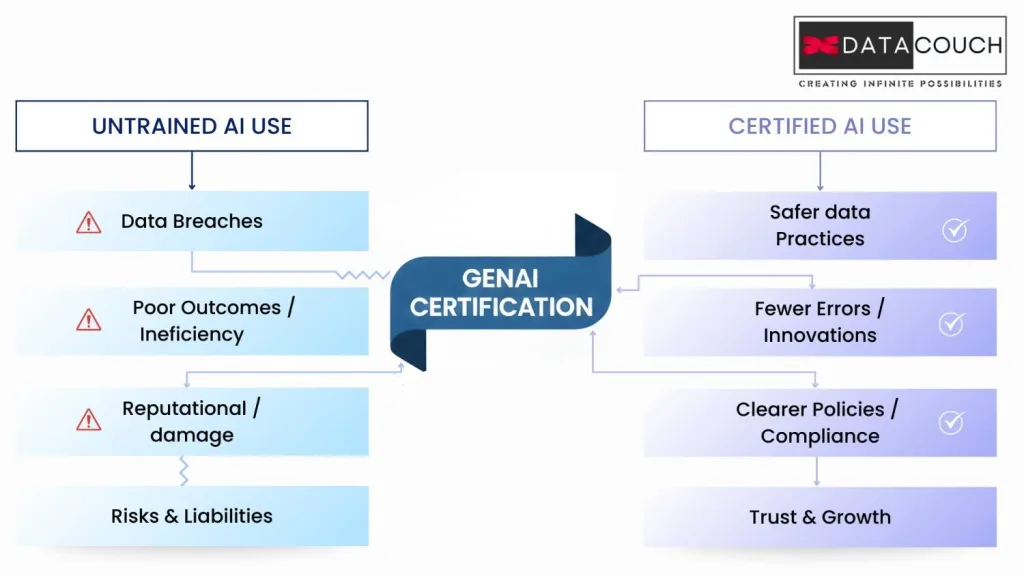
When teams use AI tools without proper education and certification, you often see:
- Data leaks from pasting sensitive content into public tools
- Wrong decisions based on hallucinated outputs
- Legal exposure from biased or non compliant responses
- Wasted time on trial and error with prompts
Certification creates order in this chaos. It gives everyone a shared baseline. It makes expectations clear. It shows auditors, clients, and boards that the company takes AI seriously, both as an opportunity and as a risk.
Training vs Certification: Why It Matters For Enterprises
Here is the surprising truth about AI learning in companies. Watching a few videos does not change how people work.
Training means content. Certification means:
- Structured curriculum
- Defined learning outcomes
- Assessments and proof of skill
- Renewal and updates over time
For corporate teams, certification links directly to:
- Job descriptions and role definitions
- Performance reviews and promotion criteria
- Internal mobility and career paths
- Compliance and audit requirements
Most public articles talk to individual learners. They suggest courses that a single person can buy on their own. They rarely explain how certification fits into enterprise structures. That is what this guide focuses on.
AI-Proof Your Career: A Guide for Pros Over 40
The DataCouch Generative AI Certification Stack For Corporate Teams
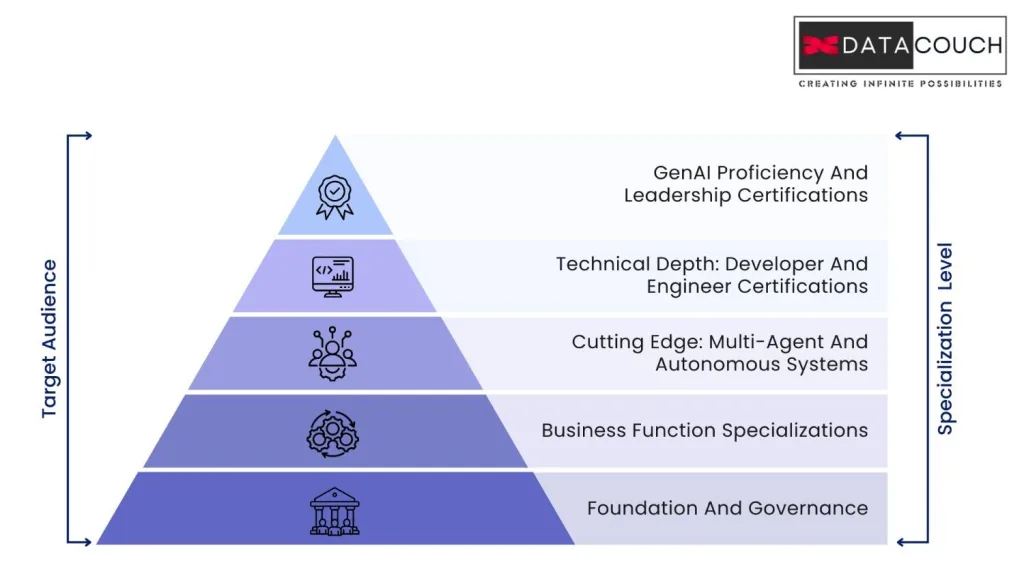
At DataCouch, we have designed a complete certification stack that maps to how modern organizations actually work. Our programs are built for enterprise needs, not just individual learners.
GenAI Proficiency And Leadership Certifications
Target audience: Executives, managers, and business professionals who guide AI adoption but do not build models.
DataCouch programs for this layer:
- Generative AI for Executives – Unlocking innovation and growth with strategic AI adoption
- Generative AI for Leaders – Driving transformation, efficiency, and strategy across the software lifecycle
- AI-Driven Business Transformation for Decision Makers – Empowering leaders to harness GenAI potential
- Generative AI for Technical Managers – Ramping up managers to lead GenAI projects effectively
These programs give leaders what they actually need:
- Simple explanations of how modern AI works
- Strategic opportunities across functions
- Risk, compliance, and governance basics
- Practical frameworks for leading AI powered teams and change
Technical Depth: Developer And Engineer Certifications
Target audience: Software developers, data scientists, ML engineers, data engineers, and platform teams.
DataCouch programs for this layer:
- Mastering Generative AI: From Basics to Advanced Applications – Journey through LLMs, RAG, and Agentic AI
- Generative AI for Developers Level 1 – Building intelligent solutions with GenAI
- Building Generative AI Apps with LangChain – Leverage GenAI to unlock value from business data and processes
- AI Development with RAG and LangChain on Azure – Unlocking advanced AI solutions on Azure
- Generative AI for Software Developers on Microsoft Azure – Harnessing AI creativity to elevate software development
- GitHub Copilot in Action: AI-driven Coding – Integrating AI to accelerate software development and improve workflows
- Introduction to Prompt Engineering – Exploring the power and capabilities of ChatGPT using prompt engineering
- Generative AI NLP Specialization Levels 1-4 – Building intelligent NLP solutions, diving deeper into LLMs and fine tuning
- Generative AI Computer Vision Specialization Levels 1–2 – Building intelligent computer vision solutions using GenAI
- Generative AI on GCP – A pragmatic course on generative AI
These certifications build deeper skills around:
- Model selection and fine tuning
- Retrieval Augmented Generation patterns
- Agent based workflows and orchestration
- MLOps and monitoring for GenAI systems
- Platform specific implementation on Azure, GCP, and other environments
Cutting Edge: Multi-Agent And Autonomous Systems
Target audience: Advanced practitioners and AI champions building next generation systems.
DataCouch programs for this layer:
- Foundations of Multi-Agent Automation with CrewAI – Mastering the future of autonomous systems
- Agentic AI in Action: A Beginner’s Guide to Adaptive AI Systems – A practical guide to the future of AI in work and innovation
- AI Agents & Agentic AI – Building Intelligent Autonomous Systems – Deep dive into autonomous AI architecture
These programs address the biggest shift in late 2025: moving from single models to systems of collaborating AI agents that can plan, coordinate, and execute complex tasks.
Business Function Specializations
Target audience: Teams in specific departments who need AI applied to their domain.
DataCouch programs for this layer:
- Generative AI for Retail Innovation – Harness AI to transform customer experiences and optimize operations
- Generative AI in Finance – Enhancing financial services with GenAI for automation, risk management, and decision making
- Generative AI in HR – Transforming human resources with AI driven automation, talent management, and employee engagement
- Generative AI in Marketing – Revolutionizing marketing strategies with AI driven creativity and automation
- Generative AI in Sales – Leveraging AI to enhance sales strategies and customer engagement
- Excellence in Customer Service with AI-Driven Insights – Leveraging AI to redefine customer experiences and satisfaction
- Power Your Product Management with AI – Harnessing AI for strategic product leadership and excellence
- AI in UX Design – Integrating AI to enhance creativity, user centered design, and prototyping
- AIOps Essentials – Mastering AIOps from concept to execution
- Artificial Intelligence in Content Writing – Unleashing AI potential for smarter, faster, and more interesting content creation
- Cybersecurity 4.0 – Leveraging AI for threat detection and defense, and mastering AI driven ethical hacking
These programs ensure that AI certification is not generic. It is applied directly to the workflows, data, and KPIs that matter in each function.
Foundation And Governance
Target audience: Everyone needs these basics, especially compliance, risk, and learning teams.
DataCouch programs for this layer:
- Foundation for Generative AI – Just enough AI fundamentals for GenAI
- Prompt Engineering Essentials – Unlocking the power of prompts to make the most of large language models
- Mastering Prompt Engineering for Microsoft Copilot in Microsoft 365 – Enhancing productivity by crafting effective, contextual prompts
- Leading Ethical AI Initiatives: Governance, Integrity, and Compliance – Ensuring responsible AI development with ethical leadership
These courses create the shared language and responsible framework that every corporate AI program needs.
The Hidden Factors Most GenAI Certification Guides Ignore
Bold Truth 1: All-Purpose Training Is A Myth, Especially In AI
What most people do not realize is this. Generic AI training for everyone may look efficient, but it often fails in practice.
Research highlights that generic, one-size-fits-all AI training wastes budget and misses real strategic needs. For corporate teams, effective certification is role based. For example:
- Executives focus on strategy, risk, portfolio, vendors
- Business users focus on prompt patterns, workflow redesign, and KPI impact
- Technical teams focus on LLMs, RAG, agents, evaluation, and MLOps
- Platform teams focus on GPU infrastructure, data pipelines, and security
If your certification programs do not reflect these differences, people will either tune out or fail to apply what they learn.
DataCouch solves this by offering distinct learning paths for each role, from executive briefings to deep developer tracks, all within a single, unified platform.
Bold Truth 2: Understanding About Governance Is Not Optional
Industry research emphasizes that GenAI value comes only when you pair capability with control. Many courses treat responsible AI as a side topic. In a corporate setting, it must be central.
Your certification design should:
- Match company AI policy on data handling and tool usage
- Reflect sector rules around privacy, auditability, and fairness
- Link with your vendor governance framework and approved tools
Good questions to ask any provider:
- Do you include realistic risk scenarios in assessments?
- Do you discuss data residency, logging, and model monitoring?
- Can we embed our own AI policies into the course?
DataCouch builds governance through dedicated courses like Leading Ethical AI Initiatives and by weaving responsible AI principles into every technical track.
Bold Truth 3: Old Certificates From Twenty Twenty Four Are Already Outdated
GenAI tools and best practices can change in a matter of months. Static certifications can age quickly.
To keep pace, ask:
- How often is the content updated?
- Do learners get access to new modules after they certify?
- Is there a re-certification model or continuous learning path?
In many cases, you should treat AI certifications as living programs, not one time events.
DataCouch updates content quarterly and provides continuous access to new modules for all certified learners, ensuring skills stay current.
Bold Truth 4: Badge Inflation Kills Credibility
Many organizations run big campaigns. They push thousands of staff to complete a basic AI course. Then they celebrate the number of badges.
If you do not link certification to behavior, nothing changes.
Instead, track:
- Hours saved on specific processes after certification
- Number of AI enhanced workflows launched into production
- Reduction in policy violations and shadow AI usage
Tie learning to:
- Individual and team KPIs
- Innovation and automation OKRs
- Promotion or role criteria where it makes sense
DataCouch helps measure real impact by providing skill assessments, project based certifications, and templates for linking learning outcomes to business metrics.
Bold Truth 5: Middle Managers Decide Whether AI Sticks
Industry research points out that middle management is the missing link in many AI transformations.
If managers do not understand AI or do not support new workflows, teams quietly return to old habits, even after passing exams.
To fix this:
- Include managers in leadership and champion level certifications
- Give them playbooks on how to coach AI usage in their teams
- Make them owners of local AI adoption metrics
DataCouch addresses this gap with specific programs like Generative AI for Technical Managers and AI-Driven Business Transformation for Decision Makers, plus champion enablement kits.
Bold Truth 6: Integration With Your Learning And Data Stack Matters
Modern platforms offer skill dashboards and LMS integration. Advanced systems use AI to adapt content in near real time.
Check for:
- Single sign-on (SSO) and connection to your HR systems
- Exportable learning data for your analytics teams
- Secure support for labs and exercises on your own, internal data
This integration turns certification into something you can measure and manage, not just a list of attendees.
DataCouch provides enterprise grade integration with SSO, LMS connectors, and secure lab environments that can run on your infrastructure and data.
Bold Truth 7: AI Can Improve AI Learning
A powerful but less discussed topic is this. AI itself can personalize learning.
Leading programs use AI to:
- Recommend learning paths based on role, skill gap, and performance
- Generate practice questions from internal policies and documentation
- Provide AI tutoring for just in time help during labs
Over time, the most effective corporate programs will combine human instruction with AI powered support.
DataCouch uses AI driven personalization within its platform to adapt course difficulty, suggest next modules, and generate company specific practice scenarios.
How To Evaluate GenAI Certification Programs For Corporate Teams
Here is a practical checklist you can adapt.
Strategic Fit
- Does the program map to your AI roadmap and main use cases?
- Does the provider have experience in your industry?
- Can they share examples from similar clients?
Role Based Structure
- Are there distinct paths for executives, business users, technical teams, and governance roles?
- Can cohorts follow different tracks but still share a common AI language?
Rigor And Assessment
Look for:
- Proctored exams where needed, especially for technical and leadership roles
- Hands on labs and capstone projects, not just quizzes
- Scenario based questions around risk, ethics, and policy
Enterprise Readiness
Ask about:
- Admin tools for cohort creation, tracking, and reporting
- Localization and language support
Integration options for LMS, LXP, and HR systems
Governance And Compliance
- Is responsible AI built in from the start?
- Can the provider embed your AI policies and legal guardrails into the content?
- Do they address bias, explainability, auditing, and data protection?
Change Management
Strong providers often include:
- Office hours and coaching
- Train the trainer or AI champion tracks
- Kits for internal communication and manager enablement
Impact And ROI
From the provider side:
- Baseline and post program skill assessments
- Case studies and benchmarks from other clients
From your side:
- Link completion to process metrics and business results
- Track AI projects launched and value created
- Monitor policy compliance and reduce shadow AI
DataCouch meets all these criteria across its enterprise certification portfolio, making it a single partner for end to end GenAI skill development.
Step By Step Blueprint To Roll Out GenAI Certification
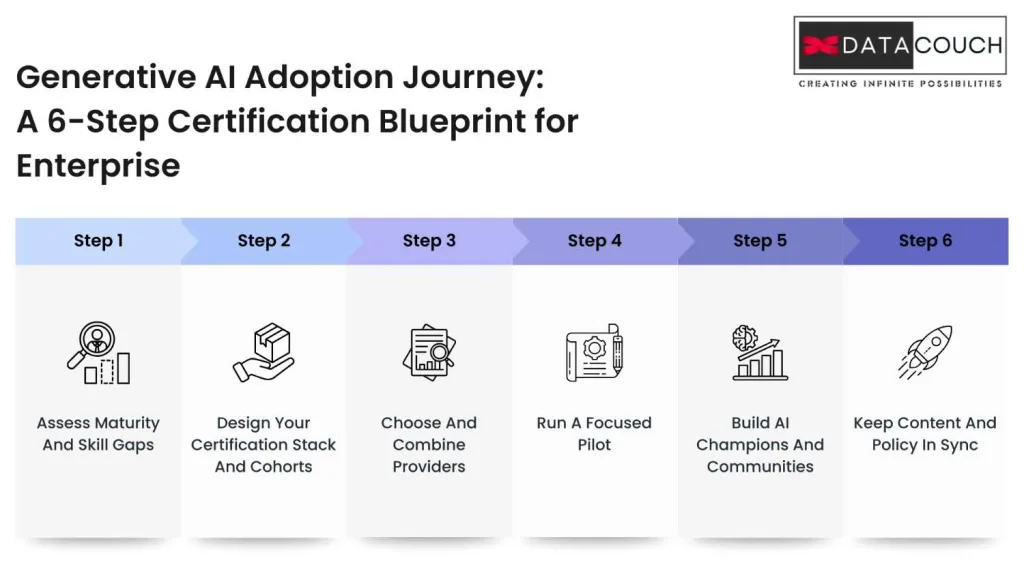
Step 1: Assess Maturity And Skill Gaps
Use short surveys and simple assessments. Tools from learning platforms can help.
Ask about:
- Current AI usage patterns at work
- Comfort levels with tools like ChatGPT and Copilot
- Understanding of data sensitivity and policy
- Role specific needs and pain points
DataCouch provides assessment tools to benchmark current skills and identify gaps by role and department.
Step 2: Design Your Certification Stack And Cohorts
Create a clear map of who needs what.
For example:
- All knowledge workers take a foundation course with a basic certificate on GenAI and responsible use
- Leaders enroll in business and strategy certifications, plus any leadership tracks you select
- Technical staff follow platform specific engineer certifications
- Special groups, such as AI champions, compliance teams, and HR or L&D, take deeper or more focused programs
DataCouch helps design this stack through consultation, ensuring each cohort gets the right depth and focus.
Step 3: Choose And Combine Providers
Avoid the trap of searching for a single perfect program.
Instead:
- Use your main cloud provider for platform aligned certifications
- Use an online platform for broad access and tracking at scale
- If budget allows, bring in a provider for governance, industry depth, and change management support
- Add a short, internal bootcamp where teams apply learning to your real workflows and data
DataCouch can serve as the primary or partner provider, offering both breadth across roles and depth in governance, ethics, and applied projects.
Step 4: Run A Focused Pilot
Select one or two business units. Make the goals very clear.
Example targets:
- Reduce document drafting time by 30 percent
- Automate a set number of recurring tasks
- Design a pipeline of concrete AI use cases for delivery
Use certification programs that require participants to work on real, work related problems.
DataCouch specializes in project based certification, where learners build solutions using your actual data and challenges.
Step 5: Build AI Champions And Communities
Create an internal “AI Guild” or similar community.
AI champions should:
- Go through advanced or leadership level certification
- Coach peers and review AI use cases
- Host clinics and office hours
- Help teams follow policy and best practice
DataCouch provides champion enablement as part of enterprise licenses, including playbooks, office hours, and community management tools.
Step 6: Keep Content And Policy In Sync
Set a review cycle, maybe every 6 to 12 months.
In each cycle:
- Add modules for new tools and patterns, such as agents and multimodal models
- Update governance content based on new regulations and internal policies
- Refresh assessments and labs
Use AI itself to generate updated practice scenarios from your latest documents and rules.
DataCouch updates content quarterly and provides tools for you to upload your own policy documents to generate custom practice scenarios.
The Future Of GenAI Certification In 2026
As we close out, several trends are becoming clearer.
Continuous Micro Credentials
One time certification is not enough in a field that moves this fast. The future is about:
- Stackable, short credentials that build on each other
- Quarterly updates and new module releases
Just in time learning that people can access when they need it
AI Driven Personalization
AI is starting to personalize learning in real time. It can:
- Adjust difficulty based on learner performance
- Generate practice questions from your own company’s documents
- Recommend next steps automatically
This trend will accelerate as AI tutoring and coaching tools improve.
Integration With Workforce Systems
The line between learning and talent management is blurring. Certification data will connect directly to:
- Performance and productivity metrics
- Workforce planning and upskilling roadmaps
- Internal mobility and career progression
- Job architecture and compensation decisions
Emphasis On Responsible AI
Regulators and boards are paying more attention. Certifications that include strong governance, ethics, and compliance modules will become standard, not optional.
Summary And Next Step
Generative AI certification for corporate teams is not a vanity project. It is a way to build a workforce that is competent, confident, and compliant.
Key points to remember:
- Role based learning works better than generic training
- Governance and legal alignment must sit inside the curriculum, not outside it
- Middle managers and AI champions decide whether new habits stick
- A smart stack of certifications will be stronger than any single course
- Real value shows up only when certified skills lead to better workflows, faster delivery, and lower risk
Are you ready to move your teams from casual AI use to a certified, strategic, and responsible GenAI culture?
If you need help designing and implementing a GenAI certification strategy tailored to your organization’s unique needs, DataCouch offers end to end solutions. From assessing your current maturity to customizing learning paths and integrating with your existing systems, our approach ensures your teams don’t just earn certificates, they transform how work gets done.