
Maximizing Team Productivity: The Right Metrics for Scaling Your GCC
Picture this.
Your Global Capability Center just hit 500 people. The spreadsheet looks beautiful. Cost per employee sits 35% below your headquarters. Your CFO sends you a congratulatory email. Everything seems perfect.
Then your CEO walks into the board meeting and asks something that stops you cold: “Is this team making us faster?”
You pause. You have delivery numbers. You have cost savings. But when the CEO is asking if your $50 million investment is actually moving the business needle, are they building the next product? Are they driving innovation? Are they just executing? Your metrics suddenly feel hollow.
This is the Global Capability Center paradox of 2025. You’re measuring what’s easy to count, not what actually matters.
What is a GCC? A Global Capability Center, is an offshore office where multinational companies place talented teams to handle everything from product development and research to customer support and financial operations. But here’s what most GCC leaders don’t realize: measuring productivity in a GCC isn’t about headcount or cost per FTE. It’s about understanding what actually drives business value.
Let’s talk about the metrics that truly matter.
The Problem: You're Measuring the Wrong Things
Here’s something that might surprise you. Most companies operating a GCC in India or elsewhere are tracking metrics that look impressive on a spreadsheet but tell almost nothing about real productivity.
Cost per employee. Attrition rate. SLA compliance. Delivery on time.
These numbers live in your dashboard. They make your CFO happy. But they’re only measuring inputs, not outcomes. They’re like counting how many bricks your construction team laid without asking whether the building is actually standing.
What most people don’t realize is that 92% of Global Capability Centers are still stuck measuring costs and efficiency. Only 8% have advanced to measure innovation, competitive advantage, and real business transformation.
Think about what this means for your organization.
If you’re measuring only cost, your GCC leader will optimize for cost. This creates a vicious cycle. You hire based on budget, not capability. You attract cheaper talent instead of better talent. Your best people leave because there’s no innovation work. You replace them with even cheaper people. The GCC stays stuck in low-value execution.
Years pass. Your team can execute flawlessly, but they can’t build the next product. They can’t drive strategic change. They can’t compete for the company’s best assignments.
This is the cost-center trap, and it catches most organizations.
The Hidden Costs Nobody Measures
Let me show you something most GCC articles completely miss.
The Real Cost of Losing One Senior Person
Your best data architect leaves your GCC. You know it happens. Your HR team initiates the replacement process, right? You post the job. It takes two months to hire someone decent. That person needs three months to ramp up. Then you need one of your team members to spend an hour a day teaching them the systems and context.
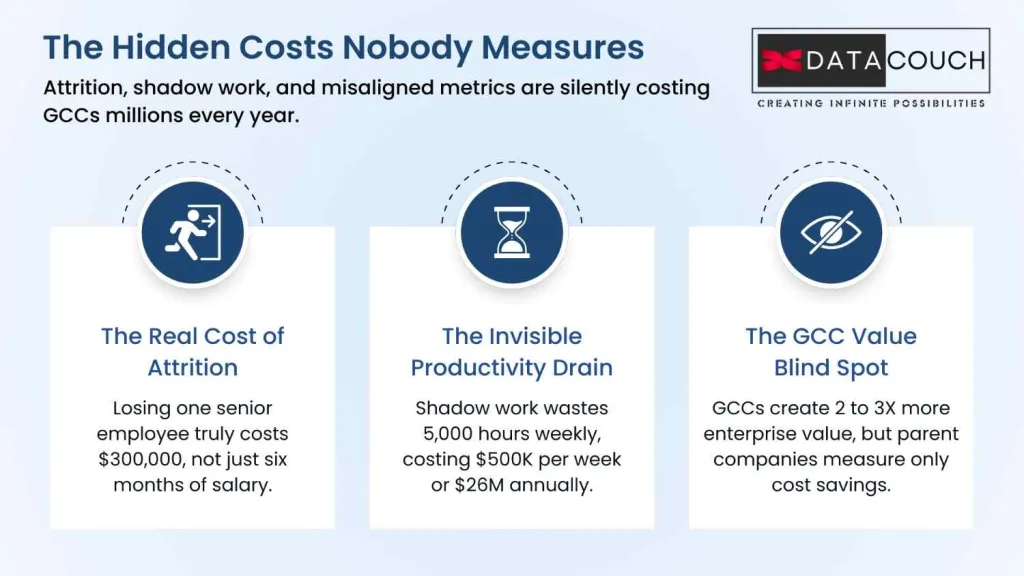
Your finance person calculates: six months of salary. Let’s say $75,000 for a senior role. Total cost? About $75,000.
But here’s what you’re not counting.
That person held regulatory knowledge that took five years to build. They had client relationships spanning three years. They understood the shortcuts, the workarounds, the “how we actually get things done here” that no documentation captures. They were mentoring two junior people. They were on the steering committee for your biggest automation project.
When they walk out the door, they take all of that.
The true cost looks more like this:
- Replacement cost: $75,000
- Lost productivity while you’re hiring and ramping: $60,000
- Knowledge transfer time from your existing team: $45,000
- Intellectual property you can’t recover: $90,000 (regulatory expertise, client trust, project momentum)
- Project delays and penalties: $30,000
Total real cost? Around $300,000.
That’s four times what your finance team is calculating. And you probably have 15-25% attrition in critical roles across your GCC right now. Do the math.
One company we studied had an 18% annual attrition rate in its analytics team. They thought the cost was around $1.5 million (20 people x $75K). The real cost, when you include knowledge loss and project delays, was closer to $6 million. When they fixed their leadership and built a real career path, attrition dropped to 9%, and their project turnaround improved by 30%. Suddenly, “attrition” wasn’t just an HR number. It was a $3 million business problem they could actually solve.
The Invisible 2-Hour Drain You're Not Measuring.
Here’s something that doesn’t show up on any productivity dashboard.
Your teams spend about two hours every single day on what researchers call “shadow work.” Not the actual work you hired them to do, but the stuff that gets in the way. Waiting for system access. Asking for approval. Getting information from other departments. Finding documents. Jumping between unrelated tasks because there’s no priority clarity.
This isn’t laziness. This is organizational friction that eats your productivity alive.
One study looked at knowledge workers across multiple industries. They found that employees spend:
- 30 minutes per day waiting for approvals
- 20 minutes jumping between unrelated tasks because of context switching
- 15 minutes searching for documents or data
- 10 minutes waiting for routine decisions from managers
Add those up. That’s roughly two hours per person per day that isn’t actually creating value.
In a 500-person GCC, you’re losing 5,000 hours per week to shadow work.
At $100 per hour (a conservative estimate for GCC salaries), that’s $500,000 per week in lost productivity. Annually, that’s $26 million.
And nobody measures it because the work isn’t “visible.” It doesn’t show up in project tracking systems. It’s not on anyone’s timesheet. But it’s destroying your actual output.
What most websites don’t talk about: The best performers are often the people doing the most invisible work. They’re mentoring, solving problems spontaneously, and bridging departments. These are the exact people who burn out first because nobody counts these hours when they’re measuring productivity.
Ready to measure what actually matters?
The Parent Company Blind Spot: You're Worth 3x More Than They Think
This one hurts.
Your headquarters measures your GCC using one metric: cost savings. This creates a problem that almost nobody talks about.
When your parent company sees your GCC only through the lens of cost, they treat it like a cost center. When you’re treated like a cost center, GCC leadership optimizes for efficiency, not capability. This confirms headquarters belief that the GCC is best used as an execution arm, not a strategic partner. So they don’t invest in capability development. Strategic work doesn’t flow to your team.
You stay stuck.
Meanwhile, your GCC is actually creating value that nobody’s measuring.
Your regulatory training in Mumbai is taught to teams across five regions. Your automation work, developed by your GCC, gets deployed across 10 countries and saves $50 million enterprise-wide. But your budget only gets credit for the local process savings. Your best people rotate into global leadership roles with three-times higher salaries, and that value disappears from your GCC metrics.
The research on this is striking. Organizations that implement comprehensive GCC value measurement, measuring innovation, knowledge transfer, talent development, and strategic impact, discover they’re creating 2 to 3 times more value than their cost metrics showed.
Let us translate that: Your parent company might be undervaluing your GCC by hundreds of millions of dollars annually.
The Metrics That Actually Matter: Five Dimensions
Stop measuring cost per person. Start measuring these.
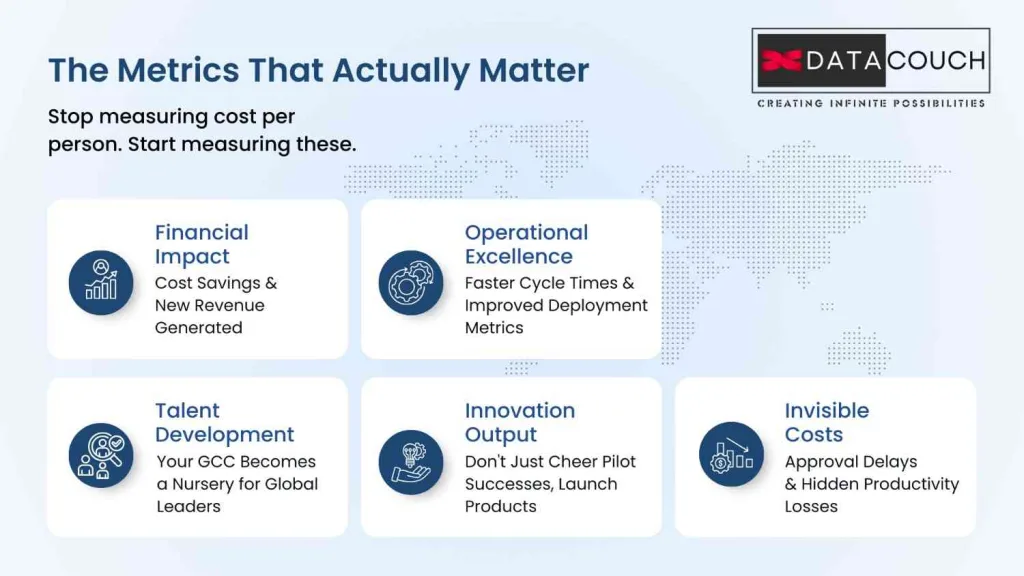
1. Financial Impact (Not Just Cost)
Most companies measure: “We saved $10 million in costs.”
Actually, powerful companies measure: “We saved $10 million in costs AND generated $50 million in new revenue through products our GCC developed.”
Financial productivity means ROI per initiative, not just headcount. It means understanding the revenue influence of GCC-led work. One automation your team builds might save three departments millions annually. That’s not in your “cost savings” line item.
2. Operational Excellence (The Speed Question)
Your CEO asked if you could make them faster. Here’s how you measure that.
Cycle time reduction is the real metric. How much faster is your global organization moving because of your GCC? A mature GCC delivers 40% faster cycle times compared to headquarters. Your team should be measured on how much speed you’re adding to the enterprise, not just whether you hit your deadlines.
For engineering teams specifically, track DORA metrics: How often you deploy to production. How long does code take to reach production? What percentage of deployments fail? How fast you recover from failures. These separate high-performing GCCs from average ones.
3. Talent Development (Your Real Asset)
This one surprises people. Your GCC should be a leadership development laboratory, not just an execution center.
How many open roles at your headquarters get filled by people who rotated through your GCC? How many GCC professionals are now leading global initiatives? That talent multiplier is worth millions.
One company discovered that 40% of its top global leaders had served in its GCC at some point. That career pipeline was worth far more than the quarterly cost savings.
4. Innovation Output (What 92% Miss)
Only 8% of GCCs measure this at all. If you’re doing it, you’re ahead of the competition.
How many ideas become products? How many pilots actually move to production? How many automation initiatives launch? One organization found they were starting 20 innovation POCs (proof of concept) every quarter, but only getting one to production. They had a pipeline problem, not an innovation problem. Once they measured this, they could fix it.
Innovation throughput rate separates real innovation from busy work.
5. Invisible Costs (What Shadow Work Is Actually Costing You)
Your teams need clear metrics on approval cycle time, system access request fulfillment time, and how long it takes to find information. These seem small, but they add up to that $26 million annual drain we talked about.
Building Your GCC Scorecard: A Simple Framework
You don’t need 50 metrics. You need four.
Pick one from each category:
- Financial: Revenue influence per initiative plus cost savings divided by total GCC investment
- Operational: Cycle time improvement percentage plus automation coverage percentage plus SLA compliance
- Innovation: POCs converted to production, plus patents filed, plus new capabilities developed
- Talent: Percentage of open global roles filled from GCC, plus internal promotions, plus upskilling rate
Track these quarterly. That’s it. Everything else is detail.
The GCCs That Win in 2026
Here’s the reality. Over the next 18 months, 120+ new Global Capability Centers are launching in India alone. That’s 120 organizations trying to figure out what matters.
The ones that win won’t be the cheapest. They’ll be the ones who understand productivity actually means driving innovation, speeding up the business, and developing talent, not just managing cost.
Your GCC can be a cost center, a delivery center, or a strategic engine. You get to choose. But here’s what you need to know: The metric you choose determines the team you build, the people you attract, and the value you create.
If you measure cost, you’ll build a cost center.
If you measure innovation, speed, and impact, you’ll build something strategic.
How DataCouch Helps Your Team Measure What Matters
Most GCC teams want to measure innovation and impact. They just don’t have the skills yet.
DataCouch helps enterprise teams build capability in AI, automation, and digital transformation. We work with Fortune 500 companies to upskill their Global Capability Centers so they can move from execution to innovation. If you want to understand what your GCC is truly capable of, let’s talk.
We’ve worked with teams across financial services, technology, and consulting to help their GCCs transition from execution-focused to innovation-focused. The results? Higher retention, faster delivery, real revenue impact, and strategic mandate expansion.
Stop guessing about your GCC's true productivity.
The Bottom Line: Measure What Actually Drives Value
Your CEO’s question, “Is this team making us faster?”, deserves an answer based on real metrics.
Stop measuring cost per FTE. Start measuring innovation throughput, cycle time improvement, talent pipeline contribution, and enterprise impact. These are the metrics that actually tell you whether your $50 million GCC investment is working.
Here’s what we know from companies that made this shift: Within 12 months, their best people are more engaged. Their productivity metrics actually improve. And most importantly, their GCC becomes a strategic priority instead of a cost center.
The question for you isn’t whether you can measure productivity differently. It’s whether you can afford not to.
What's One Change You Can Make Today?
Pick one metric from the five dimensions we discussed. Just one. Get it into your measurement system by next month. Track it for three months. Then tell us what changed.
Because here’s the surprising truth: Once you start measuring what actually matters, everything else starts to shift.
Your GCC was probably worth more than you thought all along. You were just measuring the wrong things.