
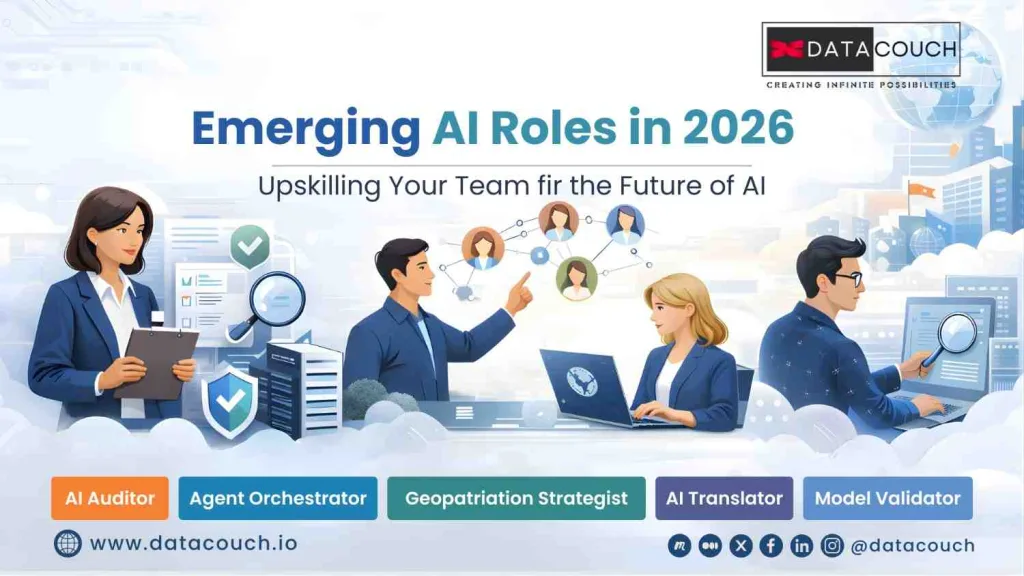
Emerging AI Roles in 2026 and Skills Your Team Needs
By 2026, AI success is no longer defined by experimentation or access to tools. It is defined by governance, orchestration, and measurable business outcomes. As organizations move from copilots to autonomous agent teams, they need people who can control risk, cut low-value output, and prove ROI.
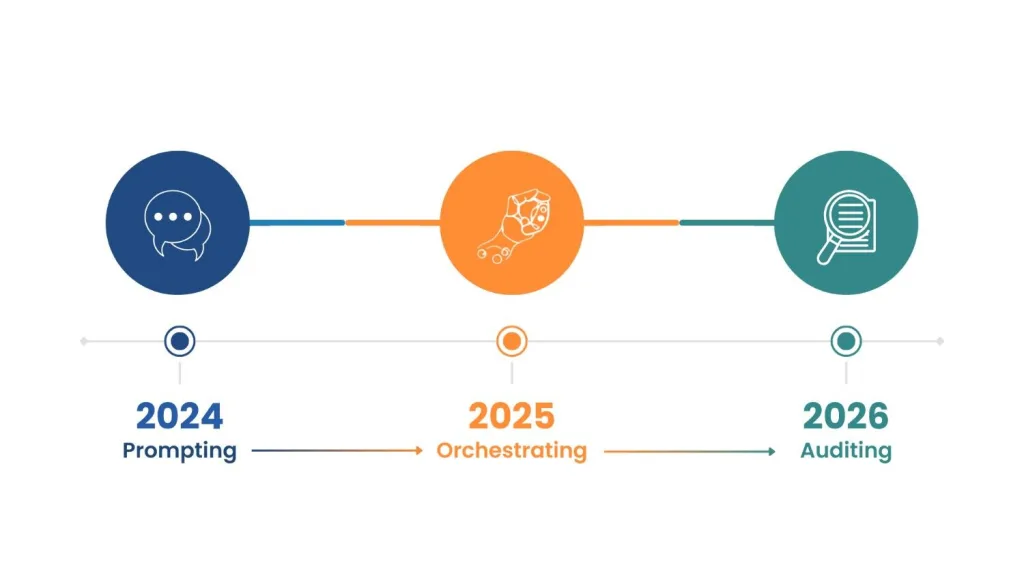
That shift is exactly why emerging AI roles in 2026 are moving the focus from simple prompting to managing autonomous multi agent systems. These roles protect organizations from low quality AI content and ensure that data stays secure within regional or sovereign boundaries.
The Surprising Truth About the 2026 Productivity Gap
What most leaders realize too late is that buying AI tools is not the same as getting results. In early 2025, many companies rushed to give every employee a chatbot. By 2026, those same companies are facing a hidden crisis known as workshop.
Workslop is high-polish but low-value content that AI creates when it lacks human context. It might look like a great report or a clean piece of code at first glance. However, it often misses the small details that make a project successful. Research from late 2025 shows that employees now spend an average of one hour and 56 minutes fixing every piece of workslop they receive. For a firm with 10,000 people, this productivity drain costs over 9 million dollars every year.
If you are a CTO or a Manager, your biggest challenge is no longer “How do we use AI?” Instead, it is “How do we find people who can stop the slope and drive real value?” This shift is creating entirely new jobs that did not exist two years ago.
The Geopatriation Wave: Why Your Cloud Strategy is Changing
There is a new word that every CFO and CTO must know in 2026: Geopatriation. For years, the goal was to put everything in the global cloud. Now, because of new laws like the EU AI Act and rising global tensions, companies are moving their data back.
Geopatriation is the act of shifting data and AI models into local or sovereign environments. Leaders want to own the entire stack, from the chips to the software. This move ensures that sensitive information stays under local laws and away from foreign risks. It also means you need a team that understands how to build AI in private, air gapped systems rather than just using a public API.
Transitioning from "pilots to profit" requires more than just buying software. If you want to see how your team can move toward meaningful outcomes, exploring a consultative approach to corporate training is a vital first step
Five Essential AI Roles Your Team Needs Today
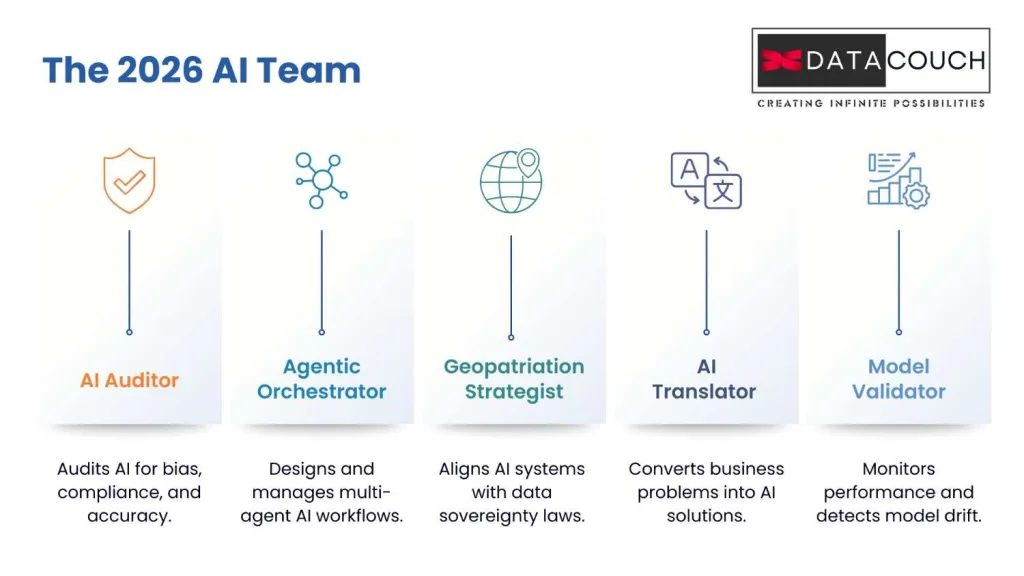
To win in 2026, you must look beyond the standard AI Engineer title. Here are the specific roles that are defining the modern workforce.
1. The AI Auditor
This role is the watchdog for your company. Governments now demand that AI systems are fair and accurate. An AI Auditor checks models for bias, ensures they follow privacy laws, and verifies that they are not hallucinating. They are the quality control specialists who prevent your company from facing massive fines.
2. The Agentic Orchestrator
We have moved past the era of one person writing one prompt. Today, we use Multi Agent Systems (MAS). These are teams of different AI agents that work together to solve a big goal. The Orchestrator is the person who designs these teams. They decide which agent researches, which agent writes, and which agent checks the work for errors.
3. The Geopatriation Strategist
As mentioned earlier, data sovereignty is a top priority. This specialist decides which workloads stay in the global cloud and which must move to local servers. They bridge the gap between IT architecture and international law.
4. The AI Translator
This is the perfect role for people who do not want to code but love technology. The AI Translator takes a business problem and explains it in a way that an AI system can solve. They ensure that your corporate training budget produces results that the CFO can actually see on a balance sheet.
5. The Model Validator
A model that works today might fail tomorrow. This is called “model drift.” The Validator monitors AI performance in real time. They catch silent failures before they turn into customer complaints or security breaches.
To stay ahead of these rapid changes, we have launched a dedicated YouTube AI series
The 2026 Skill Stack: What to Look For
If you are leading a team, you might think you need more coders. The surprising truth is that technical skills are changing so fast that they are almost becoming a commodity. Instead, you should focus on these three areas for your Team Upskilling efforts:
- Process Redesign: This is the most valuable skill in 2026. Teams that can rethink an entire workflow to include AI are twice as likely to beat their revenue goals.
- Digital Provenance: This involves verifying where data came from and if it is authentic. With 25 percent of candidate profiles predicted to be fake by 2028, your HR team needs to be able to spot human truth in a world of AI noise.
- Critical Thinking: Since AI creates so much workslop, your team needs the courage to question the machine. We no longer need people who accept AI answers blindly.
Where to Find the Best AI Training in 2026
When it comes to AI training, you have three main paths. Each one serves a different need for your organization.
The Comparison: Who Should You Trust?
| Provider Type | Examples | Best For | Pros/Cons |
|---|---|---|---|
| Global Aggregators | Coursera, LinkedIn Learning | Broad literacy | Good for basic certificates but often lacks deep, hands-on practice. |
| Technical Bootcamps | Simplilearn, Udacity | Job ready skills | Focuses on specific tools like AWS or Python with a fast pace. |
| Specialized Partners | DataCouch | High end transformation | Best for firms needing secure labs and Agentic AI expertise. |
For many managers, the goal is Gen AI Training that actually sticks. While large platforms are great for basic knowledge, they often fail when it is time to build something real. Specialized providers like DataCouch help teams move from theory to action by using virtual labs that mirror a company’s real tech stack. This approach ensures that your engineers can practice in a safe environment without risking your actual data.
Why "Prompt Engineering" is Yesterday's News
If you are still investing heavily in basic prompt engineering, you are falling behind. Prompting is now considered a legacy skill for many. The focus has moved to Gen AI Training that covers “Agentic Engineering”.
Instead of learning how to write one good prompt, teams now need to learn “Orchestration First Learning”. This means understanding how to secure API keys, manage cloud costs that can explode in minutes, and connect agents to live data sources reliably. Organizations that redesign their entire end to end workflows are the only ones seeing a real jump in their profit margins.
Information Most Websites Miss: The Rise of the "Process Pro"
Most articles will tell you to hire people who know Python. What they miss is the rise of the “Process Pro.” In 2026, the real value is not in the code itself. It is in the “human in the loop” who understands the business logic better than any machine ever could.
We are seeing a trend where white collar workers are moving toward “AI proof” careers. They are focusing on roles that require deep empathy, complex negotiation, and physical presence. For example, an AI can draft a contract, but it cannot sit across a table and read the body language of a partner during a billion dollar merger.
At DataCouch, we believe that AI will not take your job, but someone trained on AI will. Our focus is on building the “Digital DNA” of your team so they can lead these new autonomous workflows with confidence. We help you move from being a company that uses AI to being an organization that is powered by intelligent agents.
How to Prepare Your Team for the 2026 Workforce
- Make Training Mandatory: If you rolled out tools without real training, you failed your change management goals. Workers with no training are six times more likely to say AI harms their productivity.
- Focus on Evaluation, Not Just Generation: Your team needs to spend more time learning how to audit and verify AI results than they do learning how to create them. This is the only way to stop the workslop tax.
- Hire for Potential: Hiring based on demonstrated skills is becoming more productive than hiring based on degrees. Look for “digitally curious” employees and put them in your pilot programs.
- Invest in Governance: Create an “AI and Ethics Council” to oversee how the technology is used across the company.
Conclusion: Building a Resilient Workforce
The year 2026 is a turning point for the global economy. We are moving away from the excitement of simple chatbots and toward the serious work of autonomous systems. Success now depends on your ability to find the right roles, like AI Auditors and Agentic Orchestrators, and giving them the skills they need to manage this new reality.
The tools will keep changing, but the need for human wisdom and process design will only grow. By focusing on high fidelity AI training and a sovereign data strategy, you can turn the threat of workslop into a competitive advantage.
Are you ready to stop the “workslop tax” and build a team that actually drives ROI? What is the one process in your company that is currently being held back by a lack of AI literacy?
True transformation happens when your team stops using AI as a tool and starts leading it as an integrated workforce. Our specialized AI training and hands-on labs are designed to help you turn these emerging roles into your company’s greatest competitive advantage.